A burglar alarm system is one of the most direct investments you can make in protecting your property. Whether you own a home in Brooklyn or manage a commercial building in Midtown, the right alarm system deters break-ins, documents incidents, and ensures a fast response when something goes wrong. This guide covers everything you need to know about burglar alarm systems — how they work, what installation involves for homes and businesses, how monitoring works, and what it all costs.
What Is a Burglar Alarm System
A burglar alarm system is a network of sensors, a control panel, and notification devices designed to detect unauthorized entry and trigger an alert. When a sensor is triggered — a door opens, a window breaks, motion is detected — the control panel processes the event and activates a response: a local siren, a push notification to your phone, or an alert to a professional monitoring center that dispatches police.
Modern systems do considerably more than sound a buzzer. They log every event with a timestamp, integrate with cameras and access control, communicate over cellular networks, and can be managed remotely from any device. The core purpose, however, remains what it has always been: detect an intrusion as early as possible and create a response that stops or documents it.
How a Burglar Alarm System Works
Every burglar alarm system has three functional layers working together.
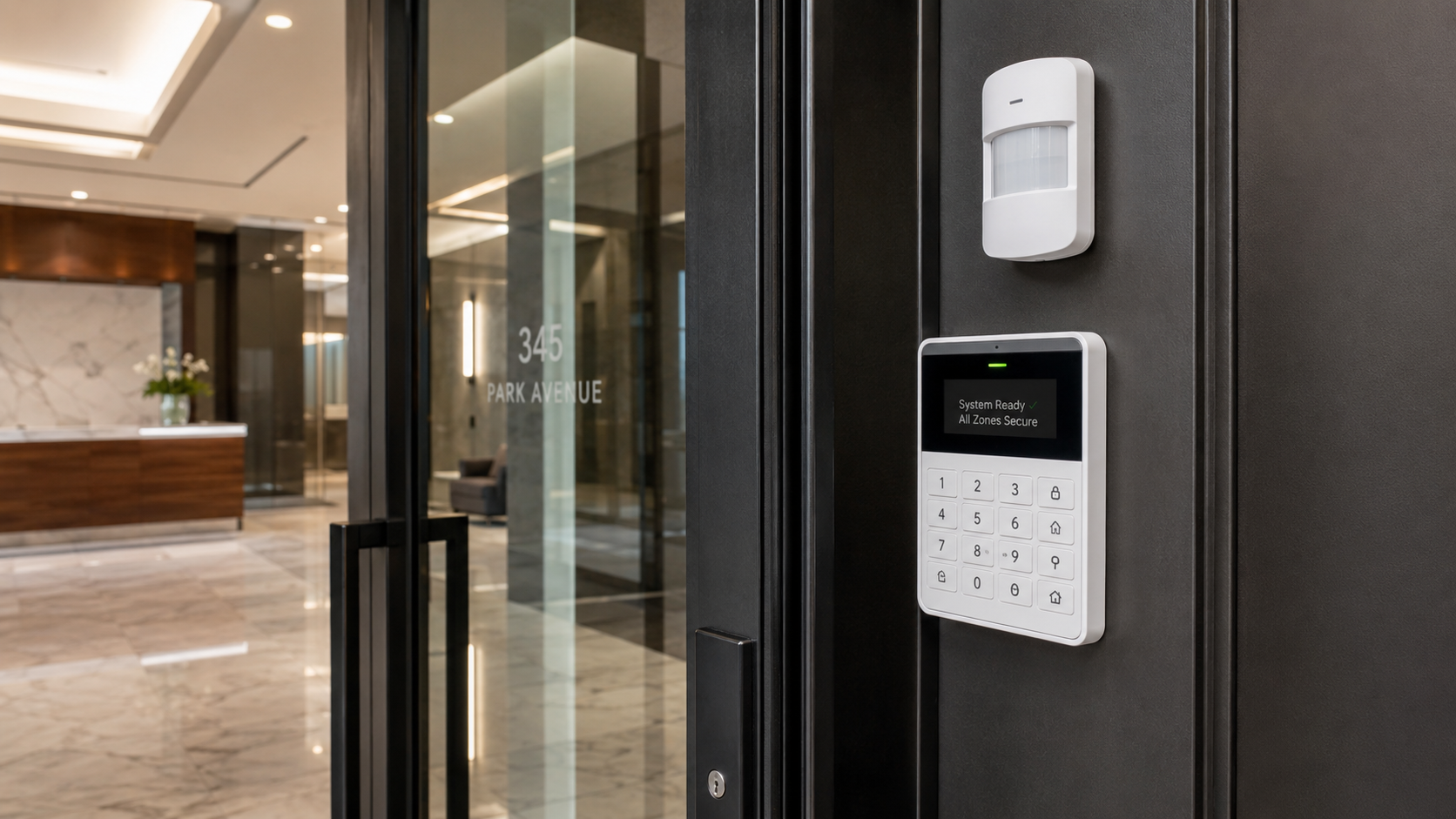
The first layer is detection. Sensors placed at entry points and throughout the property monitor for triggering events. Door and window contact sensors detect when a door or window opens. Motion detectors using passive infrared technology sense movement within a room. Glass break detectors listen for the acoustic frequency of shattering glass. Vibration sensors detect impact on walls or doors before they open.
The second layer is the control panel. This is the brain of the system — it receives signals from all sensors, checks whether the system is armed, and decides what response to activate. Modern panels communicate over cellular networks with a backup internet path, ensuring the signal reaches the monitoring center even if phone lines are cut.
The third layer is response. A local siren alerts anyone nearby and deters intruders. Notifications reach the property owner’s phone immediately. If the system is professionally monitored, the central station receives the alert within seconds and contacts the owner to verify before dispatching police. The entire sequence from sensor trigger to police dispatch typically takes one to three minutes.
Types of Burglar Alarm Systems
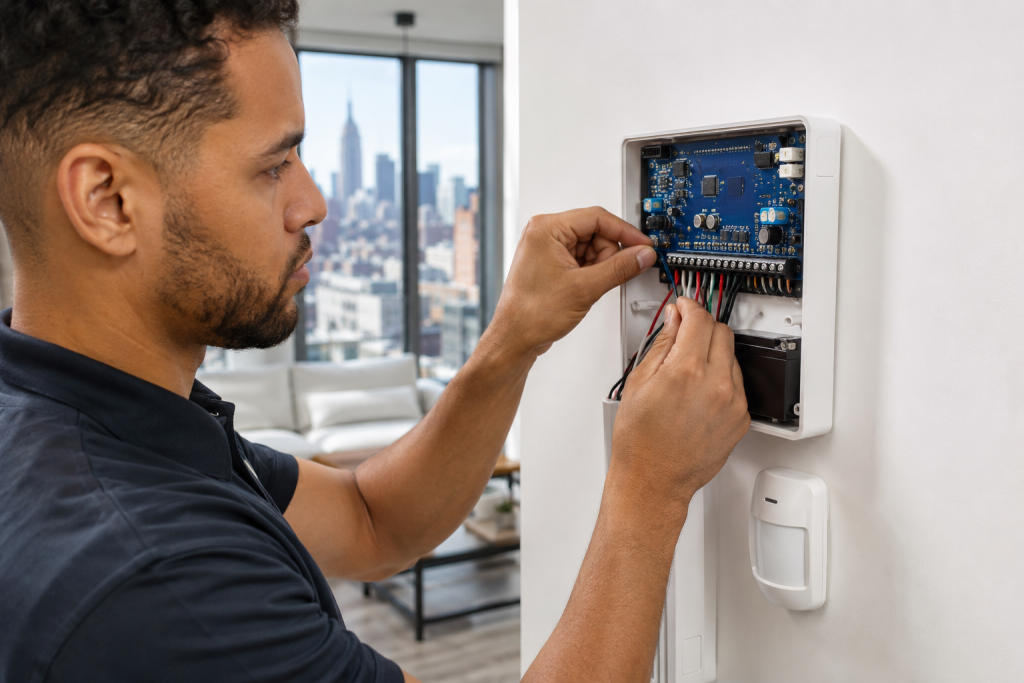
Hardwired systems connect all sensors to the control panel via low-voltage cable. They are extremely reliable, immune to wireless interference, and require no battery changes in sensors. Installation is more invasive — cables run through walls and ceilings — which makes them the natural choice for new construction or properties undergoing renovation.
Wireless systems communicate via radio frequency between sensors and the control panel. Installation is faster and less disruptive, making them ideal for finished spaces, historic buildings, or rental properties where running cable through walls is impractical. Sensors run on batteries that typically last 3 to 5 years.
Hybrid systems combine both approaches — hardwired sensors where cable access is straightforward, wireless sensors in difficult-to-reach locations. This is common in older buildings where some areas have accessible ceiling voids and others don’t.
Smart systems add cloud management, smartphone control, and integration with cameras, smart locks, and access control. All management happens through a web interface or app — arming and disarming remotely, reviewing event logs, adjusting user codes — without being on site.
Burglar Alarm Installation for Homes
Residential burglar alarm installation covers the home’s primary vulnerabilities: every exterior door, every ground-floor window, and the main interior zones. A properly designed residential system ensures that any unauthorized entry — through any point — triggers the alarm before the intruder reaches the interior of the home.
A standard residential installation includes a control panel with cellular communicator, door and window sensors on all exterior openings, one to two motion detectors covering main hallways or living areas, a keypad at the primary entry door, and an interior siren. Larger homes with multiple floors, attached garages, or outbuildings need additional sensors and detectors for complete coverage.
Burglar alarm installation for homes in NYC presents specific challenges. Brownstones with basement entries, apartments with multiple access points, and co-ops with shared building entrances each require different approaches. Professional installers familiar with NYC building stock know how to design coverage for these layouts without unnecessary equipment or missed entry points.
Typical residential installation takes 4 to 8 hours depending on the number of sensors and whether the system is wireless or hardwired. The result is a system that is tested at every zone, configured for the household’s entry and exit routines, and documented so any future technician can service it without guesswork.
Burglar Alarm Installation for Businesses
Commercial properties have more entry points, more zones to protect, and higher stakes when incidents occur. A retail store needs coverage at the front entrance, back door, cash register area, and storage. A warehouse needs loading dock sensors, perimeter coverage, and interior motion detection. An office building needs lobby monitoring, server room protection, and after-hours coverage of every floor.
Commercial burglar alarm systems installation also involves considerations that don’t apply to residential work: NYC permit requirements, compliance with local fire and building codes, coordination with other building systems, and integration with existing access control or video surveillance. Some commercial occupancies require annual inspection of the alarm system as a condition of their certificate of occupancy.
Multi-tenant buildings and properties with separate secured zones benefit from addressable alarm systems where each sensor has a unique identifier. When an alarm triggers, the control panel identifies the exact device and location — “rear loading dock sensor, zone 14” — rather than just indicating which circuit is in alarm. This matters enormously during an investigation or when troubleshooting false alarms.
Commercial installations typically involve a site assessment before any work begins. The installer walks the property, identifies all entry points and high-risk zones, reviews existing infrastructure, and produces a coverage plan. This prevents the common problem of installing equipment first and discovering coverage gaps later.
Burglar Alarm Monitoring: Residential vs Commercial
Professional alarm monitoring is what separates a system that makes noise from a system that actually responds. A monitored system sends an alert to a UL-listed central station the moment an alarm triggers. Operators verify the event — calling the property owner, checking video if available — and dispatch police within minutes if they cannot confirm it’s a false alarm.
For residential properties, monitoring adds a layer of protection that matters most when occupants are asleep, traveling, or simply unable to respond quickly enough on their own. Many homeowners also qualify for a 5 to 20% reduction in their home insurance premiums with a professionally monitored system, which offsets a portion of the monthly cost.
For commercial properties, monitoring is often a compliance requirement rather than an option. Insurance carriers covering commercial property typically require a monitored system as a condition of coverage. NYC businesses must also register their alarm systems with the NYPD — unregistered systems can result in delayed police response and fines.
Monthly monitoring costs range from $25 to $60 for residential systems and $40 to $100 for commercial systems depending on the level of service, number of zones, and communication method. Cellular-only monitoring costs slightly more than internet-based plans but is significantly more reliable — a cut phone line or internet outage does not affect the alarm signal.
Costs: Equipment, Installation, and Monitoring
Residential systems for a typical NYC home or apartment run $800 to $2,500 professionally installed, covering equipment and labor for a complete system with 6 to 12 sensors. Basic systems at the lower end of that range are wireless with a standard control panel and keypad. More comprehensive systems with additional sensors, a cellular communicator, and integration with cameras approach the upper end.
Commercial systems for small businesses covering 3 to 8 entry points typically run $1,500 to $5,000 installed. Mid-size commercial properties with 10 or more zones, addressable panels, and code-compliant installation can reach $8,000 to $20,000. The wide range reflects differences in building size, construction type, number of sensors, and integration requirements.
Monitoring adds $25 to $100 monthly depending on the plan. Over a five-year period this represents $1,500 to $6,000 in monitoring costs — a meaningful ongoing expense, but one that comes with 24/7 professional response and the insurance benefits that often partially offset it.
What drives cost up: concrete or masonry construction requiring hammer drills and specialized anchors, high ceilings needing lift equipment, pre-war buildings with no accessible conduit, and integration with existing access control or video systems.
What drives cost down: wireless systems in finished spaces (no wall opening), new construction where cable runs happen before finishing, and phased installations that start with essential coverage and expand over time.
Choosing the Right Burglar Alarm System
The right system depends on four things: property type, number of entry points, monitoring requirements, and budget.
For a single-family home or apartment, a wireless system with a cellular communicator and professional monitoring covers the essentials without invasive installation. For a residential property under renovation or new construction, a hardwired system is the better long-term investment.
For a small business, start with a system that covers all entry points and has room to grow — an 8-zone panel costs only marginally more than a 4-zone unit but doubles your expansion capacity without replacing core equipment. For larger commercial properties, addressable systems with cloud management are the standard because they scale efficiently and provide the audit trails that compliance and insurance require.
In both cases, working with an installer who knows NYC building types, local permit requirements, and the specific challenges of pre-war construction makes a significant difference in both the quality of the installation and the total cost.
Frequently Asked Questions
Do I need a permit for a burglar alarm system in NYC?
What is the difference between a burglar alarm and a security system?
How many sensors does a home burglar alarm need?
What happens if a burglar cuts the phone line or internet?
How quickly does a monitored alarm system notify police?
Can a burglar alarm system be added to an existing security setup?
Burglar Alarm Installation in NYC
Lock and Tech installs burglar alarm systems for residential and commercial properties across all five boroughs and New Jersey. We work with homes, apartments, retail stores, office buildings, warehouses, and multi-tenant properties — each with a system designed for the specific layout, entry points, and security requirements of that property.
Every installation starts with a site assessment. We identify coverage requirements, review existing infrastructure, and produce a system design before any equipment is ordered. Installation is handled by licensed technicians familiar with NYC building types and code requirements. Every completed system is fully tested, documented, and registered with the appropriate authorities.
Contact Lock and Tech to schedule a free site assessment and get a quote for burglar alarm installation at your property.