
Why the Garage Is a Common Entry Point for Burglars
The garage is one of the most frequently targeted entry points in residential break-ins. According to FBI property crime data, burglars prioritize entry points that are out of direct view and require minimal time to breach — both of which describe the average residential garage.
Most attached garages connect directly to the main living area of the home through an interior door that is often hollow-core and inadequately locked. A burglar who gains access to the garage effectively bypasses the home’s primary perimeter security.
Garages also store high-value items: vehicles, power tools, bicycles, outdoor equipment, and in many cases an additional refrigerator or safe. This combination of easy access and valuable contents makes the garage a priority target.
The garage door itself is frequently left open unintentionally — while the homeowner is working in the yard, running a short errand, or simply forgetting to close it before bed. A garage door alarm with an open-door alert eliminates this vulnerability by notifying the homeowner whenever the door has been left open beyond a set time threshold.
What Is a Garage Door Alarm

A garage door alarm is a security device that monitors the position, movement, or integrity of a garage door and generates an alert when an unauthorized or unexpected event is detected.
The alarm consists of two core components: a sensor that detects the triggering event, and a response mechanism that acts on that detection. The response can be a local audible siren, a push notification to a smartphone, a signal to a connected security panel, or a combination of all three.
Garage door alarms are available as standalone battery-powered devices that operate independently of any other system, or as sensors that integrate with a whole-home alarm system and professional monitoring service. The right configuration depends on the level of security required and whether the garage alarm needs to communicate with the rest of the home’s security infrastructure.
How a Garage Door Alarm Works
A garage door alarm works by monitoring the state or position of the garage door using a sensor. When the sensor detects an unexpected change — the door opening, moving, or being forced — it triggers a programmed response.
The sequence of events in a typical garage door alarm system is as follows. The sensor continuously monitors the door’s state. When a change is detected that matches a trigger condition — such as the door opening when the system is armed — the sensor sends a signal to a control unit. The control unit processes the signal and activates the configured response: sounding a siren, sending a push notification to the homeowner’s phone, or transmitting an alert to a professional monitoring center.
In smart garage door alarm systems, the control unit connects to the home Wi-Fi network. This allows real-time remote monitoring through a mobile app — the homeowner can check whether the garage door is open or closed from anywhere, receive instant alerts, and in some configurations remotely close the door.
In integrated systems connected to a home security panel, the garage door sensor behaves like any other entry sensor. If the system is armed and the garage door opens without the correct disarm sequence, the panel triggers the full alarm response including siren, notification, and monitoring center alert.
Types of Garage Door Alarm Sensors
Garage door alarms use different sensor types depending on what they are designed to detect — door position, movement inside the garage, or forced entry.
Tilt sensor is the most common type for sectional garage doors. It attaches to one of the door panels and detects the change in angle when the door moves from horizontal (closed) to vertical (open). Tilt sensors are simple, battery-powered, and do not require wiring to the door frame. They trigger an alert any time the door moves from its closed position.
Magnetic contact sensor consists of two components: a magnet attached to the moving door panel and a reed switch mounted on the door frame. When the door is closed, the magnet holds the reed switch in a closed circuit. When the door opens, the magnet separates from the switch, breaking the circuit and triggering the alarm. Magnetic contact sensors are the same technology used on standard door and window sensors in home security systems.
Motion detector is a PIR (passive infrared) sensor mounted inside the garage. Rather than monitoring the door itself, it detects movement within the garage space. A motion detector catches threats that a door sensor would miss — such as someone who entered through a side door or a window — and is often used alongside a door sensor for layered coverage.
Vibration sensor detects physical impact or forced movement on the garage door structure. It triggers when someone attempts to pry, kick, or force the door open — detecting the attack before the door actually opens. Vibration sensors are effective against brute-force entry attempts and relay attacks on the door opener signal.
Smart garage door sensor combines a tilt or contact sensor with a Wi-Fi or Z-Wave radio. It connects to a smart home hub or communicates directly with a mobile app, enabling remote status monitoring, open-door alerts with customizable time thresholds, and integration with smart home automations such as turning on lights when the door opens.
Standalone vs Integrated Garage Door Alarm Systems
Garage door alarms are available as standalone devices that operate independently, or as sensors integrated into a whole-home security system. The right choice depends on the scope of security coverage required and whether the garage needs to communicate with the rest of the home’s alarm infrastructure.
Standalone alarms are self-contained units that mount directly on the garage door or frame and include their own siren. They require no wiring to any other system and are typically battery-powered. A standalone alarm is the simplest solution and is easy to install without professional help. Its limitation is that it generates only a local audible alert — it does not send notifications, contact a monitoring center, or integrate with other sensors in the home.
Integrated systems connect the garage door sensor to a central security panel that manages all sensors in the home. When the garage door triggers, the panel processes the event alongside other sensors, activates the appropriate response, and — if monitoring is enabled — alerts a professional monitoring center. Integrated systems provide full visibility into the garage as part of the home’s overall security posture.
Smart home integrated alarms sit between the two. They connect to Wi-Fi and communicate with a smart home hub or directly with a mobile app, without requiring a dedicated security panel. They provide remote monitoring and notifications but typically do not include professional monitoring unless paired with a compatible security service.
What a Garage Door Alarm Protects Against
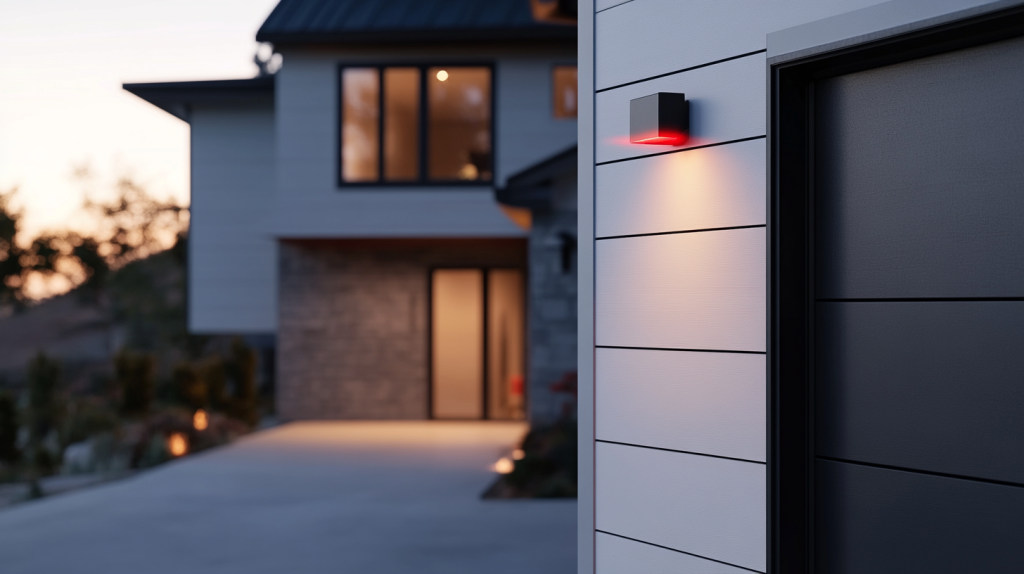
A garage door alarm protects against several distinct security threats, each addressed by a different sensor configuration.
Unauthorized door opening is the primary threat a garage door alarm is designed to detect. Any attempt to open the door from outside — whether by guessing a keypad code, using a cloned remote, or manually releasing the emergency cord — triggers the sensor and activates the alarm.
Forgotten open door is a common security gap that a smart garage door sensor eliminates. The sensor monitors how long the door has been open and sends a notification if it remains open beyond a set threshold — typically 5 to 15 minutes. This prevents the garage from being inadvertently left accessible for hours.
Movement inside a closed garage is detected by a motion sensor mounted inside the space. If someone enters through a side entrance, a window, or a connecting interior door while the garage is supposed to be unoccupied, the motion detector triggers the alarm before any damage or theft occurs.
Forced entry attempts are detected by vibration sensors, which trigger on the impact of someone trying to pry open or force the door before it actually opens. This provides an earlier warning than a contact or tilt sensor, which only trigger after the door has already moved.
Relay attacks on smart openers — a method where thieves use a signal amplifier to trick a car’s keyless entry or smart garage opener into thinking the key fob is nearby — can be detected by the alarm triggering on an unexpected opening event when the homeowner is not home.
Frequently Asked Questions
Can I add a garage door alarm to an existing security system?
Yes. Most home security panels support additional wired or wireless sensors, and a garage door sensor — tilt or magnetic contact — can be added as a zone to an existing system. The sensor is enrolled in the panel and treated identically to any other entry sensor. Compatibility depends on the panel brand and the sensor’s communication protocol (Z-Wave, Zigbee, proprietary RF, or hardwired).
What is the difference between a garage door sensor and a garage door controller?
A garage door sensor detects and reports the state of the door — open or closed — and triggers an alarm when an unauthorized event occurs. A garage door controller adds the ability to remotely open and close the door via a mobile app, in addition to monitoring its state. Controllers are typically smart home devices that connect to an existing garage door opener motor unit.
Do garage door alarms work with all types of garage doors?
Tilt sensors work with sectional roll-up garage doors — the most common residential type — because the door panels move through a consistent angle when opening. Magnetic contact sensors work with any door type that has a fixed frame, including side-hinged and sliding doors. For non-standard door configurations, a motion detector inside the garage provides coverage regardless of door type.
Will a garage door alarm go off if the power goes out?
Battery-powered standalone sensors continue to function during a power outage because they do not rely on mains electricity. Hardwired sensors connected to a security panel depend on the panel’s battery backup — most panels include a backup battery that maintains operation for 4 to 24 hours depending on the model. Smart Wi-Fi sensors lose their notification capability when the internet connection drops but may retain local siren functionality.
How loud is a garage door alarm siren?
Standalone garage door alarm sirens typically range from 85 to 120 decibels. At 85 dB, the alarm is audible throughout the home and in the immediate exterior area. At 110–120 dB — the range of most dedicated security sirens — the alarm is clearly audible from the street and typically causes a burglar to abandon the attempt within seconds.
Can a garage door alarm be installed without drilling?
Wireless battery-powered tilt and contact sensors can be mounted using adhesive tape or magnetic brackets without drilling into the door or frame. This makes them suitable for renters or situations where permanent mounting is not possible. Hardwired sensors and integrated systems that connect to a security panel require wiring and are installed by a professional.
When You Need Professional Installation for a Garage Door Alarm
A basic battery-powered garage door sensor can be installed without professional help in under 30 minutes. Professional installation is required when the garage alarm needs to integrate with a home security panel, connect to professional monitoring, or use hardwired sensors.
Professional installation is the right choice in the following situations: the garage is part of a whole-home security system that needs to be expanded; the property has multiple garage doors or entry points that require coordinated coverage; the installation requires running low-voltage wiring through walls or ceilings; or the building is in New York City and the installation must comply with local fire and building codes.
A professionally installed garage security system includes sensor placement optimized for the specific door and garage layout, correct integration with the existing security panel or smart home hub, testing of all trigger conditions and response pathways, and documentation of the installed configuration for future servicing.
Lock & Tech installs garage door alarms and complete home security systems across New York City. Our technicians assess the garage layout, recommend the right sensor type and system architecture, and handle the full installation and integration with your existing security infrastructure.
Contact Lock & Tech to schedule a security assessment for your garage and get a quote for professional installation.