
- Home
- Telecommunications Services
- Low Voltage and Network Cabling
Low Voltage and Network Cabling in New York City



One Contractor for the Whole Space
Since 1989, we’ve been securing homes and businesses across NYC and New Jersey with professional security solutions you can trust. Our licensed technicians provide 24/7 emergency service, using only the latest technology and backed by comprehensive warranties on all installations.



Cabling for Commercial Spaces
- Offices. Workstation drops, floor boxes, and a rack location chosen for the runs rather than for the leftover closet.
- Fit-outs and build-outs. Cable pulled while ceilings are open, on the general contractor’s schedule.
- Multi-floor tenancies. Riser runs between floors and a distribution point on each one.
- Warehouses and industrial sites. Long runs, conduit where the environment demands it, and wireless access points on the floor.
- Retail and showrooms. Registers, back-of-house, and display positions on one plan.
- Medical and dental practices. Treatment rooms, front desk, and imaging equipment lines placed with the room layout.
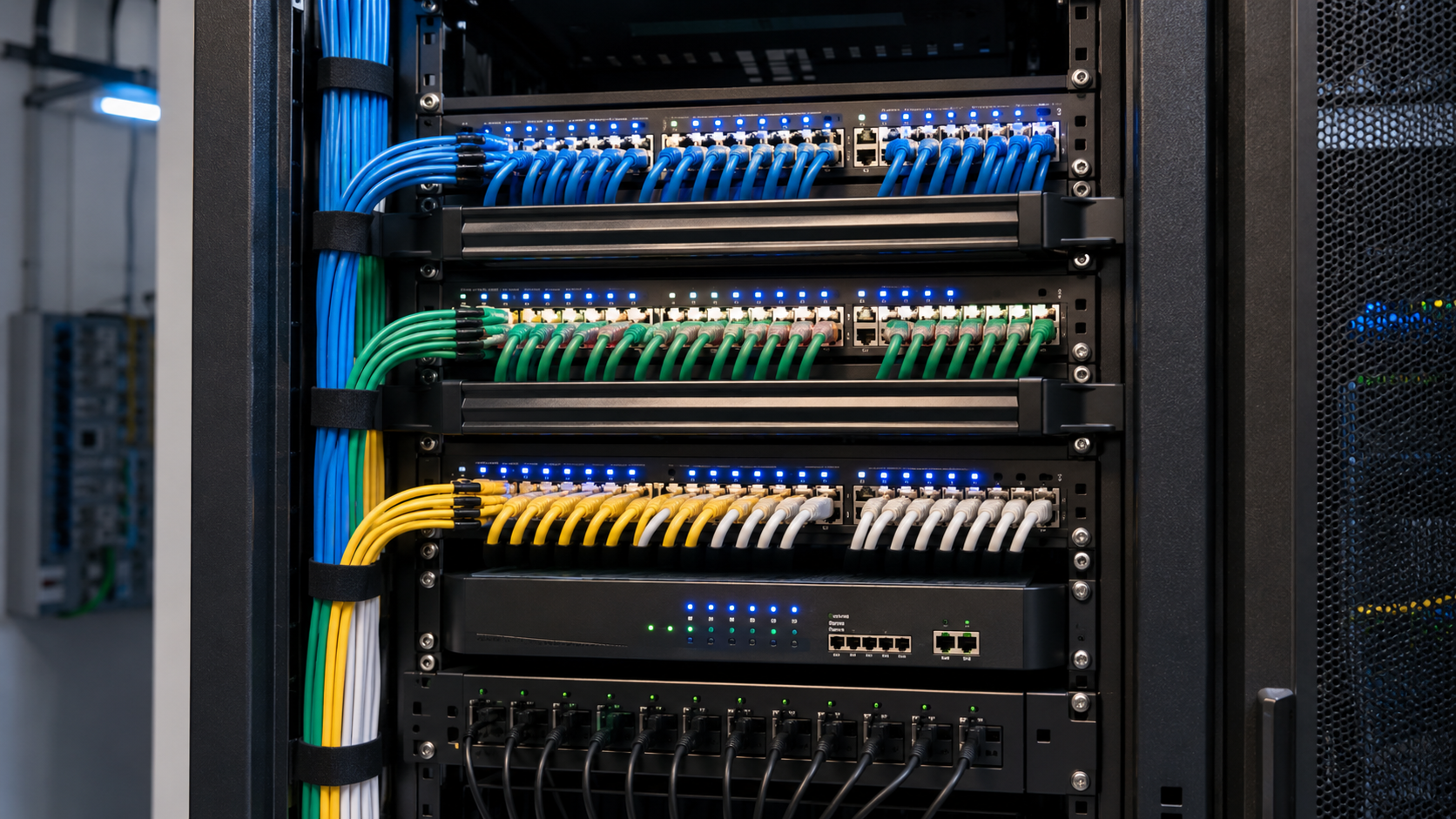
- Server and equipment rooms. Rack build, patch panels, and terminations documented port by port.
Low voltage cabling is the wiring that carries data, voice, and equipment signals through a building — everything running below the electrical system and above nothing at all, because when it fails the whole floor stops working. Lock and Tech USA installs and tests network and low voltage cabling for offices, retail spaces, warehouses, and medical practices across New York City, on weekdays between 8 and 6.
Low Voltage and Network Cabling Installation
Low voltage covers the systems that carry signal rather than power: network drops at every workstation, voice lines, wireless access points, door and intercom wiring, display and speaker runs. They share the same pathways, the same rack, and the same set of decisions about where things go, which is why running them as separate jobs by separate trades produces the ceiling most buildings actually have. Structured network cabling is the discipline of designing them as one system with a documented layout — the standards-based version of that build is covered under structured cabling.
What Low Voltage Cabling Covers
Three families of line, one infrastructure. Network cabling reaches workstations, printers, wireless access points, and anything else on the network, terminating at patch panels in a rack. Voice cabling serves handset positions, which in most modern offices runs on the same cable type but keeps its own numbering and patching. Equipment lines cover everything else low voltage touches — access points, displays, speakers, sensors, and the low voltage side of door hardware. All three land in one equipment room, on labeled panels, so a fault can be found by reading a label rather than by pulling ceiling tiles.
How a Network Cabling Installation Runs
The survey comes first: floor plan, position count, ceiling and floor construction, existing pathways, and where the rack can live. That decides route lengths, and route lengths decide what is possible. Pathways go in next — conduit, tray, or existing chases — followed by the pull itself, run in bundles with slack left at both ends. Termination follows at the outlet and at the panel, and every line is labeled at both ends to the same scheme. Then testing: each line is checked with a cable tester for continuity, pairing, length, and performance, and the results are handed to you as a document alongside a floor plan showing what runs where. That document is what makes the next change cheap.
New Offices, Fit-Outs, and Expansions
In a new office or a fit-out, cable goes in while ceilings are open and the space is empty, on the general contractor’s schedule — the cheapest version of this work by a wide margin, and the only time conference room positions can be placed properly alongside the equipment they will feed, including video conference solutions. In an occupied office, expansions are staged: new runs pulled and terminated while the existing ones stay live, with the cutover for each position taking minutes. In a relocation, we survey the new space before the move date so the office opens with everything working rather than with a week of temporary arrangements.
Voice and Data Cabling
Voice and data cabling means running both services on one physical infrastructure instead of two. Historically they were separate: telephone lines on their own cable and their own blocks, data on structured cable to a rack, installed by different people at different times. In a modern office both usually run on the same cable type to the same patch panels, and the distinction survives mainly in how positions are numbered and patched.
What that changes on site is real. One survey instead of two, one set of pathways, one bundle through the ceiling, one label scheme, one test document. When a desk moves, both services move with one patch change. When something fails, one contractor owns it — which is the practical reason most voice and data cabling companies are asked to take on the network side as well, and why we quote them together rather than as separate line items.
Handset positions still need their own treatment during design: how many, where reception sits, which rooms need a phone but no workstation. Where calls run over the network rather than dedicated lines, the requirements shift to the network side — bandwidth, switch capacity, and power delivered to the handsets over the same cable, covered under data and VoIP cabling. The phone system that sits on top of all this is its own project, covered under business telephone systems. Our part is the cable, the terminations, and the documentation that says what connects to what.
Cable Types and What They Affect
Cable choice is decided by three things on site: how far the run has to go, what the space does to a signal, and what the building will be asked to carry in a few years. Nobody rewires an office because the cable aged. They rewire because the original choice ran out of room.
Copper Categories
Copper categories differ in how tightly the pairs are twisted, how they are shielded, and how much frequency headroom they leave. Higher categories tolerate longer runs at higher speeds and hold up better near fluorescent lighting, motors, and electrical runs they cannot avoid crossing. Lower categories cost less per foot and terminate faster, which matters when the count is high and the runs are short. The cost difference across a whole floor is usually a small fraction of the labor, so the category is chosen for the building rather than for the invoice. Shielded cable is used where the environment justifies it — industrial floors, plant rooms, long parallel runs beside power — and it requires proper grounding to do any good at all.
When Fiber Is Used
Fiber comes in where copper runs out: between floors, between buildings, from a rack to a distant closet, and anywhere distance exceeds what copper supports. It is also the answer where electrical noise is severe enough that shielding is not enough. Full detail on fiber optic cabling.
Where We Install
We work in offices and corporate workspaces, fit-outs and build-outs under a general contractor, multi-floor and multi-tenant commercial buildings, retail spaces and showrooms, warehouses and industrial facilities, medical and dental practices, and server rooms and network closets. We cover New York City and Brooklyn, plus Queens, the Bronx, Staten Island, and the surrounding areas within our service radius. Businesses with several addresses can run all of them through one contractor with a consistent label scheme and documentation across sites.
Our Process and Pricing
Work starts with a free estimate, on site or by phone. Low voltage cabling contractors quote from position count and route length, so the survey is what makes an estimate mean anything — we count drops, walk the pathways, and look at what is already installed before putting a number on it.
On site we install pathways, pull and terminate, label, and test, working around your hours where the space is occupied. Test results and a floor plan are handed over at completion. Pricing is labor plus material for one total figure, itemized against the position count. On larger jobs payment is a partial deposit up front with the balance on completion, and a signed contract goes in place before work begins. Installation carries a 90-day warranty on the mechanical side and 12 months on electronics, covering parts and labor. We work weekdays from 8 to 6.
Warranty, Service Area, and Payment
Lock and Tech USA backs new installations with a 90-day mechanical warranty and a 12-month electrical warranty, covering both parts and labor. Repairs are not covered by a warranty. We provide installation within 75 miles of Midtown Manhattan and support extended zones, multiple locations, and multi-site service for clients with several properties. Phone and email support is available during business hours.
We accept cash, wire transfer, ACH, credit card, and check, as well as Zelle and Venmo, and we offer invoicing and business accounts for commercial clients. Depending on the size of the job, payment is typically a partial deposit up front with the balance collected on completion. Before starting, we require a signed contract and a tax exemption form if applicable.
Frequently Asked Questions
What counts as low voltage cabling?
Can you cable an office while people are working in it?
How do we know the cable was installed correctly?
Which cable category should we install?
What does a cabling installation cost?
What our clients say