
- Home
- Telecommunications Services
- Structured Cabling
Structured Cabling in New York City



Faults Found by Reading
Since 1989, we’ve been securing homes and businesses across NYC and New Jersey with professional security solutions you can trust. Our licensed technicians provide 24/7 emergency service, using only the latest technology and backed by comprehensive warranties on all installations.


Cabling for Commercial Properties
- Offices and corporate workspaces. Workstation drops, floor boxes, and a rack location chosen for the runs rather than for the leftover closet.
- Server rooms and equipment closets. Rack build, patch panels, and terminations documented port by port.
- Retail and point-of-sale environments. Registers, back-of-house, and display positions on one plan.
- Warehouses and distribution facilities. Long runs, conduit where the environment demands it, and access point positions across the floor.
- Healthcare and professional offices. Treatment rooms, front desk, and equipment lines placed with the room layout.
- Educational and institutional buildings. Classroom and lab positions with backbone runs between floors and wings.
- Multi-tenant and multi-floor buildings. Riser runs between floors and a distribution point on each one.
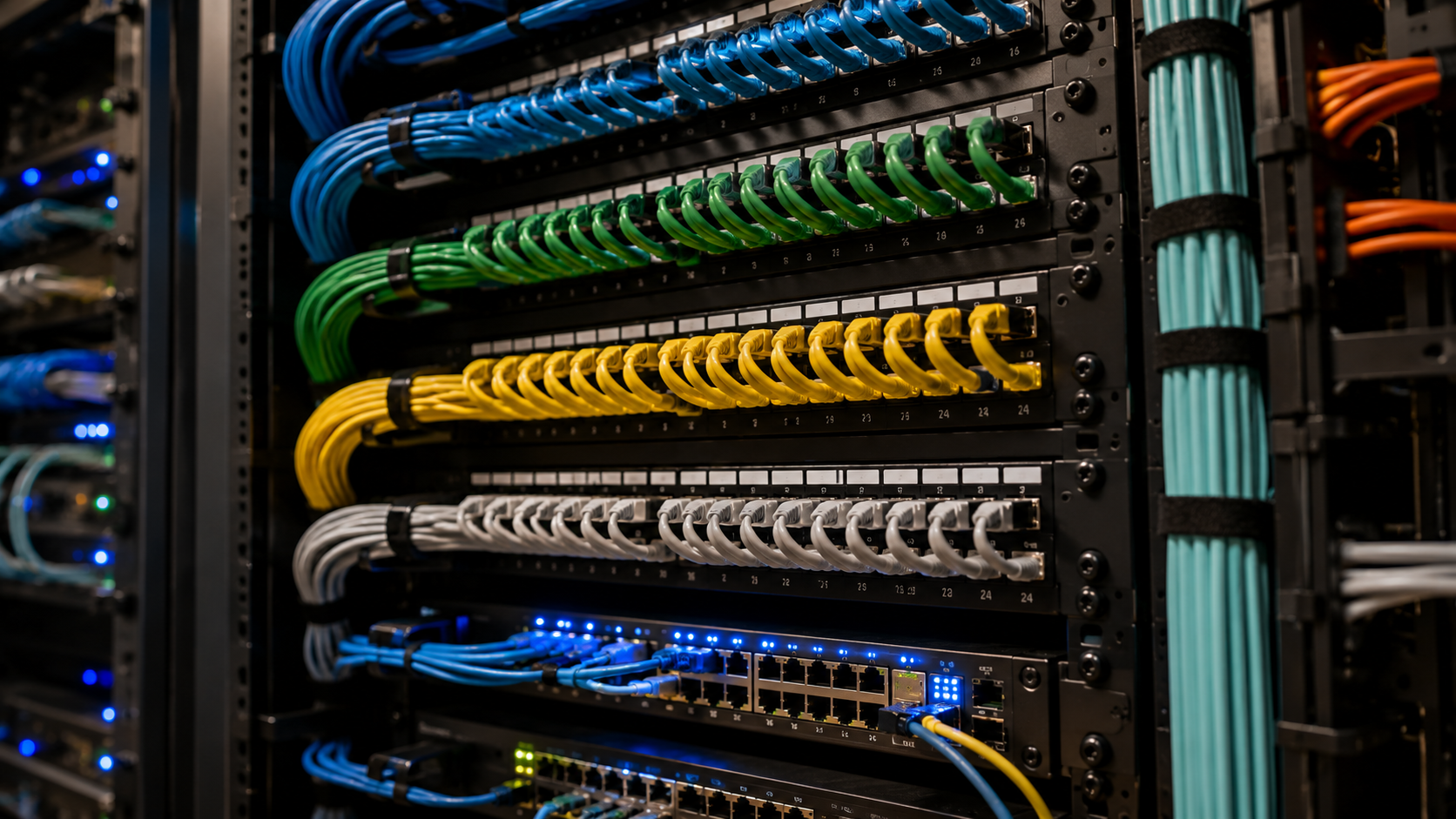
Structured cabling is the physical layer everything else in a building runs on — the backbone between floors, the horizontal runs to every position, the panels and racks they land on, and the documentation that says what connects to what. Lock and Tech USA designs and installs structured cabling for offices, retail spaces, warehouses, and commercial buildings across New York City, on weekdays between 8 and 6.
Structured Cabling Design and Installation
Structured cabling is a discipline rather than a product: data, voice, wireless, and equipment lines designed as one system, on shared pathways, terminating in one place, labeled to one scheme. The alternative is what most buildings actually have — separate trades arriving in sequence, each adding cable above the ceiling with no record of what went where, until nobody can trace a fault without pulling tiles.
As a structured cabling contractor we work from a position count and a floor plan rather than from a package. The survey establishes where the rack can live, what the pathways allow, and how far each run has to travel, because route length decides what is possible before any equipment is chosen. Commercial structured cabling on an occupied floor adds one more constraint: the existing runs stay live while the new ones go in, and each position is switched over individually.
What We Install
- Structured cabling design and installation
- Backbone runs between floors and closets
- Horizontal runs to workstations and equipment positions
- Fiber optic backbone links
- Voice and equipment lines on shared pathways
- Patch panels, network drops, and wall jacks
- Racks, cable management, and terminations
- Wireless access point positions and cabling
- Labeling at both ends and as-built documentation
- Testing with results handed over
- Structured cabling repair and reconfiguration
Where We Install
We work in offices and corporate workspaces, server rooms and equipment closets, retail stores and point-of-sale environments, warehouses and distribution facilities, healthcare and professional offices, educational and institutional buildings, and multi-tenant and multi-floor commercial properties. We cover New York City and Brooklyn, along with Queens, the Bronx, Staten Island, and the surrounding areas within our service radius. Businesses with several addresses can run all of them through one contractor with a consistent label scheme across sites.
Low Voltage and Network Cabling
The working layer of the same system: network drops at workstations, voice lines, wireless access point positions, and the equipment lines that displays, speakers, and sensors need. All of it shares pathways and lands in one rack, which is why it is surveyed and quoted together rather than as separate jobs. Detail on low voltage and network cabling.
Data and VoIP Cabling
Where calls run over the network instead of dedicated lines, the requirements move to the data side: capacity for the number of simultaneous calls, switches that deliver power to handsets over the same cable, and traffic handling so a large transfer does not degrade a call in progress. Detail on data and VoIP cabling.
Ethernet Cabling
Copper runs to individual positions — desks, printers, access points, cameras, and anything else taking a wired connection. Category choice follows run length, the electrical environment along the route, and what the position will be asked to carry in a few years. Cable is a small share of the total cost, so it is chosen for the building rather than for the invoice. Detail on ethernet cabling.
Fiber Optic Cabling
Fiber comes in where copper reaches its limit: between floors, between buildings, from a rack to a distant closet, and anywhere electrical noise is severe enough that shielding is not the answer. It is also the usual choice for a backbone meant to outlive the equipment plugged into it. Detail on fiber optic cabling.
Wireless Network Installation

Access points are part of the cabling job, not an accessory to it. Each position needs a run back to the rack and power delivered over that run, and placement follows how the walls in the building actually behave rather than a grid on a drawing. Detail on wireless network installation.
Our Installation Process and Pricing
We start with a free consultation and site survey. Structured cabling companies quote from position count and route length, so the survey is what makes an estimate mean anything — we count drops, walk the pathways, and look at what is already installed before putting a number on it.
Pathways go in first, then the pull, then terminations at the outlet and at the panel, with every line labeled at both ends to the same scheme. Testing closes the job: each run is checked with a cable tester for continuity, pairing, length, and performance, and the results are handed to you as a document alongside a floor plan showing what runs where. That document is what makes the next change cheap. Structured cabling installation services are priced as labor plus material for one total figure, itemized against the position count. On larger jobs payment is a partial deposit up front with the balance on completion, and a signed contract goes in place before work begins. Installation carries a 90-day warranty on the mechanical side and 12 months on electronics; repair and reconfiguration visits are not covered by that warranty.
Warranty, Service Area, and Payment
Lock and Tech USA backs new installations with a 90-day mechanical warranty and a 12-month electrical warranty, covering both parts and labor. Repairs are not covered by a warranty. We provide installation within 75 miles of Midtown Manhattan and support extended zones, multiple locations, and multi-site service for clients with several properties. Phone and email support is available during business hours.
We accept cash, wire transfer, ACH, credit card, and check, as well as Zelle and Venmo, and we offer invoicing and business accounts for commercial clients. Depending on the size of the job, payment is typically a partial deposit up front with the balance collected on completion. Before starting, we require a signed contract and a tax exemption form if applicable.
Frequently Asked Questions
What does structured cabling include?
What testing is done before handover?
Do you handle data, voice, and wireless in one project?
Can you work on cabling that is already installed?
Will the cabling support future expansion?
What does structured cabling cost?
What our clients say


