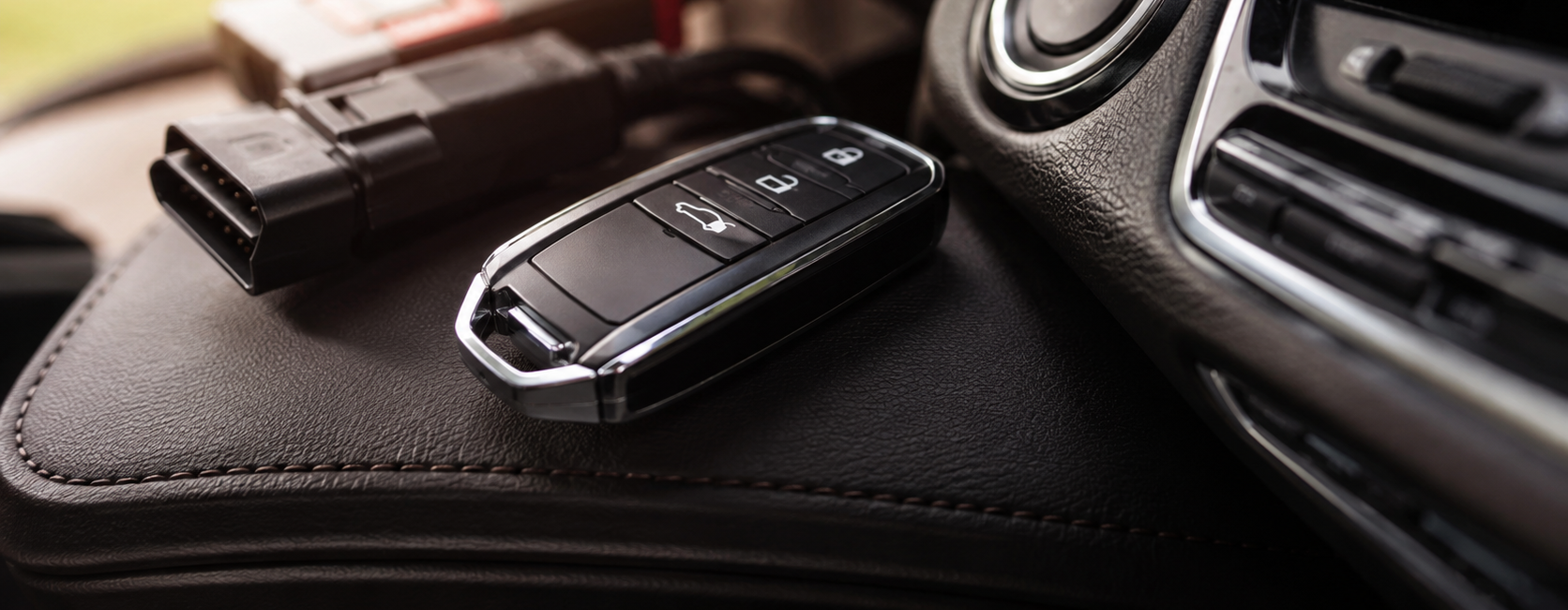
Whether you can program a key fob yourself depends on the type of key. Many older remote-only fobs can be programmed at home using an on-board sequence of ignition cycles, but transponder chip keys and modern push-to-start (proximity) fobs require diagnostic equipment and must be programmed by a locksmith or dealer. This guide covers the DIY on-board method, how to re-sync an existing fob, and how to tell which keys can’t be done at home.
Can You Program a Key Fob Yourself?
Whether a fob can be self-programmed comes down to which of three key types you have.
Remote-only keyless entry (RKE) fobs control locks and the trunk but do not start the car. Many of these — especially on vehicles from the late 1990s to early 2010s — support on-board programming you can do yourself in a few minutes.
Transponder chip keys contain a chip that must be recognized by the vehicle’s immobilizer before the engine will start. These usually cannot be programmed on-board and require a programming tool.
Smart proximity and push-to-start fobs pair to the vehicle electronically and almost always require dealer-level diagnostic equipment to program.
How to Program a Key Fob Yourself (On-Board Method)
On-board programming puts the vehicle into a “learn” mode through a specific sequence of ignition cycles, after which the fob is registered by pressing a button. The exact number of cycles and timing varies by make and model year, so confirm the sequence in your owner’s manual before starting.
- Get in and close the doors. Sit in the driver’s seat with all doors shut and the key fob in hand.
- Cycle the ignition. Insert the key and turn it from OFF to ON (or RUN) the number of times specified for your vehicle, usually within a few seconds. Do not start the engine.
- Wait for programming mode. The vehicle signals it has entered learn mode — typically the door locks cycle once, or a chime sounds.
- Press a fob button. Press the lock or unlock button on the fob. A confirmation (locks cycle again) means the fob is registered.
- Program additional fobs. If you have more than one remote, press a button on each within the same session before exiting.
- Exit and test. Turn the ignition off, remove the key, and test each fob from a few feet away.
If the sequence does not trigger learn mode after two attempts, the vehicle likely does not support on-board programming, and the fob will need to be programmed with a tool.
How to Reprogram an Existing Key Fob
Reprogramming applies when a fob that previously worked has lost synchronization with the vehicle — a different situation from programming a brand-new remote.
A fob can lose sync after a battery replacement, a dead battery left in too long, or repeated button presses out of range. Re-syncing uses the same on-board sequence as initial programming, which re-registers the existing fob to the vehicle.
If the on-board sequence does not restore function, the problem is usually a worn button, a failed circuit board, or a fob that was never correctly paired. In those cases re-syncing will not help, and the fob needs to be tested or replaced.
What You Need to Program a Key Fob
The requirements depend on the key type, but most jobs need the following.
- A compatible fob that matches the vehicle’s make, model, year, and frequency. A generic or mismatched remote will not pair.
- The owner’s manual or the correct on-board sequence for that specific vehicle.
- A working key, since some vehicles require one or two already-programmed keys present to add a new one.
- An OBD programming tool, required for transponder chip keys and all smart/proximity fobs — this is the equipment home users do not have.
Programming a Transponder or Push-to-Start Key
Transponder and push-to-start keys cannot be programmed with an ignition sequence because the chip inside must be written into the vehicle’s immobilizer through a diagnostic port.
The immobilizer blocks the engine from starting unless it reads a recognized chip. Adding or replacing one of these keys requires a programmer that communicates with the vehicle’s security system — the reason the on-board method has no effect on them.
This is where a locksmith is the practical option. An automotive locksmith can program a transponder or push-to-start fob on-site with the same class of equipment a dealer uses, and if the key itself is lost or broken, they can cut and code a replacement — usually faster and for less than a dealership.
Frequently Asked Questions
Can I program a key fob myself?
Sometimes. Many remote-only keyless entry fobs can be programmed at home using an on-board ignition sequence. Transponder chip keys and push-to-start fobs cannot, and require a locksmith or dealer with a programming tool.
Do I need the old key to program a new fob?
Sometimes. Certain vehicles require one or two already-programmed keys to be present before a new one can be added. If all keys are lost, the system usually has to be reset with diagnostic equipment.
How long does it take to program a key fob?
On-board programming of a remote-only fob takes a few minutes. Programming a transponder or push-to-start key with a tool typically takes 10 to 30 minutes, depending on the vehicle’s security system.
Will programming a new fob erase my other keys?
Not usually when adding a key. However, a full immobilizer reset — needed when all keys are lost — erases every existing key, so any keys you still want to use must be reprogrammed afterward.
Why won’t my key fob program?
The most common reasons are an incompatible fob, a weak fob battery, an incorrect on-board sequence, or a vehicle that does not support on-board programming at all. Transponder and proximity keys will never respond to the ignition-cycle method.
Is a locksmith cheaper than the dealer for key fob programming?
In most cases, yes. An automotive locksmith uses the same class of programming equipment as a dealer, often comes to your location, and typically charges less for the same transponder or push-to-start key.
When to Call a Locksmith
Programming a remote-only fob with the on-board method is a reasonable DIY task. Transponder chip keys, push-to-start fobs, and any situation where all keys are lost require professional equipment.
If your vehicle does not support on-board programming, or you need a new key made in the New York City area, a mobile automotive locksmith can program or replace it on-site.