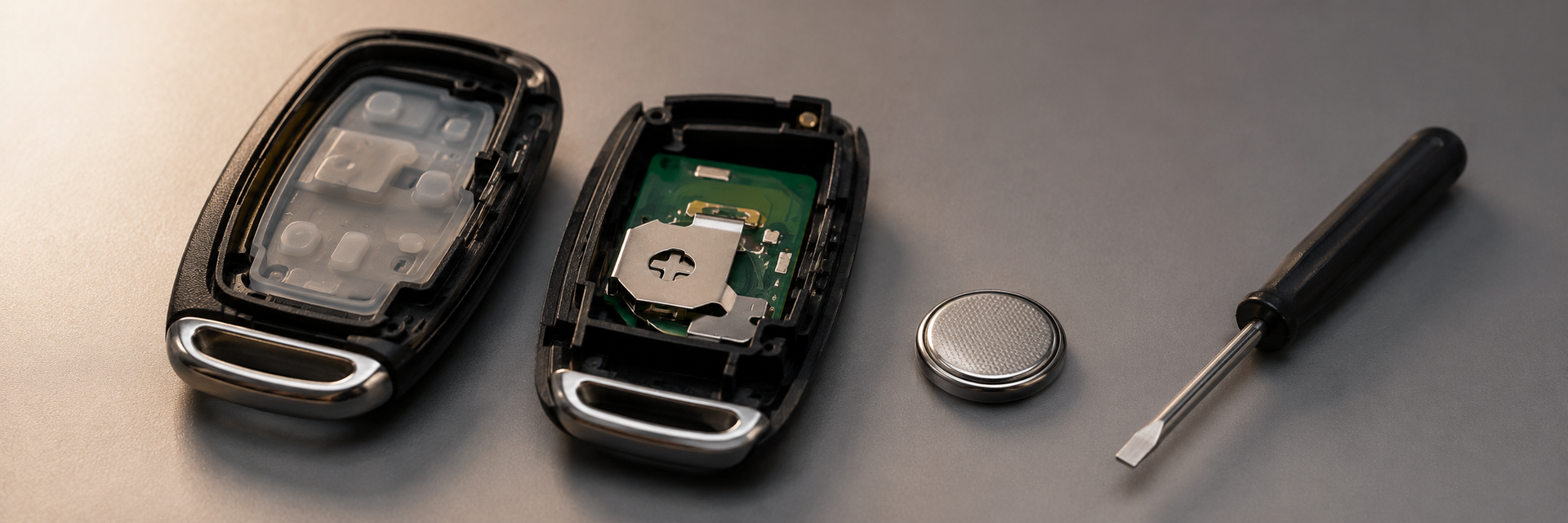
A dead key fob battery is the most common reason a remote stops locking, unlocking, or starting a vehicle. Most key fobs use a single coin-cell battery — usually a CR2032 or CR2025 — and replacing it takes about five minutes with no special tools. The steps below work for nearly every brand, followed by battery types, brand-specific notes, and what to do if the fob still doesn’t respond after a fresh battery.
What You Need Before You Start
You need three things: a replacement coin-cell battery of the correct type, a small flathead screwdriver or plastic pry tool, and a clean flat surface to work on.
The battery type is printed on the old cell once you open the fob. The most common sizes are CR2032, CR2025, and CR2016 — the four digits indicate diameter and thickness, so a CR2032 is thicker than a CR2025 and they are not always interchangeable.
Avoid touching the flat faces of the new battery with bare fingers. Skin oils can shorten contact life and cause intermittent connection.
How to Change a Key Fob Battery: Step-by-Step
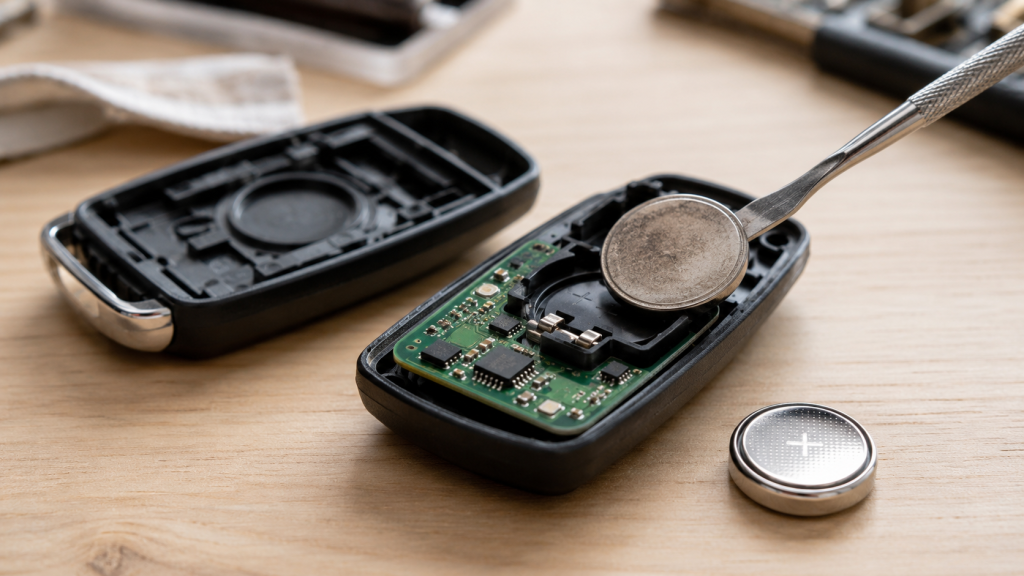
The replacement process is nearly identical across brands, regardless of make or model. Only the method of opening the case and the battery size differ.
- Open the case. Locate the seam around the edge of the fob. Insert a flathead or plastic pry tool into the notch and gently twist until the two halves separate. Many fobs have a physical emergency key that slides out first to reveal the seam.
- Note the orientation. Before removing the old battery, look at which side faces up — the positive (+) side is usually printed and faces a specific direction. Photograph it if unsure.
- Remove and replace. Slide or pop out the old cell and insert the new one in the same orientation. It should sit flush under any retaining clip.
- Reassemble. Align the two halves and press until they click shut. Reinsert the emergency key blade if you removed one.
- Test. Press each button from a few feet away. The indicator light should flash and the vehicle should respond.
How to Find the Right Key Fob Battery
The correct battery type is the one already inside the fob. Read the code printed on the flat face of the old cell — it will start with “CR” followed by four numbers.
CR2032 is the most common key fob battery, followed by CR2025 and CR2016. The difference is thickness: 3.2 mm, 2.5 mm, and 1.6 mm respectively. A thinner battery may make weak contact, and a thicker one may not let the case close.
Buy the exact code. Substituting a “close enough” size is the most frequent cause of a fob that works intermittently after a replacement.
Key Fob Battery Replacement by Brand
The universal process applies to every brand, but the case-opening method and battery size vary by manufacturer and model year. Always confirm the size against the old battery before buying.
Honda and Toyota
Most Honda and Toyota smart keys use a CR2032. The case usually opens after sliding out the metal emergency key and prying at the exposed slot.
Ford
Ford remotes typically use a CR2032, though many intelligent-access fobs use a larger CR2450. Check the old cell — the difference matters here.
Chevrolet and GM
Most Chevrolet, GMC, and Buick fobs use a CR2032. Flip-key models open at the back seam; some pull apart after removing the emergency blade.
Nissan
Nissan Intelligent Keys often use a CR2025, though some models take a CR2032. Confirm against the removed battery.
BMW
Many BMW fobs use a CR2450, and some display or Comfort Access keys are rechargeable with no user-replaceable battery. If there is no seam and no removable blade, the key charges from the vehicle rather than a coin cell.
Signs Your Key Fob Battery Is Dying
A weakening battery produces recognizable symptoms before it fails completely.
- The remote works only at close range or when pointed directly at the vehicle.
- You have to press a button several times for it to register.
- A “key fob battery low” or “key not detected” warning appears on the dashboard.
- Push-to-start requires holding the fob against the start button or steering column.
These signs point to the battery first. Replacing it is the correct initial step before assuming a fault with the remote itself.
Key Fob Still Not Working After Replacing the Battery?
If the fob does not respond after a confirmed-good battery, the problem is no longer the battery. There are three likely causes.
Poor contact or reversed orientation. Reopen the fob and confirm the new cell is seated firmly and facing the correct way. Bent contacts inside the case can also break the connection.
Worn or cracked buttons. Physical buttons and the internal circuit board wear out over years of use. A fob that lights up but doesn’t trigger the car often has a failed board.
Lost synchronization or a transponder issue. Modern keys pair to the vehicle electronically. If the remote loses sync, or if it is a transponder or push-to-start key, it may need to be reprogrammed with dealer-level equipment. This is not a DIY step — an automotive locksmith can reprogram a key fob on-site, and if the key itself is damaged, they can cut and code a replacement for less than most dealerships charge.
Frequently Asked Questions
How long does a key fob battery last?
A key fob battery typically lasts two to four years. Frequent use, extreme temperatures, and leaving the fob near the vehicle overnight (which keeps it “awake”) shorten that lifespan.
Can I replace a key fob battery myself?
Yes. Replacing the coin-cell battery is a simple do-it-yourself task that takes about five minutes and requires only a small flathead or pry tool. Programming and key cutting are separate jobs that require a locksmith.
What battery does my key fob use?
The battery type is printed on the old cell inside the fob and is most often a CR2032, CR2025, or CR2016. Read the code before buying a replacement.
Do I need to reprogram the fob after changing the battery?
No. Replacing the battery does not erase programming. If the fob stops working after a battery change, it is a contact, button, or synchronization issue — not lost programming.
Why does my fob work only sometimes after a new battery?
Intermittent operation usually means the battery is the wrong thickness, seated loosely, or making poor contact. A worn button or circuit board can cause the same symptom.
Is replacing the battery cheaper than going to the dealer?
Yes. A coin-cell battery costs a few dollars, while dealers often charge a service fee for the same swap. Reprogramming a lost or damaged key is where professional pricing applies.
When to Call a Locksmith
Changing a key fob battery is a straightforward DIY job. Reprogramming a fob, replacing a lost transponder key, or cutting a spare for a push-to-start vehicle requires professional equipment.
If your fob still won’t respond after a fresh battery, or you need a replacement key made in the New York City area, a mobile automotive locksmith can program or replace it on-site, usually faster and cheaper than a dealership.