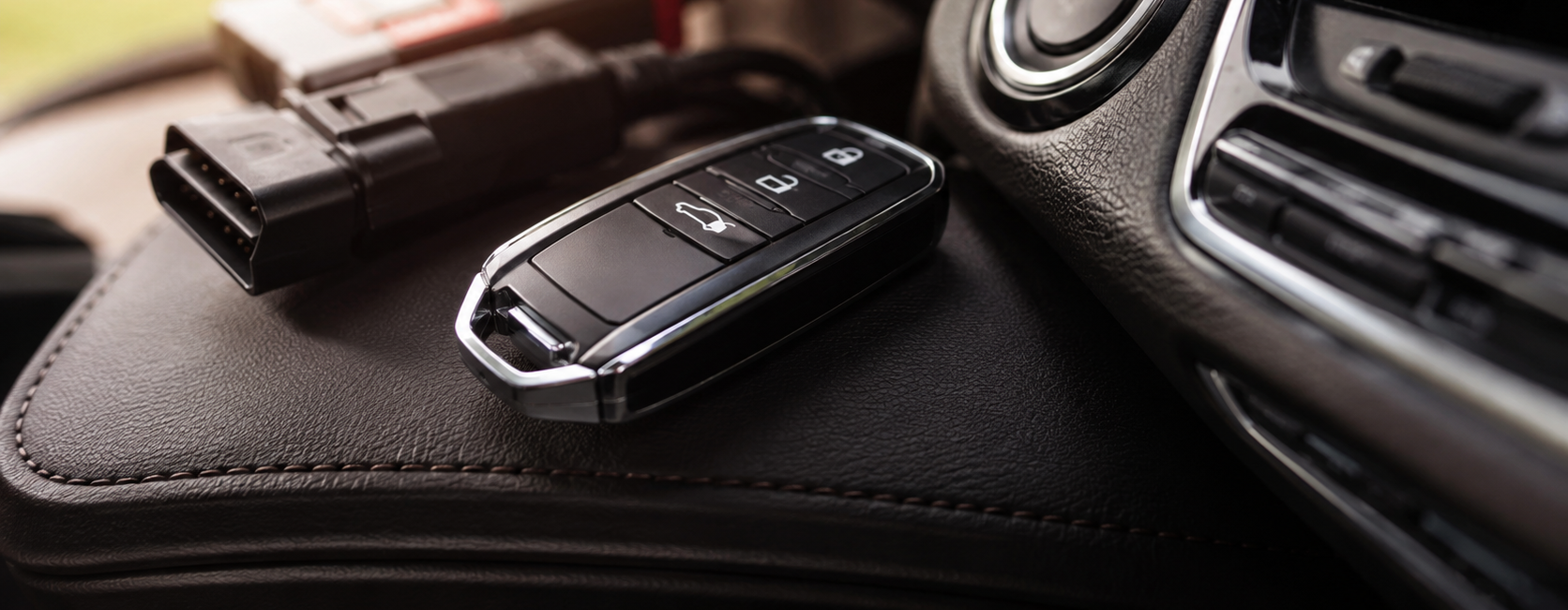
Whether you can program or reprogram a key fob yourself depends entirely on which type of key you have. Many older remote-only fobs can be programmed at home through an on-board sequence of ignition cycles, and a fob that has simply lost sync can usually be re-registered the same way. Transponder chip keys and modern push-to-start fobs cannot — they require diagnostic equipment and have to be done by a locksmith or dealer. This guide covers the on-board method step by step, how to reprogram a fob that stopped working, what to do when the original key is gone, and how to tell which situation you are in before you start.
Can You Program a Key Fob Yourself?
The answer comes down to which of three key types is sitting in your hand. If you are not sure which you have, our guide to what a key fob is covers how each type works.
Remote-Only Keyless Entry Fobs
These control the locks and trunk but play no part in starting the engine — the car still needs a separate metal key turned in the ignition. Many vehicles from the late 1990s through the early 2010s support on-board programming for this type, which means you can do it yourself in a few minutes with no tools at all.
Transponder Chip Keys
A transponder key has a chip embedded in the plastic head that the vehicle’s immobilizer must recognize before the engine will start. The chip has to be written into the vehicle’s security system, and that cannot be done by cycling the ignition. These need a programming tool.
Smart Proximity and Push-to-Start Fobs
If your car starts with a button and unlocks as you approach, the fob pairs to the vehicle electronically and almost always requires professional diagnostic equipment of the kind dealers and automotive locksmiths use. No sequence of ignition cycles will register one of these, regardless of what a generic instruction video suggests.
How to Program a Key Fob Yourself: The On-Board Method
On-board programming puts the vehicle into a learn mode through a specific sequence of ignition cycles, after which the fob registers when you press a button. The number of cycles and the timing vary by make, model and year, so confirm the exact sequence for your vehicle in the owner’s manual before you begin — using the wrong sequence is the most common reason this fails.
Get in and close the doors. Sit in the driver’s seat with every door shut and the fob in hand. An open door prevents many vehicles from entering learn mode at all.
Cycle the ignition. Insert the key and turn it from OFF to ON or RUN the number of times specified for your vehicle, usually within a few seconds. Do not start the engine.
Wait for programming mode. The vehicle signals that it has entered learn mode — typically the door locks cycle once, or a chime sounds. If nothing happens, the sequence was wrong or the vehicle does not support the method.
Press a button on the fob. Press lock or unlock. A second cycle of the door locks confirms the fob has been registered.
Program any additional fobs. If you have more than one remote, press a button on each of them within the same session. On many vehicles, leaving one out of the session erases it.
Exit and test. Turn the ignition off, remove the key, step back a few feet and test every fob on both lock and unlock.
If the sequence does not trigger learn mode after two clean attempts, stop. The vehicle almost certainly does not support on-board programming, and repeating the cycles will not change that.
How to Reprogram a Key Fob That Stopped Working
Reprogramming is a different situation from programming a new remote. Here the fob was already paired to the car and has lost that pairing, which means the vehicle still knows the fob but no longer agrees with it.
Why a Fob Loses Sync
Remote fobs and vehicles use a rolling code that changes with every button press, and both sides track where they are in that sequence. Pressing buttons repeatedly while out of range advances the fob without the car following along, and if the gap grows far enough, the car stops accepting the signal. A battery that died and sat flat for a long time can produce the same result, as can a battery replacement on some vehicles.
Re-Syncing With the On-Board Sequence
On vehicles that support on-board programming, re-syncing uses exactly the same ignition-cycle sequence described above. You are not adding a new remote, you are re-registering the one you already have, and the steps are identical. Include every fob you own in the session, not just the one that stopped working.
After a Battery Change
Most fobs keep their pairing through a battery swap and work again immediately. Some lose it, and a few need a specific reset. If the fob went dead before you changed the battery and does not respond afterward, run the on-board sequence before assuming the fob has failed. Our guide on changing a key fob battery covers opening the case and fitting the cell without damaging the board.
When Re-Syncing Won’t Fix It
If the sequence completes normally and the fob still does nothing, the problem is physical rather than logical. Worn button contacts, a cracked circuit board from being dropped, corrosion from a leaked battery, or a broken solder joint at the battery terminal all produce a fob that cannot transmit no matter how many times it is registered. At that point the fob needs testing or replacement, not reprogramming.
What You Need Before You Start
- A compatible fob matching the vehicle’s make, model, year and radio frequency. A mismatched or generic remote will not pair, and this is the single most common cause of a programming session that appears to work but produces nothing.
- The correct on-board sequence for your specific vehicle, from the owner’s manual rather than from a video covering a different model year.
- A working key — some vehicles require one or two already-programmed keys to be present before a new one can be added.
- A fresh battery in the fob you are programming. A weak cell can complete the sequence and still fail to transmit at range.
- An OBD programming tool for transponder and push-to-start keys. This is the piece home users do not have.
Programming a Transponder or Push-to-Start Key
These keys are outside DIY range for a structural reason, not because the procedure is difficult.
Why the Immobilizer Blocks the On-Board Method
The immobilizer prevents the engine from starting unless it reads a recognized chip nearby. That recognition is stored inside the vehicle’s security module, and the only way to add a new chip to the list is to write to that module through the diagnostic port. Cycling the ignition does not open a channel to it, which is why the on-board method has no effect on transponder keys at all.
Push-to-Start and Proximity Fobs
Keyless-start fobs work the same way with an extra layer: they also handle the proximity detection that lets you unlock and start without touching the key. Pairing one involves both the immobilizer and the body control module, and on many newer vehicles the process requires an online authorization step from the manufacturer before the tool will write anything. That requirement is why some vehicles genuinely can only be done at a dealer or by a locksmith with the right subscription.
What the Programming Tool Actually Does
The tool connects to the diagnostic port, reads the vehicle’s security configuration, authenticates itself, and writes the new key’s identity into the immobilizer’s list of accepted keys. It also confirms afterwards that the vehicle recognizes the key and, where the system allows, reports how many keys are currently registered — useful information if you have just bought a used car and do not know how many keys exist for it.
Programming a Key Fob Without the Original
Adding a key when you already have a working one is a simple addition. Losing every key is a different job.
With no working key, the vehicle has nothing to authenticate against, so the security system usually has to be reset and rebuilt from scratch. That reset erases every key previously registered, which is the point — it makes any key still in circulation useless. The consequence is that a spare sitting in a drawer at home will also stop working and has to be reprogrammed in the same session, so bring every key you still own even if you think it is dead.
An all-keys-lost job also needs the key itself to be cut before anything can be programmed, either from the vehicle’s key code or by decoding a lock. A car key locksmith can cut and code a replacement on site, which matters when the car is parked somewhere you cannot easily move it from.
Who Can Program a Key Fob: Dealer, Locksmith or You
Three options, and the right one depends on the key type rather than on price.
You can handle remote-only fobs on vehicles that support on-board programming, and any re-sync on those same vehicles. It takes a few minutes and costs nothing. You cannot do transponder or push-to-start keys.
An automotive locksmith covers everything a dealer does for most makes, using the same class of diagnostic equipment, and comes to the vehicle rather than requiring the vehicle to come to them. That is the practical difference when the car will not start where it sits. A locksmith can also cut a key from scratch when nothing is left to copy.
The dealer is sometimes the only option, typically on very recent models where the manufacturer restricts key programming or requires proof of ownership through their own system. The vehicle usually has to be brought in, which means a tow if it will not start.
On timing: an on-board remote takes a few minutes. A transponder key with a tool generally takes twenty to thirty minutes, and a push-to-start key up to an hour, depending on the security system, and an all-keys-lost job takes longer because the key has to be cut and the system reset first. For what each route typically costs, see our breakdown of key fob programming prices.
Frequently Asked Questions
Can I program a key fob myself?
Sometimes. Many remote-only keyless entry fobs can be programmed at home with an on-board ignition sequence. Transponder chip keys and push-to-start fobs cannot, and need a locksmith or dealer with a programming tool.
Does a key fob need to be reprogrammed after changing the battery?
Usually not — most fobs keep their pairing through a battery change. If the fob does not respond afterward, run the on-board sequence to re-sync it before concluding the fob has failed.
Do I need the old key to program a new fob?
On many vehicles, yes — one or two already-programmed keys must be present to add another. If every key is lost, the security system has to be reset with diagnostic equipment instead.
How long does it take to program a key fob?
A few minutes for an on-board remote. Twenty to thirty minutes for a transponder key and up to an hour for a push-to-start key, depending on the vehicle’s security system. An all-keys-lost job takes longer because the key must be cut first.
Can a locksmith program a key fob?
Yes. An automotive locksmith uses the same class of diagnostic equipment as a dealer and can program transponder and push-to-start keys on site, as well as cut a replacement when the original is gone.
Will programming a new fob erase my other keys?
Not when a key is simply added. A full immobilizer reset, needed when all keys are lost, does erase every registered key — so any key you still want to use has to be reprogrammed in the same session.
Why won’t my key fob program?
Most often an incompatible fob, a weak battery, the wrong on-board sequence, or a vehicle that does not support the method. Transponder and proximity keys never respond to ignition cycling, whatever the sequence.
When to Call a Locksmith
Programming a remote-only fob with the on-board method is a reasonable job to do yourself, and re-syncing one that lost pairing is the same procedure. Transponder chip keys, push-to-start fobs, and any situation where every key is missing need professional equipment, and no amount of ignition cycling substitutes for it.
If your vehicle does not support on-board programming, or you need a key made in the New York City area, a mobile automotive locksmith can program or replace it where the car is parked.