When a lock fails at a business, the stakes are different from a residential problem. A broken lock on a retail store front door means lost trading hours. A malfunctioning door on a server room means a potential security breach. A missing master key in a multi-tenant building means rekeying an entire floor. Commercial locksmith services in NYC handle these situations every day — with the tools, licensing, and urgency that business environments require.
This guide covers what a commercial locksmith does, which services businesses use most, what commercial door work involves, and what everything costs in NYC.
What Does a Commercial Locksmith Do
A commercial locksmith handles lock and door hardware for businesses, commercial properties, and multi-tenant buildings. The work is broader and more complex than residential locksmith services — commercial properties have more entry points, higher-security requirements, more users with access, and stricter compliance obligations under NYC building and fire codes.
Core commercial locksmith services include: lock installation and replacement on commercial-grade hardware, rekeying and master key system setup, commercial lockouts and emergency entry, door closer and hardware repair, panic bar and exit device installation, high-security lock upgrades, and coordination with access control installations.
A commercial locksmith also works differently than a residential one. Jobs are often completed outside business hours to avoid disrupting operations. Hardware must meet commercial-grade specifications — the Grade 1 hardware required for most NYC commercial installations is significantly more robust than the Grade 2 or Grade 3 hardware typical in homes. And because businesses have multiple people with access rights at different levels, keying systems require more planning than a single household.
Commercial Door Locksmith Services
Doors are the primary vulnerability in any commercial property — and commercial doors have specific hardware requirements that differ significantly from residential installations. A commercial door locksmith handles the full range of hardware on commercial doors: cylindrical and mortise locksets, panic bars and exit devices, door closers, electric strikes and magnetic locks, and the coordination between mechanical and electronic components.
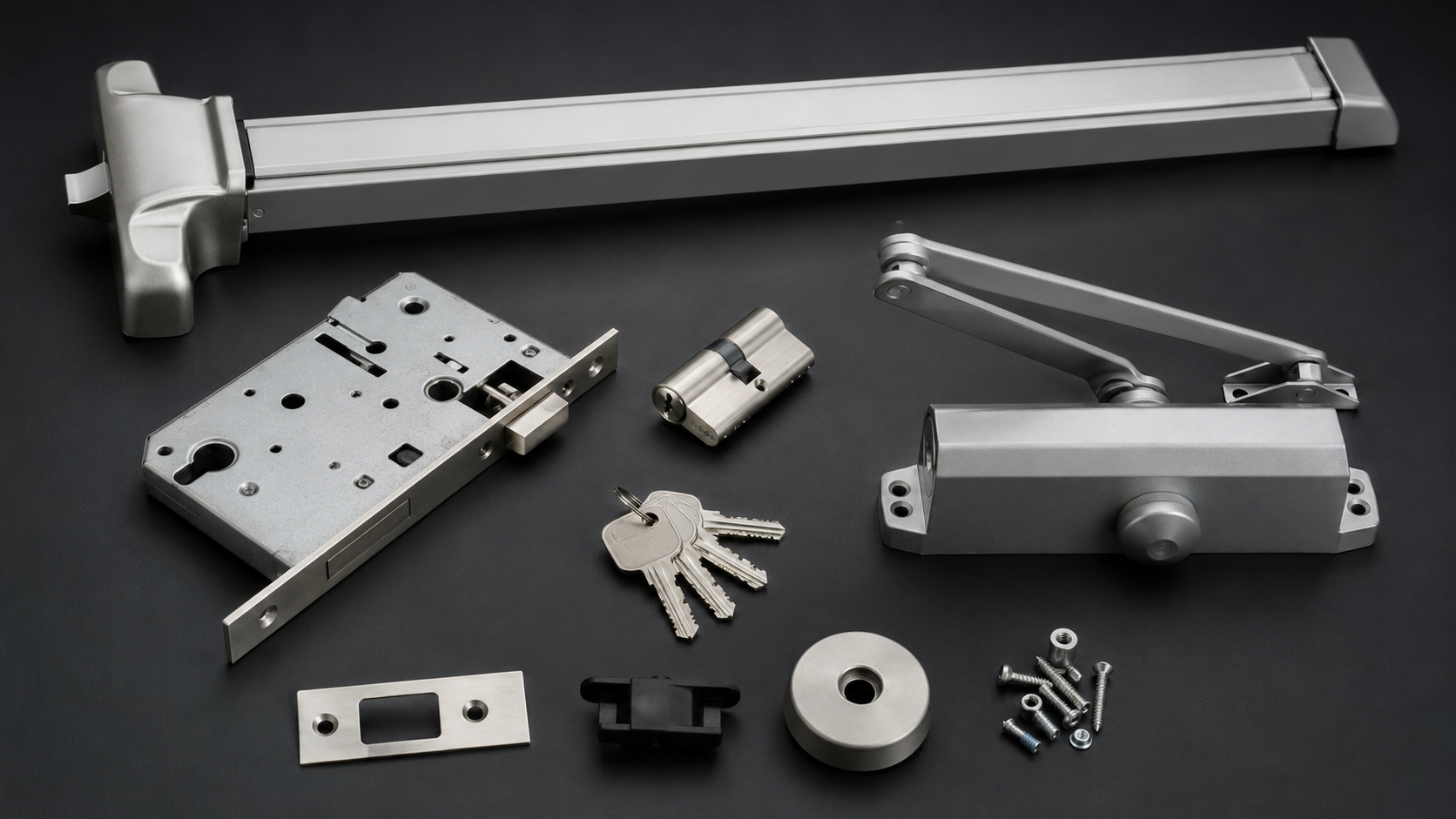
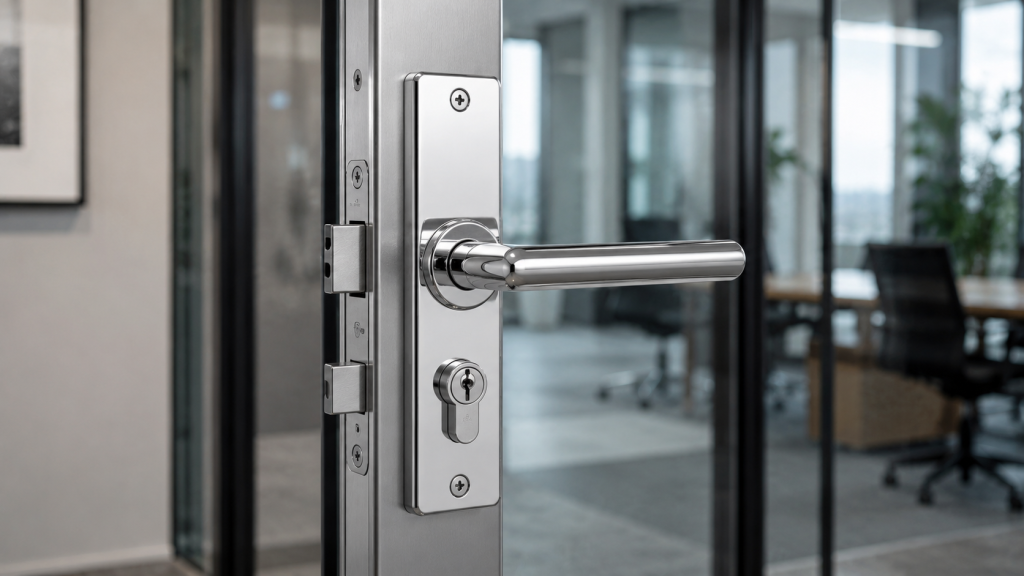
Mortise locks are the standard for commercial door applications in NYC. They are embedded within the door body rather than surface-mounted, offering superior resistance to forced entry. Mortise lock installation requires precise door preparation — routing out the lock pocket, drilling holes for the cylinder and rose, and fitting the lock body flush with the door edge. A commercial locksmith does this with dedicated tooling; it is not a job for improvised equipment.
Panic bars and exit devices are required by NYC fire code on most commercial exit doors. They allow rapid egress from inside without a key while maintaining security from outside. Installation must comply with specific hardware standards, mounting heights, and latch bolt configurations. Incorrect installation creates a life-safety violation and potential liability.
Door closers regulate how fast a commercial door closes and latches. They are required on fire doors and are standard on most external commercial doors for security — a door that does not close and latch behind visitors or employees creates a gap in perimeter security. Commercial door closers are adjusted for door weight, wind exposure, and the traffic pattern of the specific entrance.
Electric strikes and maglocks are the electromechanical hardware that connects a commercial door to an access control system. An electric strike replaces the standard door strike and releases electronically when authorized. A maglock holds the door shut with an electromagnetic force of 600 to 1,200 pounds and releases when power is cut — which means fail-safe behavior during fire alarms is built in. Installing either requires coordination between the door hardware and the access control panel.
Commercial Lock Installation and Rekeying
Commercial lock installation follows stricter specifications than residential work. Most commercial installations in NYC require Grade 1 hardware — the highest ANSI/BHMA rating for residential and commercial use — with specific cycle ratings, security grades, and finish durability requirements for different environments.
High-traffic entrances, server rooms, executive offices, and exterior doors each have different requirements. A front lobby door in a Midtown office building sees hundreds of uses daily and needs hardware rated for 250,000 cycles. A rarely-used stairwell door needs fire-rated hardware and a panic function even if traffic is minimal.
Commercial rekeying is more complex than residential work because of the number of locks and users involved. A 20-person office might have 10 doors, each requiring consideration of which employees have access to which spaces. The rekeying strategy — which locks share a key, which are on master key systems, which are standalone — has to be planned before any cylinders are touched. Getting this wrong means either returning to rekey locks a second time or issuing more keys than the security plan calls for.
Common triggers for commercial rekeying: an employee departure (particularly one with access to sensitive areas), a lost or unreturned key, the end of a contractor engagement, a building ownership or tenant change, or a security audit that reveals uncontrolled key duplication.
Master Key Systems for Businesses
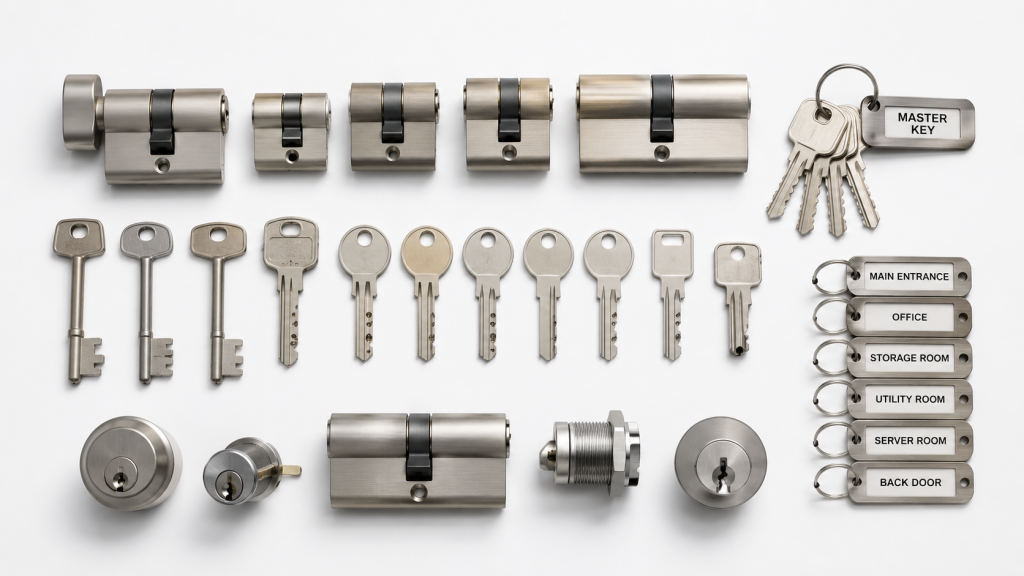
A master key system allows different levels of access with different keys. A staff member carries a key that opens only their work area. A supervisor carries a key that opens all areas in their department. A building manager carries a grand master key that opens every lock in the building.
Designing a master key system requires planning the key hierarchy before any hardware is installed or rekeyed. The number of levels, the groupings of locks at each level, and the key bitting combinations used must be carefully managed to maintain security — a poorly designed master key system can inadvertently allow lower-level keys to open higher-security areas through a phenomenon called cross-keying.
A commercial locksmith designs the system based on your organizational structure, installs or rekeyings all affected locks to the new hierarchy, and produces documented key schedules showing which key operates which locks. This documentation is essential for managing the system over time — adding a new employee or a new door requires reference to the existing hierarchy.
Master key system setup costs vary based on the number of locks and levels. A basic three-level system for a small office with 10 to 15 locks runs $500 to $1,500 for design and rekeying. Larger buildings with 50 or more locks and multiple tenant spaces can run $3,000 to $8,000 for a fully documented system installation.
Commercial Lockout Service
Commercial lockouts are more urgent than residential ones. A business locked out of its own premises at opening time is losing revenue every minute. A warehouse that cannot access a secure storage area is halting operations. These situations require fast response and the right tools for commercial-grade hardware.
Commercial lockout service in NYC for standard cylindrical or mortise locks during business hours runs $100 to $200. After-hours commercial emergency calls — which are more common given that property managers, maintenance staff, and business owners often discover problems outside of 9 to 5 — add $75 to $150 in emergency fees.
High-security commercial locks with restricted keyways, anti-pick pins, and hardened cylinders take longer to open non-destructively and cost more — $200 to $350 is typical for a high-security commercial cylinder opened by a skilled technician. Destructive entry on a commercial door that would cause significant damage to the door or frame may be cheaper than the repair costs — a locksmith assesses whether opening or replacement is the better approach given the specific hardware.
For multi-site businesses, establishing a service agreement with a commercial locksmith before emergencies occur ensures priority response and known pricing. Same-day or emergency response without a prior relationship can carry premium rates in a busy market like NYC.
High-Security Locks for Commercial Properties
Standard commercial locks provide adequate security for most general office and retail applications. High-security locks are appropriate for areas with elevated risk: cash storage, server rooms, pharmaceutical storage, executive offices, data centers, and any space containing assets or information that would cause significant harm if compromised.
High-security commercial locks use several mechanisms not found in standard hardware: patent-protected keyways that prevent unauthorized key copying, security pins that resist picking and bumping, hardened steel inserts that resist drilling, and anti-pull cylinders that resist extraction. These locks typically carry ratings from Underwriters Laboratories (UL 437) confirming their resistance to specific attack methods.
Key control is as important as lock security in commercial environments. A high-security lock with unrestricted key copying provides less real security than a standard lock with a restricted keyway. Specifying a lock brand that requires authorization for key duplication — with keys that cannot be copied on standard cutting machines — closes this gap.
Commercial Locksmith Costs in NYC
| Service | Typical Cost |
|---|---|
| Commercial lockout (standard lock) | $100 – $200 |
| Commercial lockout (high-security) | $200 – $350 |
| Commercial lock rekeying | $25 – $60 per lock |
| Mortise lock installation | $200 – $400 per door |
| Panic bar / exit device installation | $300 – $600 per door |
| Door closer installation | $150 – $300 per door |
| Master key system setup (10–15 locks) | $500 – $1,500 |
| High-security lock upgrade (per door) | $300 – $600 |
| After-hours emergency surcharge | $75 – $150 |
Prices reflect NYC market rates including labor and standard hardware. Specialty hardware, large-scale projects, and buildings with complex access requirements will fall outside these ranges.
Frequently Asked Questions
What is the difference between a commercial and residential locksmith?
How often should a business rekey its locks?
Does NYC require panic bars on commercial doors?
How much does a master key system cost for a small business?
Can a commercial locksmith work after hours?
What should I do if I am locked out of my business?
Commercial Locksmith Services in NYC
Lock and Tech provides commercial locksmith services for businesses, property managers, and building owners throughout New York City and New Jersey. Our licensed technicians handle commercial lockouts, door hardware installation, master key system design, rekeying, and emergency locksmith response across all five boroughs.
We work on all commercial hardware types — mortise locks, cylindrical locksets, panic bars, door closers, and electric strikes — and coordinate with access control installations when electronic and mechanical security need to work together.
Contact Lock and Tech to schedule commercial locksmith service or to discuss a security audit for your NYC property.