- Home
- Hospital Security Systems
- Hospital Intercom Systems
Hospital Intercom Systems in New York City



Doors Opened Without Leaving It
Since 1989, we’ve been securing homes and businesses across NYC and New Jersey with professional security solutions you can trust. Our licensed technicians provide 24/7 emergency service, using only the latest technology and backed by comprehensive warranties on all installations.


Door Intercom for Medical Facilities
- Main entrance after hours. A patient arriving for an evening appointment when the door is already locked.
- Street entrances in shared buildings. A practice on an upper floor with a door two flights down.
- Staff and back entrances. Doors used a few times a day by people who should not be waiting outside.
- Delivery and sample collection points. Couriers who arrive on their own schedule and need someone to answer.
- Corridor doors into treatment areas. A controlled door someone can be let through after a word rather than a wedge.
- Suites inside medical office buildings. Your own door answered by your own desk, independent of the lobby system.
- Practices with more than one answer point. Reception, back office, or a second floor, so a busy desk is not the only option.
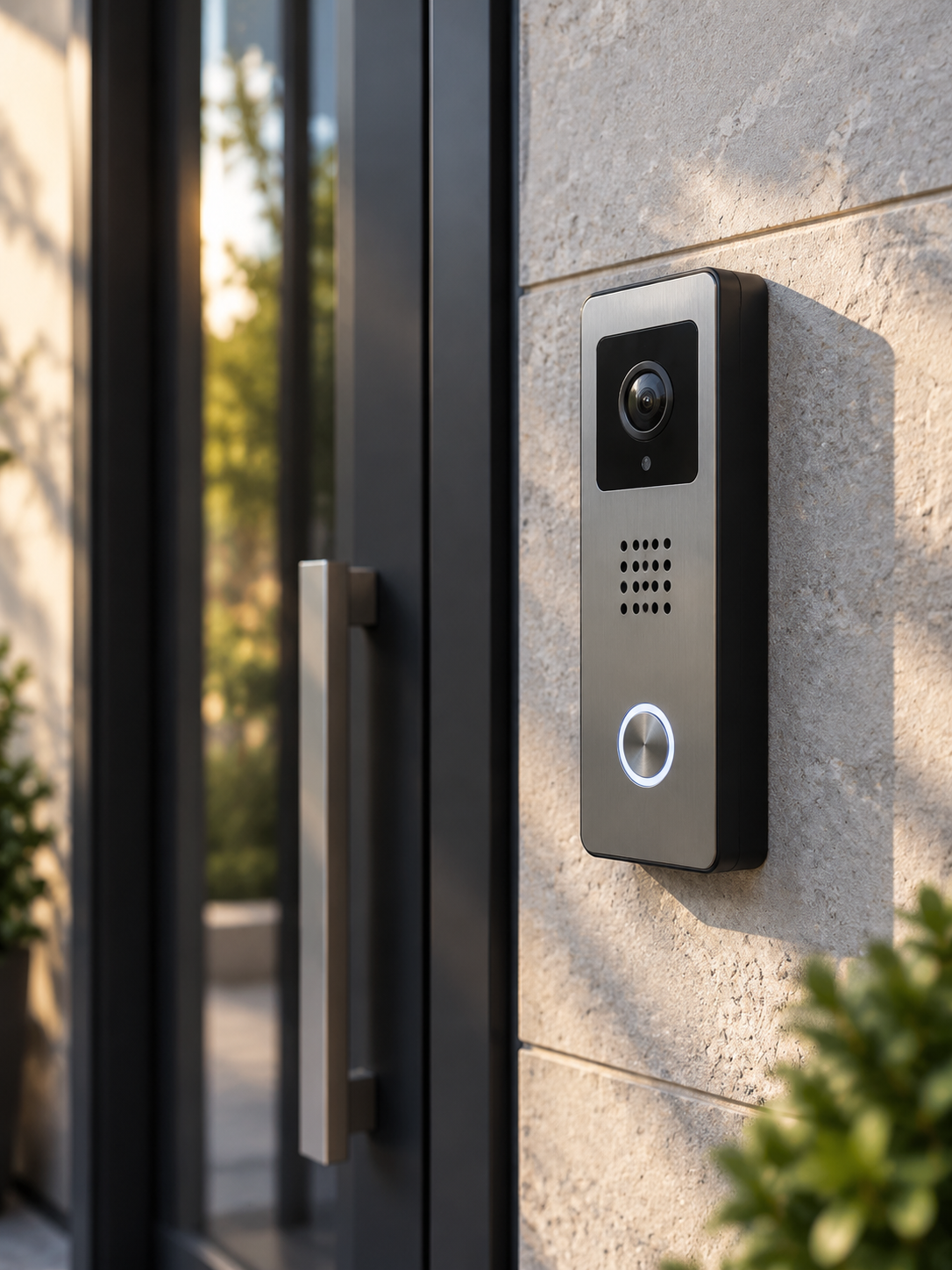
A hospital intercom on this page means the doors: a call from the entrance, a look at who is there, a word with them, and the door released from the front desk. It is not nurse call, bedside communication, or paging between departments — that is medical equipment and a different trade. Lock and Tech USA installs door intercom for clinics, practices, and medical centers across New York City.
Entrances That Need an Intercom
Most medical facilities have more than one door that matters, and each one fails in its own way. The front door is locked at the wrong moment for the wrong person; the back door means someone walks the length of the building; the delivery point has a bell nobody hears from the desk. Working out which doors need answering, and from where, is most of the design. The wider set of systems on a medical site is covered under hospital security systems, and how door intercom works in general under intercom systems.
Main Entrance After Hours
The main door is the obvious one. During opening hours it stands unlocked and the desk sees everyone who comes in; the problem starts when it is locked and someone legitimate is standing outside it — a patient arriving for a late appointment, someone collecting results, a clinician returning from a call.
With a call station at that door, the desk sees who is there before deciding anything. A medical office intercom on an upper floor of a shared building solves a second problem at the same time: the street door is two flights down, and without a call station somebody has to make that trip for every arrival.
Staff and Service Entrances
Back and service doors are used a few times a day and are usually the ones staff prop open, because the alternative is walking to them. A call station converts that walk into a short conversation at the desk. Delivery and sample collection points are the same story with a schedule nobody controls — a courier arrives when they arrive, and a bell that nobody hears means either a missed collection or a door left unlocked all afternoon.
Audio, Video, and Remote Release
Audio alone answers who is speaking. Video answers who is standing there, which on a locked door is a different and more useful question — a patient with an appointment, a courier with a box, or somebody who followed another visitor to the entrance all sound similar and look nothing alike.
For a clinic intercom the practical difference is what the person at the desk can decide without leaving it. With a video station they can see the door, speak, and release it in one action, from the same position where they are already working. That last part matters more than the picture quality: an intercom that requires walking to a wall panel gets used the same way as no intercom at all.
Release itself is a door-hardware question — the lock has to be one that can be released electrically and still meet the building’s escape requirements — and it overlaps with how the door is controlled the rest of the time. That side is covered under access control for medical facilities.
Who Answers and From Where
One answer point is rarely enough in a practice. The front desk is the natural first one, but it is also the position most likely to be occupied — on the phone, with a patient, or briefly empty. A second station in the back office or on another floor means a call at the door reaches somebody rather than ringing out.
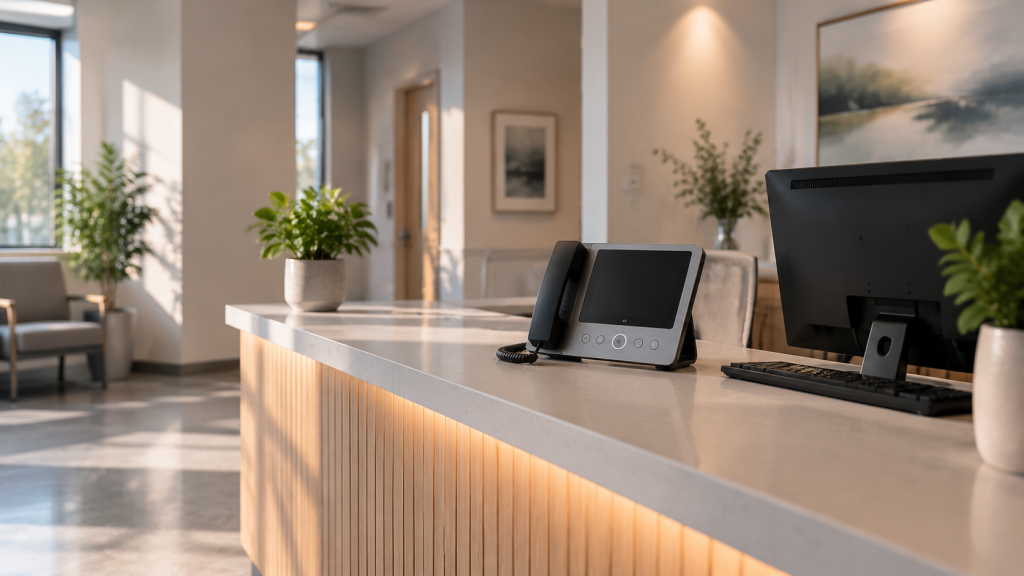
Where several stations exist, a call can ring at all of them or in sequence, so whoever is free responds. Outside opening hours the arrangement changes: fewer stations are staffed, and it is worth agreeing in advance what happens to a call at the main door at seven in the evening — answered from the back office, or not answered at all, which is a legitimate choice as long as it is a decision rather than an accident. Where a camera already covers the entrance, the two work together: the call tells you someone is there, the camera shows the approach. That side is covered under security camera installation.
Installing in a Working Clinic
Each door is a short job, so the work stages easily around a schedule. The survey establishes where the call station goes, where the answer points sit, and how cable reaches between them — in an occupied building that route is usually what decides the timing rather than the fitting itself.
Existing doors are checked first: construction, frame, and whether the current lock can be released electrically. Where it cannot, we say so before quoting rather than after. Work at the entrance is scheduled so the door stays usable, and nothing is left unfinished at the end of a day. Pricing is labor plus material for one total figure, with a signed contract before work begins.
Where We Work
We work in private clinics and medical centers, dental practices, diagnostic and imaging facilities, specialist and group practices, and suites inside medical office buildings. We cover New York City and Brooklyn, along with Queens, the Bronx, Staten Island, and the surrounding areas within our service radius.
Warranty, Service Area, and Payment
Lock and Tech USA backs new installations with a 90-day mechanical warranty and a 12-month electrical warranty, covering both parts and labor. Repairs are not covered by a warranty. We provide installation within 75 miles of Midtown Manhattan and support extended zones, multiple locations, and multi-site service for clients with several properties. Phone and email support is available during business hours.
We accept cash, wire transfer, ACH, credit card, and check, as well as Zelle and Venmo, and we offer invoicing and business accounts for commercial clients. Depending on the size of the job, payment is typically a partial deposit up front with the balance collected on completion. Before starting, we require a signed contract and a tax exemption form if applicable.
Frequently Asked Questions
Can we use the door we already have?
How many places can answer a call?
What happens if the power goes out?
What our clients say