- Home
- Hospital Security Systems
- Hospital Access Control
Hospital Access Control in New York City



Doors Nobody Needs to Prop Open
Since 1989, we’ve been securing homes and businesses across NYC and New Jersey with professional security solutions you can trust. Our licensed technicians provide 24/7 emergency service, using only the latest technology and backed by comprehensive warranties on all installations.


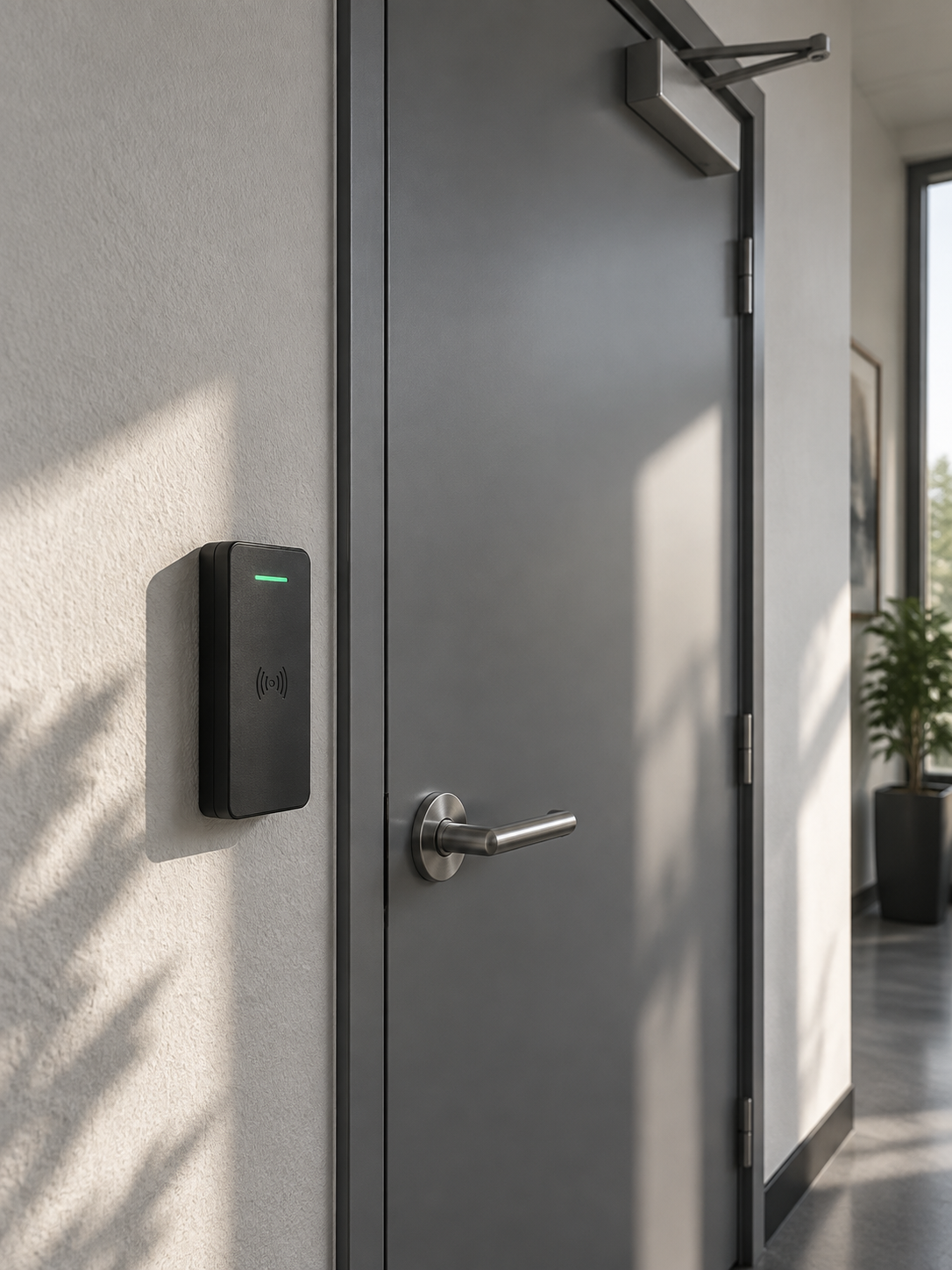
Access Control for Medical Facilities
- The reception-to-corridor door. The hardest door in the building: constant staff traffic one way, nobody the other.
- Treatment and procedure rooms. Open to clinical staff, closed to anyone who wandered past the front desk.
- Medication and supply storage. The tightest layer, limited to named people with every opening recorded.
- Server rooms and records storage. A short list of people, and a log that answers questions later.
- Staff rooms and changing areas. Personal belongings kept behind a door that is not the same door as the clinical one.
- Back and service entrances. Deliveries and cleaning crews, each with their own hours.
- Shared corridors in medical office buildings. Your suite door controlled independently of the landlord’s system.
Hospital access control comes down to a small number of doors and a much larger question about who holds what. In a clinic the equipment is the easy part; the difficulty is deciding which doors are worth controlling and keeping the list of who can open them accurate. Lock and Tech USA plans and installs healthcare access control for clinics, medical centers, and practices across New York City.
Which Doors Get Controlled
The work starts with a map of the building rather than with a device list. Controlling every internal door is expensive, slows everyone down, and produces a system people work around within a month. The useful version controls a handful of doors that actually separate one group of people from another, and leaves the rest alone. The wider set of systems on a medical site is covered under hospital security systems, and how access control works in general under access control installation.
Public Areas and Staff-Only Zones
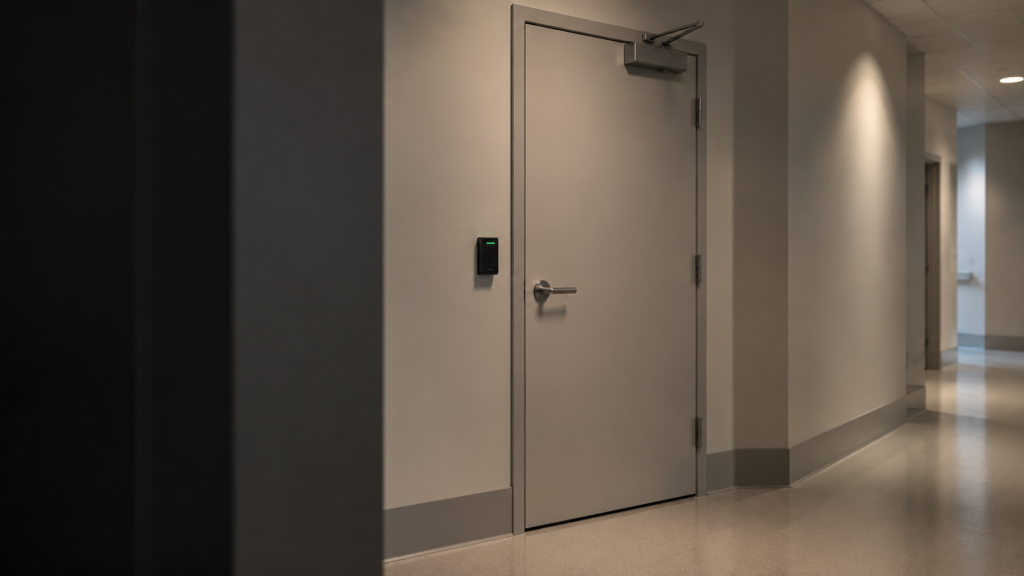
Reception and the waiting room are public, and nothing there should be controlled — the front desk does that job. The boundary is the door from reception into the treatment corridor, and it is the single most important one in the building.
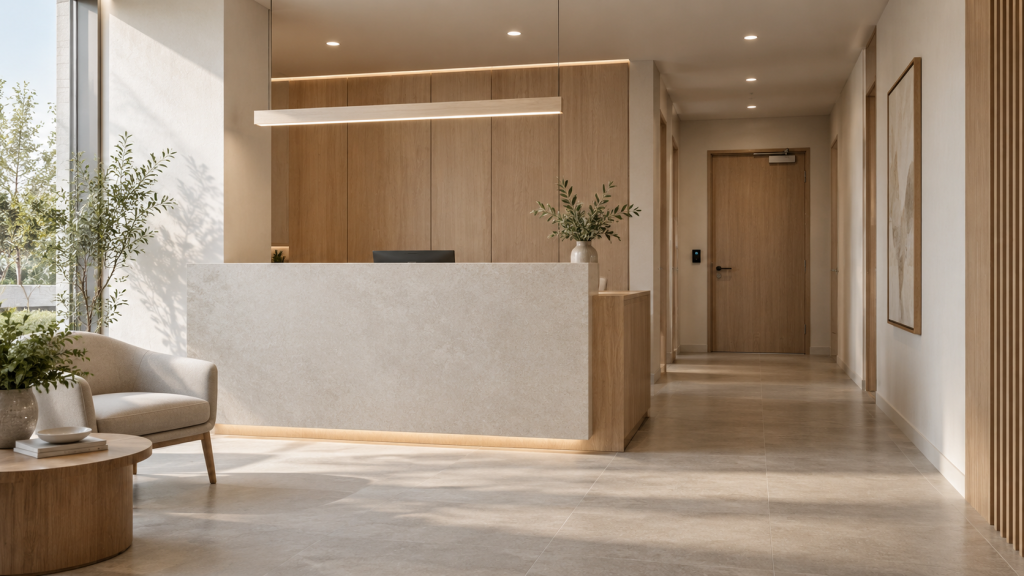
It is also where most installations fail. Staff pass through it constantly, often carrying files, samples, or equipment, and a door that takes two hands and two seconds becomes a door held open with a wedge. What works is a reader positioned where someone approaching naturally passes it, at a height reachable with an elbow or a card on a lanyard, on a door that closes reliably on its own. Where a patient or a delivery needs to be let through, reception opens it remotely after speaking to whoever is there — that side is covered under intercom systems for medical facilities.
Medication and Supply Storage
Rooms holding medication and controlled supplies are usually the tightest layer in a medical building, and the reason is accounting rather than suspicion. Stock has to be reconciled, and when a count does not match, the useful thing to have is a record of who opened the room and when. That record is what turns a discrepancy into a short conversation instead of an open question.
Access here is normally limited to named individuals rather than to a role, and it is worth reviewing the list periodically — lists of this kind grow quietly as people are added for a shift and never removed.
Server Rooms, Archives, and Records Storage
Rooms holding servers, paper records, and archived files need the same treatment for a different reason: they are rarely entered, so nobody notices when they are. A door that opens twice a month and produces a log entry each time is easy to review; a door with a key that four people have is not reviewable at all. Our part here is the physical door — who can walk into the room. What happens inside the systems in that room is a separate matter and not something we work on.
Credentials and Managing Who Has Access
Credentials come in a few practical forms, and the choice is about how a clinic works rather than about the technology. Cards and fobs are quick, easy to issue, and easy to lend to a colleague — which is convenient and is also their weakness. Codes need no hardware to issue but get shared and rarely get changed. Fingerprint readers cannot be passed to anyone else, at the cost of being slower and less reliable in gloves, which on a clinical floor matters more than it sounds. Phone credentials suit staff who always carry a phone and suit nobody who does not.
Most practices end up mixing them: cards for clinical staff, a code for a delivery entrance, tighter credentials on storage. What matters more than the choice is what happens when someone leaves.
This is the practical argument for healthcare access control over keys. A key has no owner: once it leaves the building you either get it back or you change the lock, and in a clinic with a dozen internal doors that is a real cost every time somebody resigns. A credential has an owner and an off switch. Removing access is one operation, takes under a minute, and applies to every door at once — no collection, no locksmith, no wondering whether a copy was made.
The same applies to temporary staff, locums, cleaning contractors, and equipment engineers: access is issued for the days it is needed and expires on its own. Every use is recorded, so a question about last Tuesday has an answer. Where a controlled door is also covered by a camera, an entry in the log and the footage from that moment answer it together — that side is covered under security camera installation.
Doors, Egress, and Practical Constraints
Two constraints govern every controlled door in a clinical building, and both are physical rather than electronic.
The first is leaving. A door on an escape route has to open from the inside by hand, immediately, with no card and no power. Access control on such a door works in one direction only: it decides who comes in, never who goes out. That is a property of how the hardware is specified, and it is checked on every door during the survey rather than assumed.
The second is what actually moves through the door. A corridor door that a wheelchair, a trolley, or a cleaning cart passes through needs to stay open long enough and swing far enough for that, or it will be held open with something heavy. Propping is almost never a discipline problem: it means the door was specified without watching how people use it. When we see wedges on a site survey we treat them as the most useful information available — they mark exactly which doors were designed wrong.
Installing in a Working Clinic
Each controlled door is a short job on its own, which makes this work easier to stage than most. We survey with someone who knows the room schedule, agree in advance which rooms we can enter and when, and take doors one at a time so nothing is left half-fitted at the end of a day.
Existing hardware is checked first — door construction, frame condition, and whether the current lock can take a reader and a strike. Reusing what works keeps the job smaller. At handover we set up credential groups with you, issue the first cards, and leave the door map and the group structure documented, so adding a person later does not require calling us. Pricing is labor plus material for one total figure, with a signed contract before work begins.
Where We Work
We work in private clinics and medical centers, dental practices, diagnostic and imaging facilities, specialist and group practices, urgent care sites, and suites inside medical office buildings. Where storage and records also need protecting outside working hours, that pairs with alarm systems. We cover New York City and Brooklyn, along with Queens, the Bronx, Staten Island, and the surrounding areas within our service radius.
Warranty, Service Area, and Payment
Lock and Tech USA backs new installations with a 90-day mechanical warranty and a 12-month electrical warranty, covering both parts and labor. Repairs are not covered by a warranty. We provide installation within 75 miles of Midtown Manhattan and support extended zones, multiple locations, and multi-site service for clients with several properties. Phone and email support is available during business hours.
We accept cash, wire transfer, ACH, credit card, and check, as well as Zelle and Venmo, and we offer invoicing and business accounts for commercial clients. Depending on the size of the job, payment is typically a partial deposit up front with the balance collected on completion. Before starting, we require a signed contract and a tax exemption form if applicable.
Frequently Asked Questions
What happens when a member of staff leaves?
Will doors stay locked if the power goes out?
Can we keep the locks we already have?
How long does the work take?
What our clients say