- Home
- Restaurant Security Systems
Restaurant Security Systems in New York City



Fitted Between Shifts, Not Between Closures
Since 1989, we’ve been securing homes and businesses across NYC and New Jersey with professional security solutions you can trust. Our licensed technicians provide 24/7 emergency service, using only the latest technology and backed by comprehensive warranties on all installations.


Security Systems for Restaurants, Bars, and Cafes
- Full-service restaurants. A dining room, a bar, a kitchen, and a service entrance — four areas with four different problems.
- Bars and cocktail venues. Late hours, cash across the bar, and a closing routine that often runs with one person on site.
- Cafes and quick service. High turnover of staff and a counter that is the whole business.
- Venues with outdoor seating. Sidewalk and patio areas that belong to you at night and to nobody during the day.
- Kitchens with early deliveries. A back door opened at six in the morning by whoever arrived first.
- Small groups and second locations. The same setup repeated, so a manager moving between sites finds the same thing.
- Venues with their own parking. A lot that matters most after closing, when it is empty and unlit.
Restaurant security systems have to fit a business that is open to the public, handles cash across a counter, runs long after most trades have gone home, and replaces a good part of its staff every few months. None of that is a criticism of the industry — it is simply the shape of the problem, and it makes a restaurant different from an office or a shop. Lock and Tech USA designs and installs security systems for restaurants, bars, and cafes across New York City.
Where Restaurants Are Vulnerable
Risk in a venue is not spread evenly. It concentrates in a few places — the register, the bar, the safe, the back door — and in a few hours of the day, mostly the ones at either end when the building is nearly empty. A system built around those points does far more than one built around the perimeter.
Cash Handling and the Bar
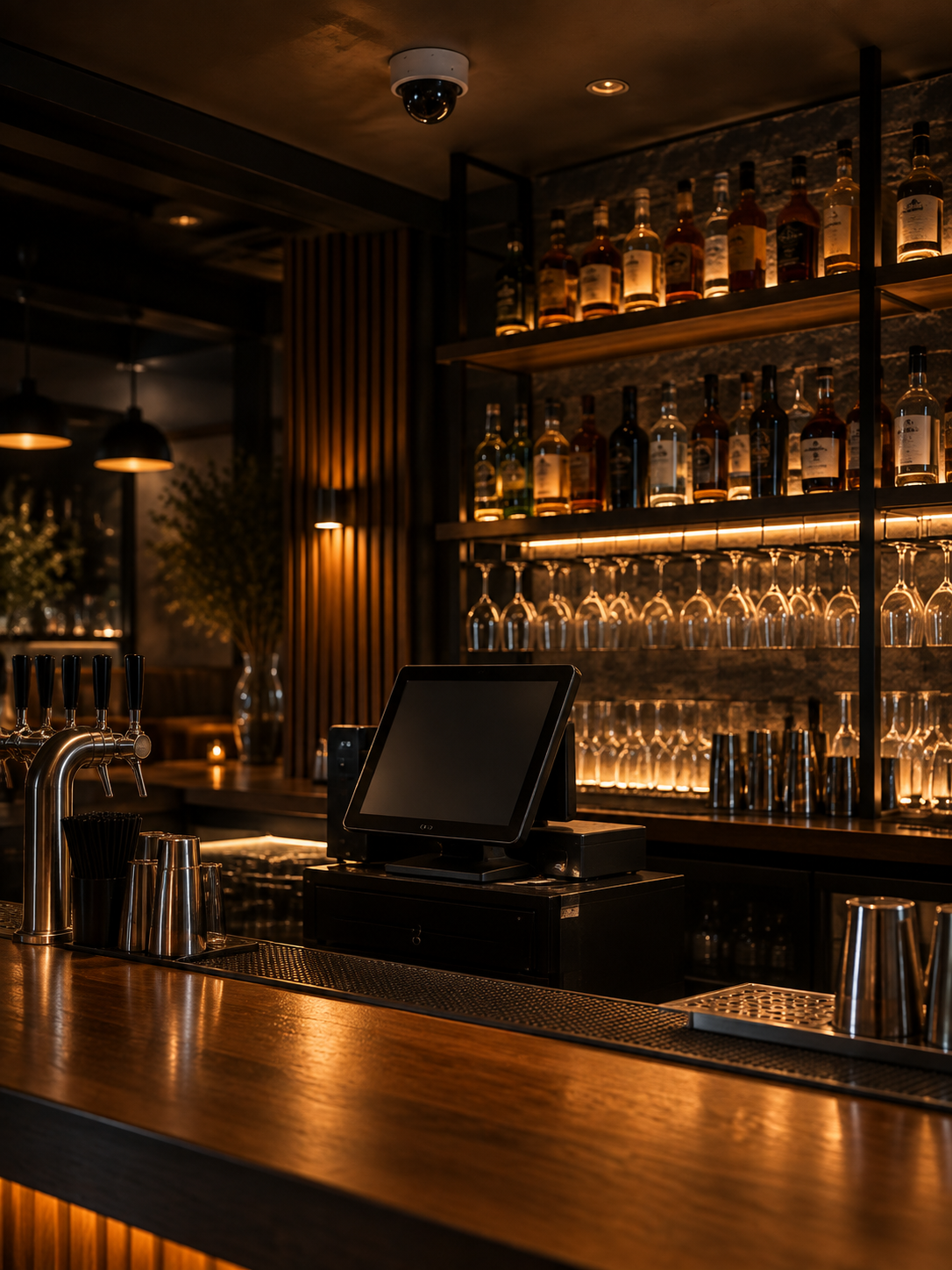
Cash is the reason most venues start this conversation. It moves between the register, the bar, the office, and the safe, and every one of those transfers happens at a specific place that either has a camera looking at it or does not.
What matters is placement rather than count. A view of the register area that shows the drawer, a view of the bar that shows the well and the till, and a view of wherever cash is counted at the end of the night cover most of the questions that come up later. When a discrepancy appears, the useful thing is footage from that spot at that time — enough to see what happened, which is usually a mistake rather than anything else, and to settle it either way. The same views answer disputes with guests, which in a busy room happen more often than anything involving money.
Back of House and Deliveries
The service door is the least watched opening in most venues and the busiest one nobody thinks about. Deliveries arrive early, often before management, and the door tends to stay propped through the drop-off. Storage rooms, walk-ins, and the dry store sit behind it, and they hold stock worth more than the register on most nights.
Coverage here is about the door itself and the route from it into storage. A camera on the back corridor answers what came in, what went out, and when — which is the question asked when a stock count does not match, and it is asked far more often than the one about the safe.
Late-Night Closing and Early Openings
Closing is when a venue is most exposed and least staffed. One or two people, cash on site, a back door, and a walk to a car. Opening has the same shape in reverse: someone alone in the building for an hour before anyone else arrives.
Those two hours are the argument for alarm zones that follow the routine rather than a single switch on the way out, and for covering the parking area and the approach to the staff entrance, which are dark and empty at exactly the moments people use them.
What a Restaurant Security System Includes
Four subsystems, each answering a different part of the picture, specified together because they overlap at the same few points in the building.
Video. The layer that answers questions afterwards, and the one most venues get the least from because the views were chosen by coverage rather than by question. Register, bar, back door, storage route, dining room, and parking cover the ground; how long footage is kept decides whether last month’s discrepancy is still answerable. Detail on restaurant security cameras.
Alarm. The layer for closed hours, and it works best when zones follow the closing routine — the dining room armed while someone finishes in the office, the back of house armed separately from the front. A system that arms as one block gets left off on the first late night. Detail on restaurant alarm systems.
Access control. The layer that deals with staff turnover, which in this industry is the single most expensive security problem to ignore. Credentials for the back door, the office, and the stock room, issued by role and removed the day someone leaves. Detail on access control installation.
Intercom. The layer for the service entrance, covered in the next section.
Intercom at the Service Entrance
A delivery arrives at half past six in the morning. The back door is locked, the kitchen is at the other end of the building, and the person nearest to it is the one who cannot leave what they are doing. The usual outcome is that the door gets left unlocked from the first delivery onwards, which undoes everything else on this page.
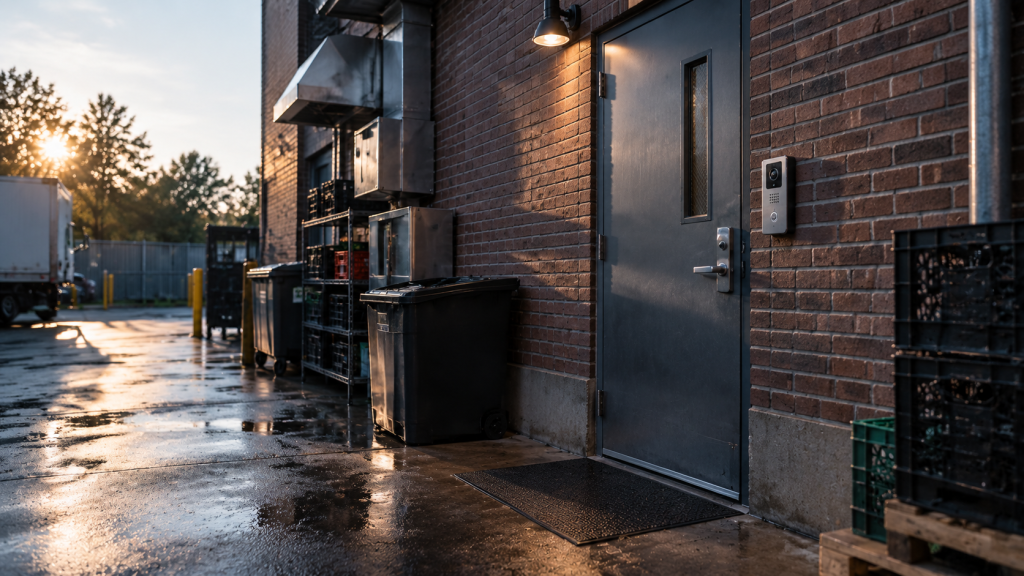
A call station at the service door changes that. The call reaches the office, the kitchen, or the register — more than one point, so somebody answers — and whoever takes it can see who is standing there before releasing the door. During service hours the same station handles couriers, contractors, and anyone else arriving at the back, without a member of staff walking the length of the venue to find out who rang. Detail on intercom systems.
Staff Turnover and Keys
Restaurants change staff more often than almost any other business, and every departure leaves the same question: where is that key, and was it copied. In practice most venues answer it by doing nothing, because the alternative is a locksmith and new keys for everyone, several times a year.
That is the real argument for controlled doors in a venue, and it has nothing to do with monitoring anyone. A key has no owner and no off switch; a credential has both. When someone leaves, their access is removed in one operation, whether or not the card came back — no lock changes, no reissuing to everyone else, no wondering. Temporary staff and contractors get access for the days they need it, and it expires on its own. Every use is recorded, so a question about a Tuesday morning has an answer rather than a guess.
Installing in an Operating Restaurant
We work weekdays from 8 to 6, which for a venue is usually the good news: most of the work lands in the hours before service, when the building is quiet and the floor is clear. The plan is staged so nothing is left unfinished when a shift starts — cable in one morning, devices the next, each area finished and back in use before the next one opens up.
The survey happens with someone who knows the routine: when deliveries come, when the kitchen fires up, when the floor is set. Noisy work goes in the earliest window. At handover we walk the system with whoever closes as well as whoever opens, since the closing routine is where a system either gets used or gets ignored. Pricing is labor plus material for one total figure, with a signed contract before work begins.
Where We Work
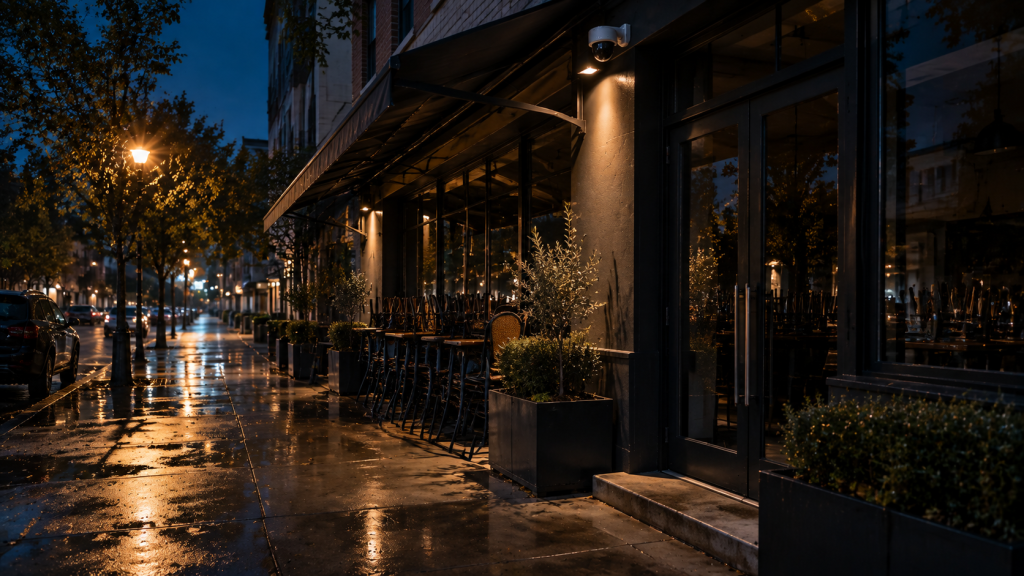
We work in full-service restaurants, bars and cocktail venues, cafes and quick service, venues with outdoor seating, kitchens with early delivery schedules, small groups with a second location, and venues with their own parking. We cover New York City and Brooklyn, along with Queens, the Bronx, Staten Island, and the surrounding areas within our service radius. The wider commercial picture is covered under business security systems.
Warranty, Service Area, and Payment
Lock and Tech USA backs new installations with a 90-day mechanical warranty and a 12-month electrical warranty, covering both parts and labor. Repairs are not covered by a warranty. We provide installation within 75 miles of Midtown Manhattan and support extended zones, multiple locations, and multi-site service for clients with several properties. Phone and email support is available during business hours.
We accept cash, wire transfer, ACH, credit card, and check, as well as Zelle and Venmo, and we offer invoicing and business accounts for commercial clients. Depending on the size of the job, payment is typically a partial deposit up front with the balance collected on completion. Before starting, we require a signed contract and a tax exemption form if applicable.
Frequently Asked Questions
Can you install without closing the restaurant?
Where should cameras go in a venue?
What happens to access when someone leaves?
Can we arm part of the venue while someone is still inside?
How long is footage kept?
What our clients say