
- Home
- Warehouse Security Systems
Warehouse Security Systems in New York City



Installed Without Stopping
Since 1989, we’ve been securing homes and businesses across NYC and New Jersey with professional security solutions you can trust. Our licensed technicians provide 24/7 emergency service, using only the latest technology and backed by comprehensive warranties on all installations.


Security Systems for Warehouses and Distribution Centers
- Distribution centers. High throughput, several docks working at once, and drivers from carriers nobody on site has met before.
- Storage and fulfillment warehouses. Racking that blocks sightlines, so coverage is planned by aisle rather than by floor area.
- Cold storage facilities. Equipment placed where temperature and condensation are part of the specification.
- Cross-dock operations. Goods that never rest, where the dock apron matters more than the interior.
- Mixed warehouse and office sites. Two very different security problems on one property and one system.
- Multi-tenant industrial buildings. Shared yards and loading areas where each tenant needs its own boundary.
- Yards and outdoor storage. Perimeter, gates, and vehicle movement after the building itself is closed.
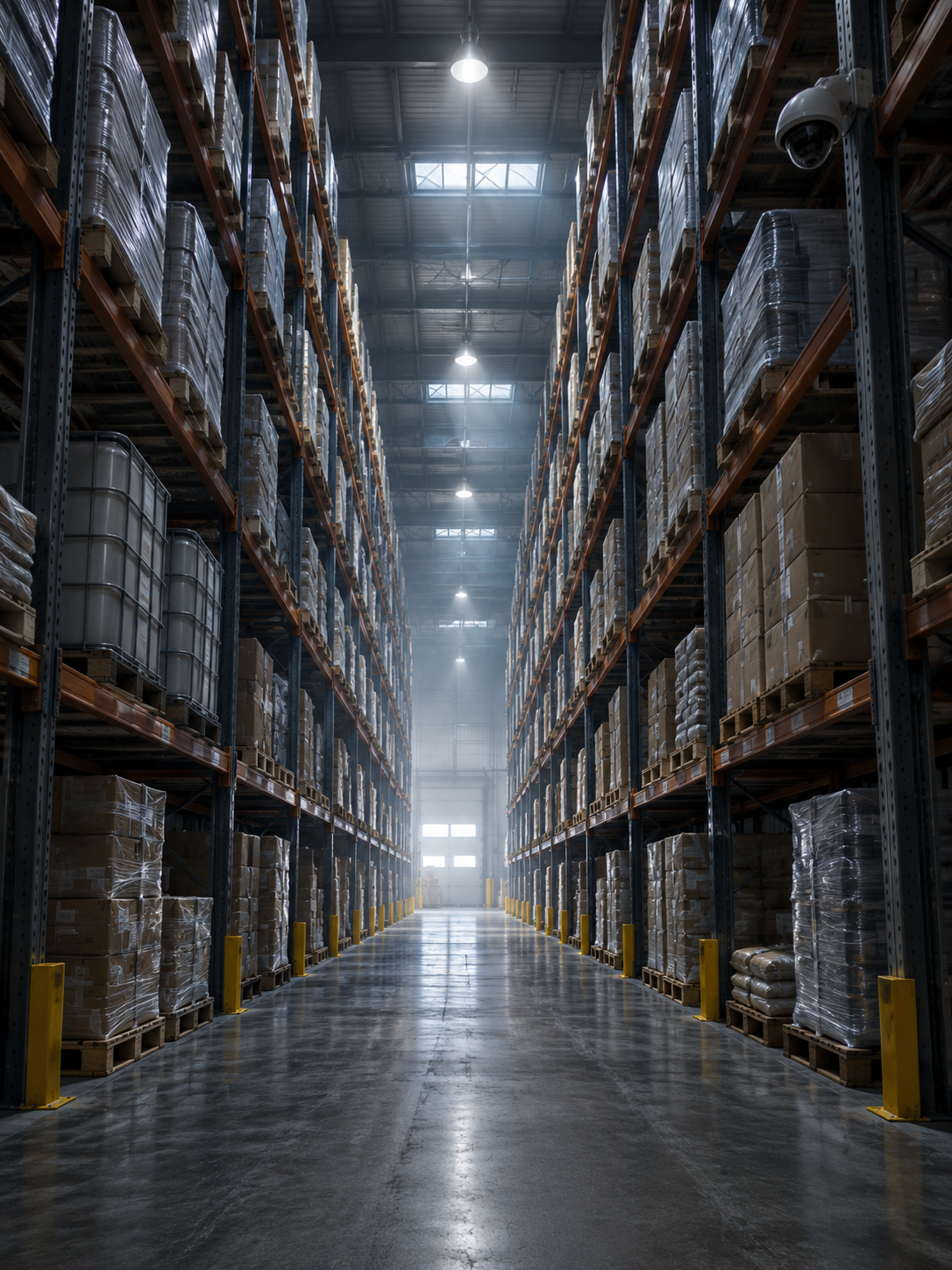
Warehouse security systems have to solve a problem the office version never faces: a very large building watched by very few people. A hundred thousand square feet, a night shift of two, loading doors standing open through the working day, and a constant flow of drivers and temporary staff nobody on site recognises. What works in an office — a few cameras, a keypad at the door, a panel by reception — covers a fraction of that. Lock and Tech USA designs and installs systems for warehouses and distribution centers across New York City.
Security Challenges Specific to Warehouses
An office is a small area with many people in it, and the people are most of the security. Someone notices an unfamiliar face. A warehouse inverts that: the area is enormous, the people are few and concentrated in a handful of spots, and most of the building is unobserved most of the time. Every decision below follows from that inversion.
Large Areas, Few People
Floor area is the wrong measure for coverage in a warehouse, because racking blocks sightlines. A camera that sees a whole empty floor sees three aisles once the racks go in, and the view changes again when the layout is reconfigured for a new contract. Coverage is planned by aisle and by route rather than by square footage, with attention to where the racking will actually stand.
The same applies to detection. Motion sensors placed for an open room behave differently in a space subdivided by steel and stock, and a system tuned during a quiet week produces false alarms the first time a fan or a hanging banner moves in a draft. Position and sensitivity are set for the building as it operates, not as it looks empty.
Loading Docks and After-Hours Access
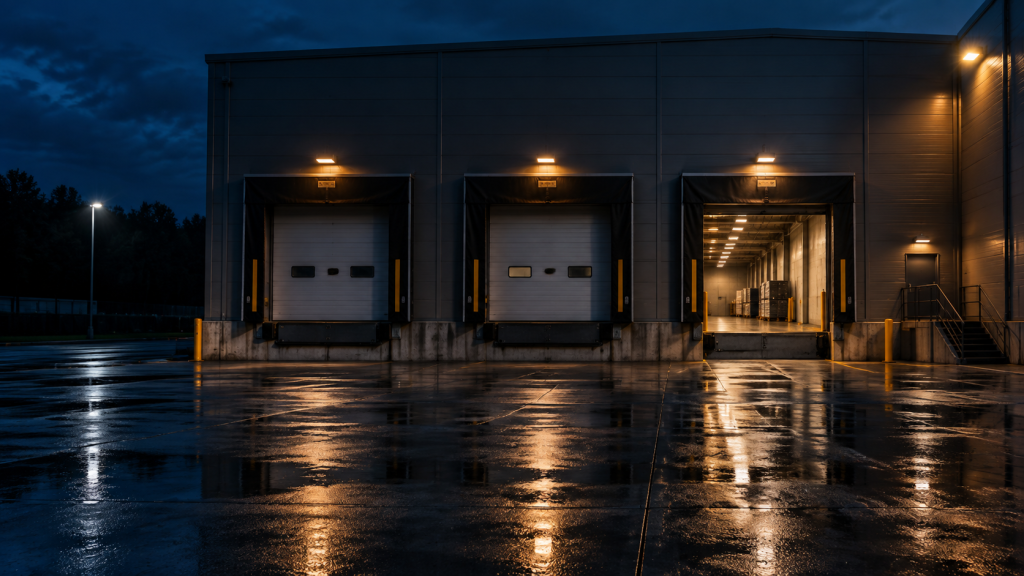
Docks are the main entrance to most warehouses, and they spend the day open. Everything that matters passes through them, and so do people the site has no relationship with — drivers from carriers, agency staff on a first shift, contractors. That is a different problem from an office door with a badge reader.
After hours the picture changes again. Deliveries arrive outside the schedule, a skeleton crew works the night, and a driver at a closed gate at two in the morning needs a way to reach whoever is inside. Coverage of the dock apron, the yard, and the approach matters as much as the interior, because by the time something reaches the interior the useful moment has passed.
Internal Loss and Inventory Shrinkage
Losses in a warehouse frequently walk out through the front, during working hours, in a vehicle that is supposed to be there. Nothing is forced, no alarm sounds, and the discrepancy appears weeks later at a count. An alarm system does not address that at all, which is why warehouse security is weighted toward recorded coverage rather than toward intrusion detection alone.
What matters then is the ability to go back. A count that comes up short gives you a date range and a stock location; the useful system is one where footage from that window still exists, covers that location, and can be found in minutes rather than an afternoon. That drives decisions about camera placement over pick faces and dispatch areas, and about how long recordings are kept.
What a Warehouse Security System Includes
Four subsystems, each answering a different part of the problem. They are specified together because they overlap: a door that reports an opening is more useful when a camera covers it, and an alarm event means more when someone can see what triggered it.
Video. The layer that does most of the work in a warehouse, because it answers the questions asked after the fact as well as during. Coverage is planned around docks, aisles, pick faces, dispatch, and the perimeter, with attention to how long footage is retained — a shortfall discovered at a monthly count is useless if recordings only go back a fortnight. Detail on warehouse security cameras.
Alarm. The layer for when the building should be empty. Contacts on doors and docks, motion in the interior, and sensors on the perimeter, arranged so partial arming is possible — a warehouse frequently has one zone working while the rest is closed, and a system that only arms as a whole gets left off. Detail on warehouse alarm systems.
Access control. The layer that answers who, and when. Credentials for staff, separated by area so the office does not open the yard gate and a temporary badge stops working on the day it should, with a record of every use. Turnover of seasonal staff is what makes this worth having: revoking a credential is instant, collecting a key is not. Detail on access control installation.
Gate communication. The layer that lets someone outside reach someone inside, covered in the next section.
Intercom and Gate Communication
A driver arrives at a closed gate. The office is somewhere on the far side of a large building, the person who can help is on a forklift in aisle forty, and the driver has a phone number that rings a desk nobody is sitting at. That situation costs a warehouse more time in a year than most people would guess.
An intercom at the gate and at each dock puts the call where it can actually be answered — to a handset in the dispatch office, to a station on the floor, to more than one point at once so whoever is free responds. On a night shift that matters most: two people covering a large site cannot be walking to the gate to see who is there. Adding video to the station means the person answering can see the vehicle and the paperwork before anything opens.
Inside the building the same infrastructure carries communication between zones — dispatch to the floor, office to the dock — which in a space where phone coverage is patchy and radios get left on chargers is frequently the more used half of the system. Detail on intercom systems.
How a Warehouse Installation Runs
It starts with a walk of the site during working hours, not after. We look at how goods move, where vehicles go, which doors are actually used, where the racking stands, and where the network and power already reach. A layout drawn from an empty floor plan misses most of that.
The plan that comes out of it is staged by zone, because a warehouse cannot stop. Cabling runs in sections, at hours agreed against the shift pattern — for many sites that means overnight or weekends, for others the quiet part of a shift. Each zone is brought into service as it is finished rather than everything switching on at the end, so the site is never in a state where the old arrangement is down and the new one is not yet up.
Work at height over live areas is scheduled around operations for obvious reasons, and that scheduling is agreed before we start rather than negotiated on the day. At handover we walk the finished system with your team — the people on the night shift as well as the manager — and leave the configuration documented so a later change does not begin with tracing what is there.
Where We Work
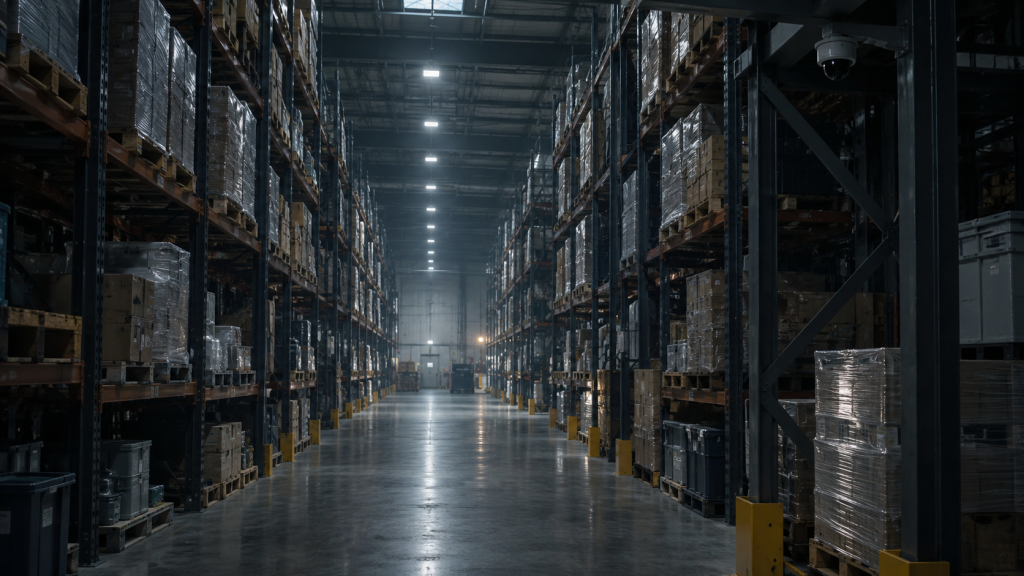
We work in distribution centers, storage and fulfillment warehouses, cold storage facilities, cross-dock operations, mixed warehouse and office sites, multi-tenant industrial buildings, and yards and outdoor storage areas. We cover New York City and Brooklyn, along with Queens, the Bronx, Staten Island, and the surrounding areas within our service radius. Operators with several facilities can keep them under one contractor with consistent documentation across sites. The wider commercial picture is covered under business security systems.
Warranty, Service Area, and Payment
Lock and Tech USA backs new installations with a 90-day mechanical warranty and a 12-month electrical warranty, covering both parts and labor. Repairs are not covered by a warranty. We provide installation within 75 miles of Midtown Manhattan and support extended zones, multiple locations, and multi-site service for clients with several properties. Phone and email support is available during business hours.
We accept cash, wire transfer, ACH, credit card, and check, as well as Zelle and Venmo, and we offer invoicing and business accounts for commercial clients. Depending on the size of the job, payment is typically a partial deposit up front with the balance collected on completion. Before starting, we require a signed contract and a tax exemption form if applicable.
Frequently Asked Questions
Can the work be done without stopping the warehouse?
How much of a warehouse needs camera coverage?
Can we arm part of the building while another part works?
How do we handle drivers arriving out of hours?
What does a warehouse system cost?




What our clients say