
- Home
- Restaurant Security Systems
- Restaurant Security Cameras
Restaurant Security Cameras in New York City



Placed for the Room It Watches
Since 1989, we’ve been securing homes and businesses across NYC and New Jersey with professional security solutions you can trust. Our licensed technicians provide 24/7 emergency service, using only the latest technology and backed by comprehensive warranties on all installations.


Camera Coverage for Restaurants, Bars, and Cafes
- Register and point of sale. The drawer, the counter, and the hands — the view most often installed at the wrong angle.
- Bar and service well. Where cash and stock move fastest and where the room is darkest by evening.
- Dining room. Wide views that show what happened at a table and how the room was laid out at the time.
- Front entrance. Everyone who comes in, framed against daylight from the street.
- Kitchen and prep areas. A filming environment of steam, heat, and grease that few cameras are specified for.
- Storage, walk-ins, and the back corridor. The route stock takes in and, occasionally, back out.
- Service entrance and parking. The door used before opening and the lot that empties after closing.
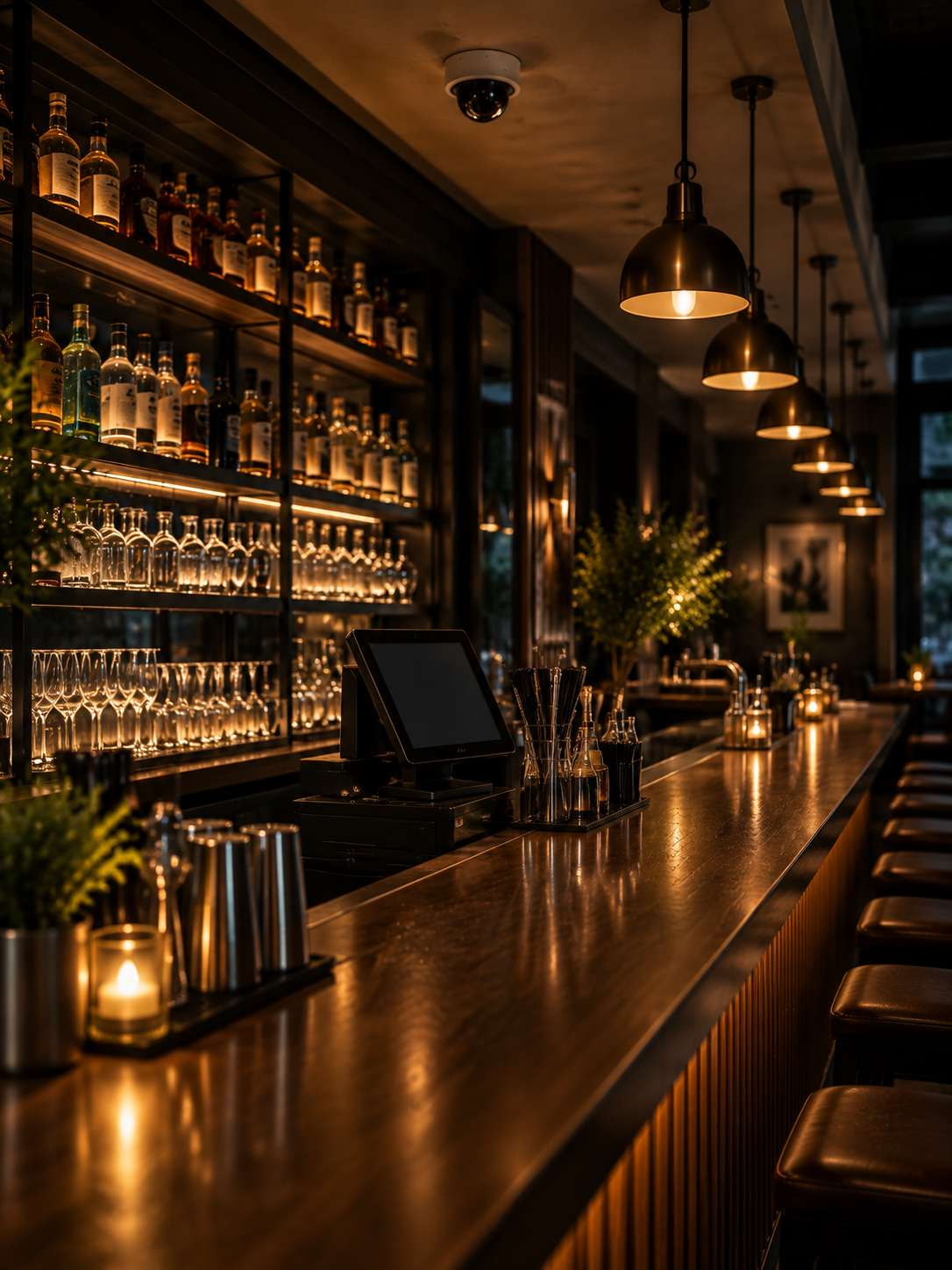
Restaurant security cameras have to work in four different filming environments inside one building. The register sits against a window, the dining room drops to half its daytime light by evening, the kitchen runs on steam and heat, and the back door is dark and unwatched. Lock and Tech USA plans and installs camera coverage for restaurants, bars, and cafes across New York City.
Where Cameras Go in a Restaurant
Coverage in a venue is planned zone by zone, because each zone answers a different question. The register answers questions about money, the dining room answers questions about incidents, the back of house answers questions about stock. A camera count means nothing until those questions are listed. The wider set of systems in a venue is covered under restaurant security systems, and how camera systems work in general under security camera installation.
Register and Bar Area
The register view is the one most often installed badly. Mounted straight above the terminal it shows the top of a head; mounted across the room it shows a person at a counter with the drawer out of frame. What is needed is an angle taking in the drawer, the counter surface, and the hands together, from close enough that the detail survives.
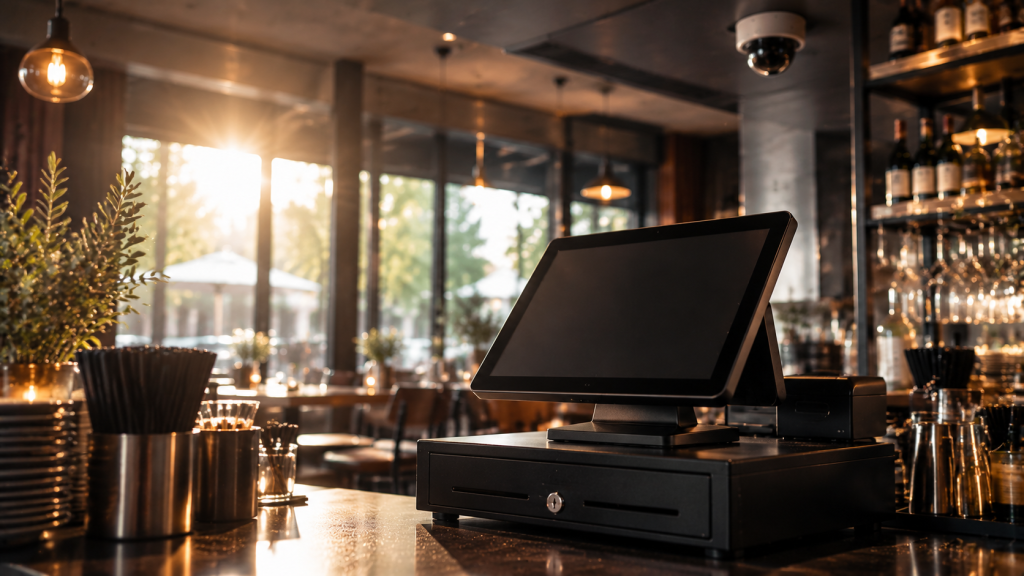
The bar has the same requirement in a harder environment: the well sits below counter height, the room dims through the evening, and glassware throws reflections. A view down the length of the bar usually works better than one across it. Wherever cash is counted at the end of the night, that spot needs its own view — it is where questions concentrate.
Dining Room and Entrance
Dining room coverage is wide rather than detailed. What matters is seeing the layout of the room and what happened in it — a fall near a step, a spill, a disagreement between tables, someone leaving without paying. Two or three wide views usually cover a room better than twenty narrow ones.
The entrance is where identification is realistic, and the light works against it: during the day the street is far brighter than the room, so a camera facing the door records silhouettes. The answer is a position slightly inside and to one side, looking at people as they turn into the room.
Kitchen, Storage, and Service Entrance
What a kitchen view is for is straightforward: the door in from the service entrance, the route to the walk-in and the dry store, and the prep area where deliveries are broken down. Conditions there are covered in the next section.
Storage coverage answers stock questions — what came in, what left, and when — which is asked after an inventory count rather than after an incident. The service door is worth its own view, since it opens early, closes late, and is used by people who do not work for you. Where that door has a call station, the two work together: the call says someone is there, the camera shows who. That side is covered under intercom systems.
What Makes Restaurant Footage Hard to Use
Light is the first problem and it changes all day. A front window that helps the room at lunch turns the register into a silhouette; the same room at eight in the evening is lit for atmosphere rather than for cameras. A single camera cannot expose for both, which is why positions are chosen against the light rather than facing it, and why the register and entrance views are decided by where the windows are.
The kitchen is its own environment. Steam condenses on lens covers and dome bubbles within minutes of service starting, and airborne grease builds a film in weeks rather than years — a camera that looked fine at handover is looking through haze by the second month unless it sits out of the direct path of the range and the dish area, and is cleaned on a schedule. At the walk-in door, warm air meeting cold produces condensation inside housings not rated for it.
Vibration finishes the list. Extraction hoods, dishwashers, and ice machines shake the structures they are fixed to, and a camera on the wrong bracket drifts off its view over a season. All of it is handled at placement: mounting on solid structure, housings appropriate to each area, and positions that can actually be reached to clean.
Camera Types by Zone
Dome cameras sit close to the ceiling in a low housing, are hard to tell which way they point, and resist being knocked or turned. That suits public rooms — dining areas, the bar, the register — where a camera should be present without being what people look at. Bullet cameras project from a bracket and aim visibly along a line; they take weather housings more easily, handle longer distances and outdoor mounting, and their visibility is often the point at a service door or over parking.
Panoramic cameras cover a whole room from one position with a very wide view, at the cost of detail toward the edges. In a small dining room or a compact bar one can replace three conventional cameras; in a long or subdivided room it leaves gaps that only become obvious when somebody needs the footage.
Recording, Retention, and Getting Footage Out
Recording runs continuously; the useful question is how far back it reaches. Retention depends on camera count, recording settings, how much movement is in frame, and how much storage was specified — those trade against each other, so depth is decided during design rather than assumed afterwards.
The right depth comes from your own operation. A stock discrepancy found at a weekly count needs a fortnight; a question that arrives weeks after a guest incident needs considerably more, and that changes the storage specification. Working it out beforehand costs nothing; discovering it later means the answer is gone. Getting a clip out matters too: at handover we set up who can view footage and how a section is exported, so a request on a Monday does not depend on one person’s memory. Where an alarm event and a camera view cover the same area, checking one against the other is quicker — that side is covered under restaurant alarm systems.
How the Installation Runs
We work weekdays from 8 to 6, which lands most of the work before service. The survey happens with someone who knows the routine — when deliveries arrive, when the kitchen fires up, when the floor is set — and the plan is staged so each area is finished and back in use before a shift starts.
Cable routes decide the schedule more than the cameras do: every position needs a run back to the recorder, and in an occupied venue that route is what takes the time. Nothing is left unfinished overnight. Pricing is labor plus material for one total figure, with a signed contract before work begins.
Where We Work
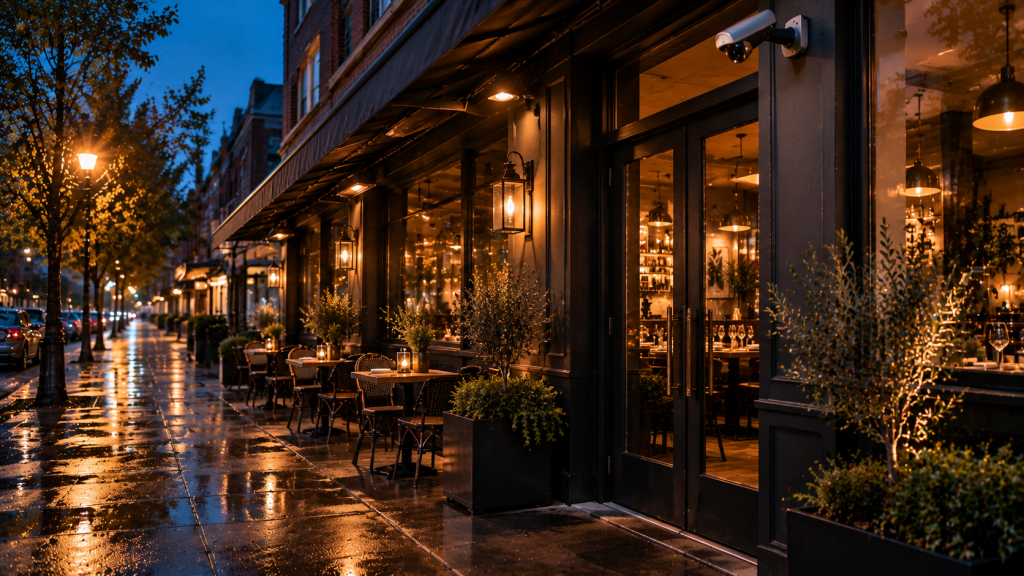
We work in full-service restaurants, bars and cocktail venues, cafes and quick service, venues with outdoor seating, and small groups with more than one location. We cover New York City and Brooklyn, along with Queens, the Bronx, Staten Island, and the surrounding areas within our service radius.
Warranty, Service Area, and Payment
Lock and Tech USA backs new installations with a 90-day mechanical warranty and a 12-month electrical warranty, covering both parts and labor. Repairs are not covered by a warranty. We provide installation within 75 miles of Midtown Manhattan and support extended zones, multiple locations, and multi-site service for clients with several properties. Phone and email support is available during business hours.
We accept cash, wire transfer, ACH, credit card, and check, as well as Zelle and Venmo, and we offer invoicing and business accounts for commercial clients. Depending on the size of the job, payment is typically a partial deposit up front with the balance collected on completion. Before starting, we require a signed contract and a tax exemption form if applicable.
Frequently Asked Questions
How many cameras does a venue need?
Will we be able to recognise faces?
How long is footage kept?
Can a camera go in the kitchen?
What our clients say