Most people have heard of fiber optic cable — but few understand what it actually is or how it differs from the standard ethernet cable running to their desk. The difference matters when you are deciding how to wire a building, upgrade a network, or expand your business infrastructure. This guide explains what a fiber optic cable is, what it is made of, how it works, where it is used, and what installation costs in NYC.
What Is a Fiber Optic Cable
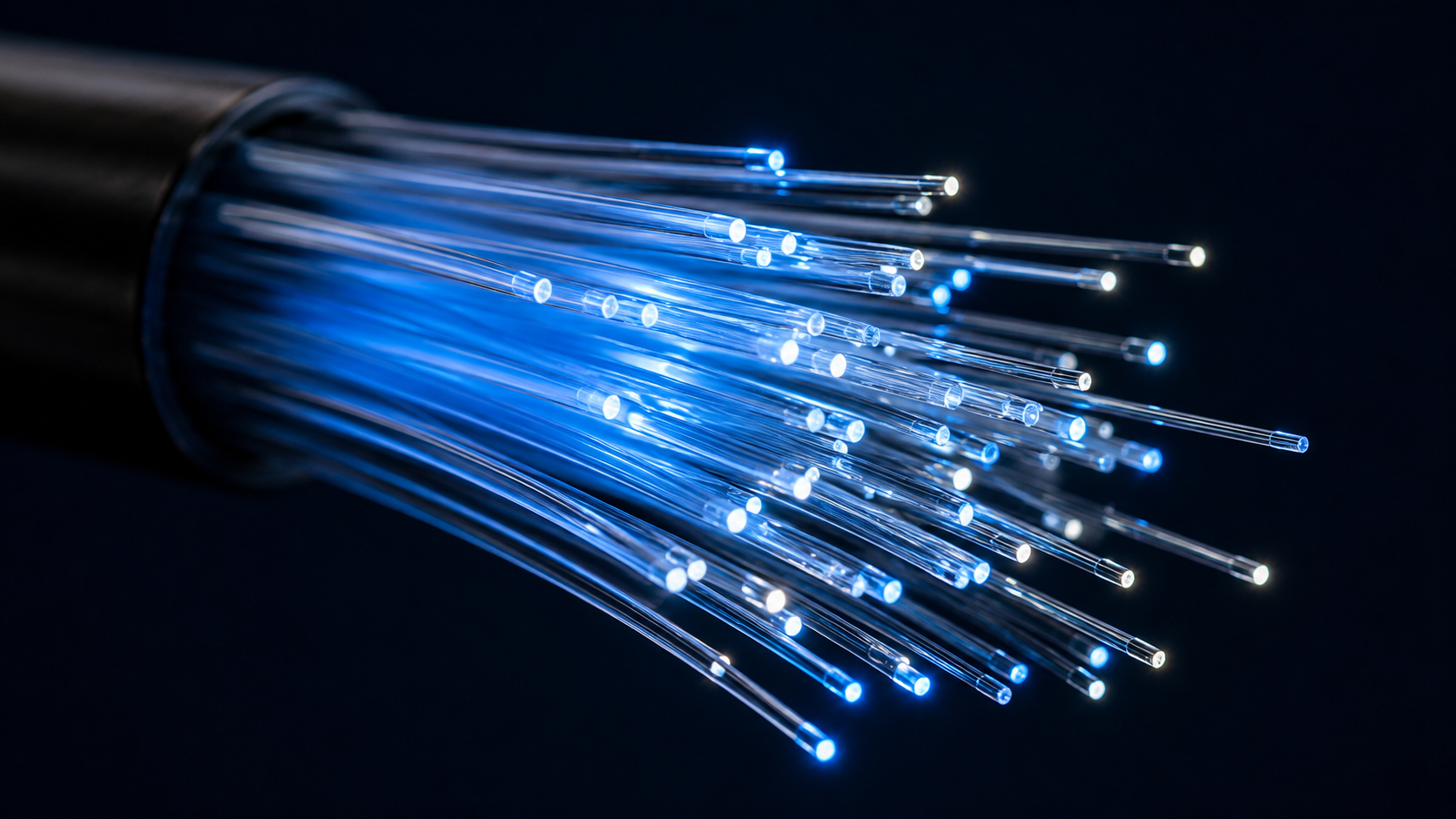
A fiber optic cable is a high-speed data transmission cable that carries information as pulses of light through thin strands of glass or plastic, rather than as electrical signals through copper wire. This fundamental difference — light instead of electricity — is what gives fiber optic cabling its performance advantages: higher bandwidth, longer transmission distances, and immunity to electromagnetic interference.
A single fiber optic cable contains one or more optical fibers, each thinner than a human hair, bundled inside a protective jacket. Each fiber acts as a waveguide — a channel that confines the light signal and directs it along the length of the cable with minimal loss. Data transmitted over a fiber optic connection arrives faster, cleaner, and over greater distances than the same data sent over copper cabling.
What Is a Fiber Optic Cable Made Of
Each fiber inside a fiber optic cable has three layers:
The core is the central channel through which light travels. It is made of ultra-pure glass or plastic — typically glass for long-distance and high-performance applications, plastic for shorter runs and lower-cost installations. The core diameter varies by fiber type: single-mode fibers have a very small core (around 9 microns) designed for long-distance transmission, while multimode fibers have a larger core (50 or 62.5 microns) suited for shorter distances within buildings.
The cladding surrounds the core and is also made of glass, but with a slightly lower refractive index. This difference in refractive index creates the principle of total internal reflection — light traveling through the core hits the cladding boundary at an angle that bounces it back into the core rather than allowing it to escape. This keeps the light signal contained and traveling forward along the fiber.
The coating is a protective layer of plastic applied over the cladding to protect the fiber from physical damage, moisture, and handling stress during installation.
Multiple fibers are then grouped together and surrounded by strength members and an outer jacket — the full assembly being the cable you see installed in a building or buried in the ground.
How Does Fiber Optic Cable Work
At the transmitting end, a light source — typically a laser or LED — converts electrical data signals into pulses of light. Each pulse represents a binary 1 or 0. These pulses travel through the fiber core at the speed of light, bouncing along the core via total internal reflection, until they reach the receiving end.
At the receiving end, a photodetector converts the light pulses back into electrical signals that the connected equipment — a switch, router, or terminal — can process.
The speed at which data can be transmitted depends on the light source, the fiber type, and the distance. Single-mode fiber with a laser light source can transmit data at speeds of 100 Gbps or more over distances of tens of kilometers with minimal signal loss. Multimode fiber with an LED source typically supports speeds of 1 to 10 Gbps over distances of up to a few hundred meters — sufficient for most in-building applications.
One key advantage of fiber over copper is that the light signal does not degrade from electromagnetic interference. Copper cables pick up interference from motors, fluorescent lighting, elevator equipment, and other cables running nearby — this degrades signal quality and limits performance in electrically noisy environments. Fiber is immune to all of this.
What Is Fiber Optic Cable Used For
Fiber optic cable is used wherever high bandwidth, long distances, or interference-free transmission is required.
Internet backbone infrastructure relies almost entirely on fiber optic cable. The cables connecting continents under the ocean, the long-haul lines connecting cities, and the regional distribution networks that carry internet traffic to neighborhoods are all fiber.
Commercial building networks use fiber optic cable for backbone connections — the high-capacity runs between floors, between buildings in a campus, and between the network equipment room and the distribution points on each floor. Individual workstations typically connect via ethernet cable from a local switch, but the connection between that switch and the core network infrastructure is often fiber.
Data centers rely heavily on fiber for the high-speed, high-density connections between servers, storage systems, and network equipment. The bandwidth demands inside a data center are extreme, and only fiber provides the combination of speed, density, and distance required.
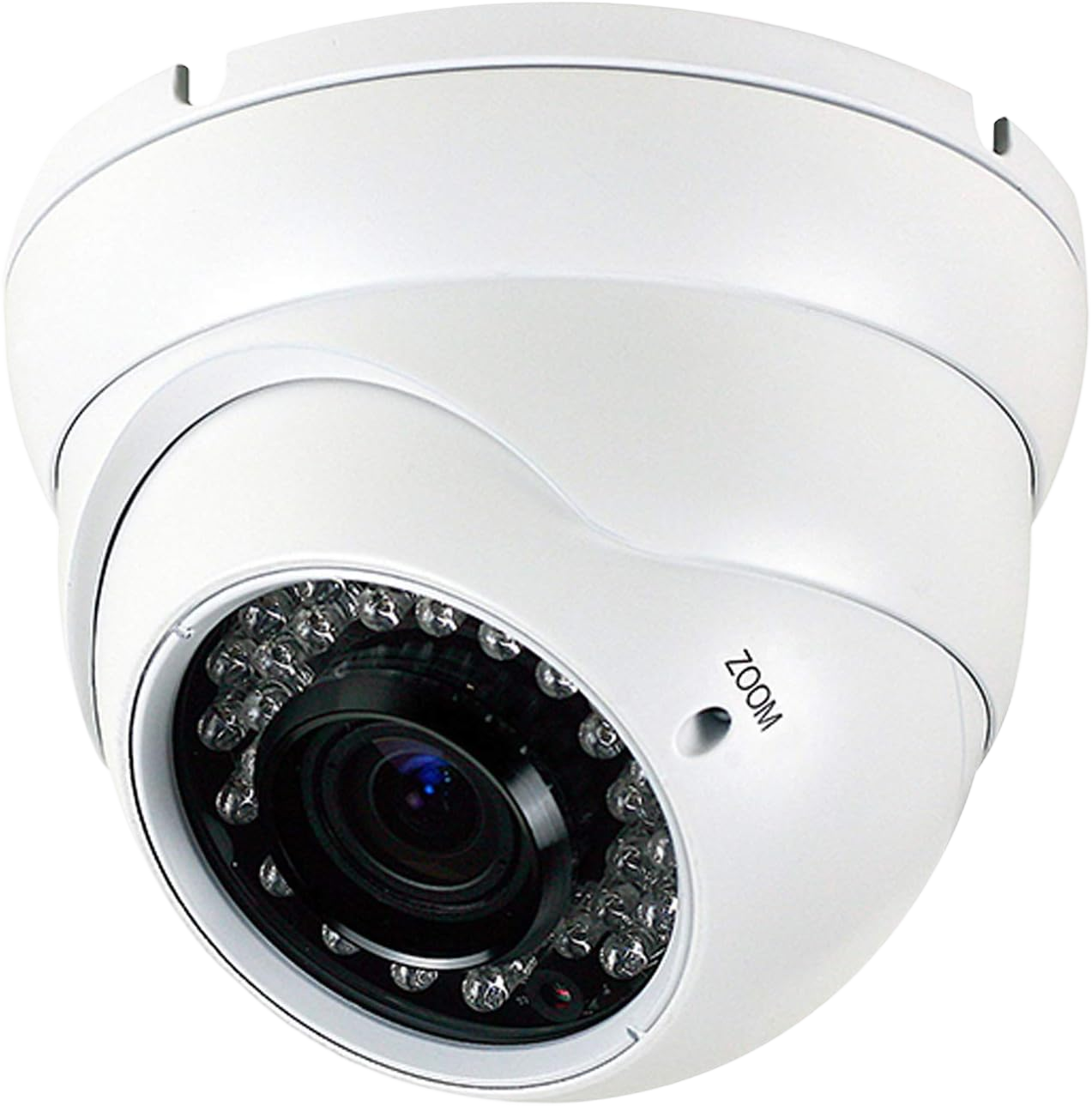
Security camera systems in large commercial properties use fiber to transmit video from cameras installed far from the recording equipment — where copper ethernet cable would exceed its 100-meter distance limit or where the cable run passes through areas with electrical interference.
Healthcare and industrial facilities use fiber in environments where electromagnetic interference from medical imaging equipment, motors, or industrial machinery would degrade copper cable performance.
Single-Mode vs Multimode Fiber
The two main types of fiber optic cable have different characteristics suited to different applications.
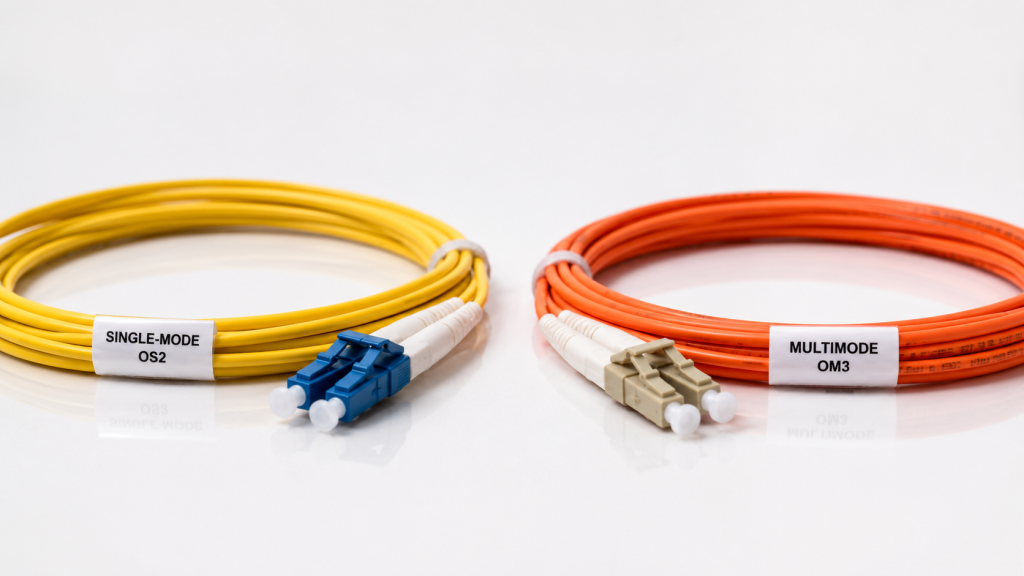
Single-mode fiber (SMF) has a very small core — around 9 microns — that allows only one mode of light to propagate. This eliminates modal dispersion (the spreading of light pulses over distance) and enables transmission over tens of kilometers at very high speeds. Single-mode fiber is the choice for long-distance runs: between buildings, between floors in tall structures, and anywhere the distance exceeds 300 to 500 meters.
Multimode fiber (MMF) has a larger core — 50 or 62.5 microns — that allows multiple modes of light to travel simultaneously. This is simpler and less expensive to terminate and connect, making it practical for in-building applications where distances are typically under 300 meters. Multimode fiber is the standard choice for within-building backbone cabling in commercial office and data center environments.
The cable jackets are color-coded for identification: single-mode cables typically use yellow jackets, while multimode cables use orange (OM1/OM2) or aqua (OM3/OM4) jackets.
Fiber Optic Cable vs Ethernet Cable
Both fiber optic and ethernet (copper) cable are used in commercial network installations, and both have appropriate use cases.
Distance is the most important differentiator. Standard Cat6 ethernet cable is limited to 100 meters between the switch and the device. Fiber optic cable supports distances of 300 meters to several kilometers depending on type — making it the only viable choice for long runs between buildings or between floors in tall structures.
Bandwidth favors fiber significantly. Cat6 supports 10 Gbps at distances up to 55 meters. Cat6A extends that to 100 meters. Fiber supports 10 Gbps, 40 Gbps, 100 Gbps, and beyond — and the fiber itself does not limit speed; only the equipment at each end does.
Cost favors copper for short runs. Cat6 cable and standard ethernet switches are less expensive than fiber cable, fiber-compatible switches, and the transceivers needed to connect them. For runs under 100 meters where 10 Gbps is sufficient, ethernet is the practical and economical choice.
Installation complexity is higher for fiber. Fiber termination requires more skill and care than copper — the connectors must be precisely aligned and the fiber end-faces must be perfectly polished. Poor fiber terminations cause signal loss and reflections that degrade performance. Professional structured cabling installers who work with fiber have the testing equipment to verify every connection meets specification.
How Is Fiber Optic Cable Installed
Fiber optic cable installation in a commercial building follows a process similar to copper cabling but with additional care requirements at the termination stage.
Planning and design. The installer maps the cable routes, identifies the locations of fiber distribution panels, and determines the fiber type and count required for each run. This includes calculating distances to confirm single-mode vs multimode selection and planning for future capacity.
Pathway preparation. Conduit, cable trays, or J-hooks are installed along the planned routes. Fiber cable has a minimum bend radius — the tightest angle it can be bent without damaging the fibers — that must be respected at every corner and transition point.
Cable pulling. Fiber cable is pulled through pathways with controlled tension. Excessive pulling force can damage the fibers internally without any visible damage to the jacket. Professional installers use tension-limited pulling equipment and follow manufacturer specifications for maximum pull force.
Termination. Each fiber end is prepared and terminated with a connector — typically LC or SC connectors in modern commercial installations. The fiber end-face is polished to optical quality using a multi-step polishing process, then inspected under a fiber microscope to confirm the end-face is clean, scratch-free, and properly centered.
Testing. Every fiber is tested with an Optical Time Domain Reflectometer (OTDR) and a light source/power meter to verify insertion loss, return loss, and the location of any faults. This documentation proves the installation meets specification and becomes the baseline for future troubleshooting.
How Much Does Fiber Optic Cable Cost
Fiber optic cable installation costs more than copper ethernet cabling, primarily due to the higher material costs and the additional skill required for termination and testing.
Cable cost: Multimode fiber cable runs $0.50 to $2.00 per foot for the cable itself. Single-mode cable is similar or slightly less. A 12-strand multimode fiber cable for a 100-meter backbone run costs $150 to $300 in materials.
Connectors and hardware: Fiber connectors, patch panels, and enclosures add $50 to $200 per termination point depending on the connector type and housing.
Labor: Fiber installation labor is $3 to $8 per foot for the cable run plus $25 to $75 per termination for the polishing and testing process. Fiber termination is slower and more exacting than copper termination.
Complete installed cost: A single fiber backbone run of 50 to 100 meters with two termination points (one at each end) typically costs $400 to $800 fully installed and tested. A multi-floor commercial installation with a fiber backbone between each floor and a centralized distribution room runs $3,000 to $15,000 depending on building size and fiber count.
For comparison: A Cat6 ethernet drop from a switch to a workstation — including cable, wall plate, patch panel connection, and testing — runs $125 to $200 installed. The same distance as a fiber run costs more, but for distances over 100 meters or applications requiring more than 10 Gbps, fiber is the only option.
When Does a Business Need Fiber Optic Cabling
Not every business needs fiber optic cabling throughout their network. The situations where fiber is the appropriate choice:
When cable runs exceed 100 meters between network equipment and end points. In large floor plates, multi-floor buildings, or campus environments, copper ethernet’s distance limit makes fiber the only viable backbone option.
When the building has high electromagnetic interference. Manufacturing facilities, buildings with large HVAC equipment, medical facilities with imaging equipment, and buildings with large elevator motors all benefit from fiber’s immunity to interference.
When future bandwidth requirements are uncertain but growth is expected. Fiber cable itself supports 100 Gbps and beyond — upgrading to higher speeds requires only replacing the switches and transceivers at each end, not pulling new cable. This makes fiber a long-term investment that does not need to be replaced as bandwidth demands grow.
When security camera runs extend beyond 100 meters from the recording equipment. Large warehouses, parking structures, and multi-building campuses with security cameras often require fiber for the longer runs.
Frequently Asked Questions
What is the difference between fiber optic and regular cable?
What is fiber optic cable used for in a commercial building?
How much does fiber optic cable installation cost?
Can fiber optic cable be repaired if damaged?
Does my office need fiber optic cabling?
What is the lifespan of fiber optic cable?
Fiber Optic Cabling Installation in NYC
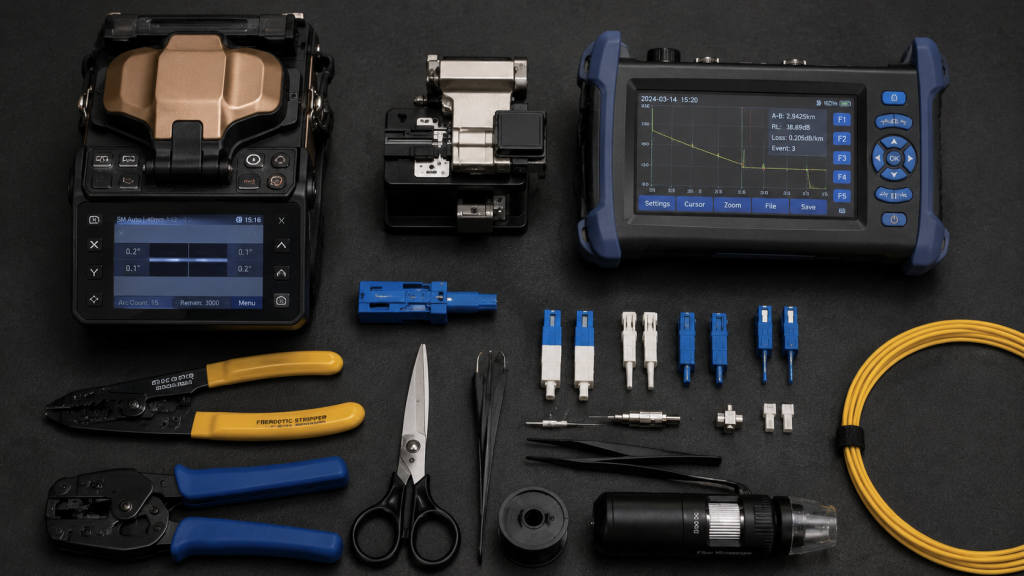
Lock and Tech designs and installs fiber optic cabling for commercial properties throughout New York City and New Jersey. We handle single-mode and multimode fiber installations for building backbones, inter-floor runs, campus connections, and security camera infrastructure — with full OTDR testing and documentation on every installation.
Our structured cabling team designs fiber installations alongside ethernet cabling infrastructure so both systems are planned and installed as a cohesive network rather than separate afterthoughts.
Contact Lock and Tech to schedule a site assessment and get a quote for fiber optic cabling installation at your NYC property.