
- Home
- Telecommunications Services
- Ethernet Cabling
Ethernet Cabling in New York City



Tested, Labeled, Documented
Since 1989, we’ve been securing homes and businesses across NYC and New Jersey with professional security solutions you can trust. Our licensed technicians provide 24/7 emergency service, using only the latest technology and backed by comprehensive warranties on all installations.


Ethernet Cabling for Commercial Properties
- Offices and corporate workspaces. Workstation drops and access point positions on one plan, terminating at one rack.
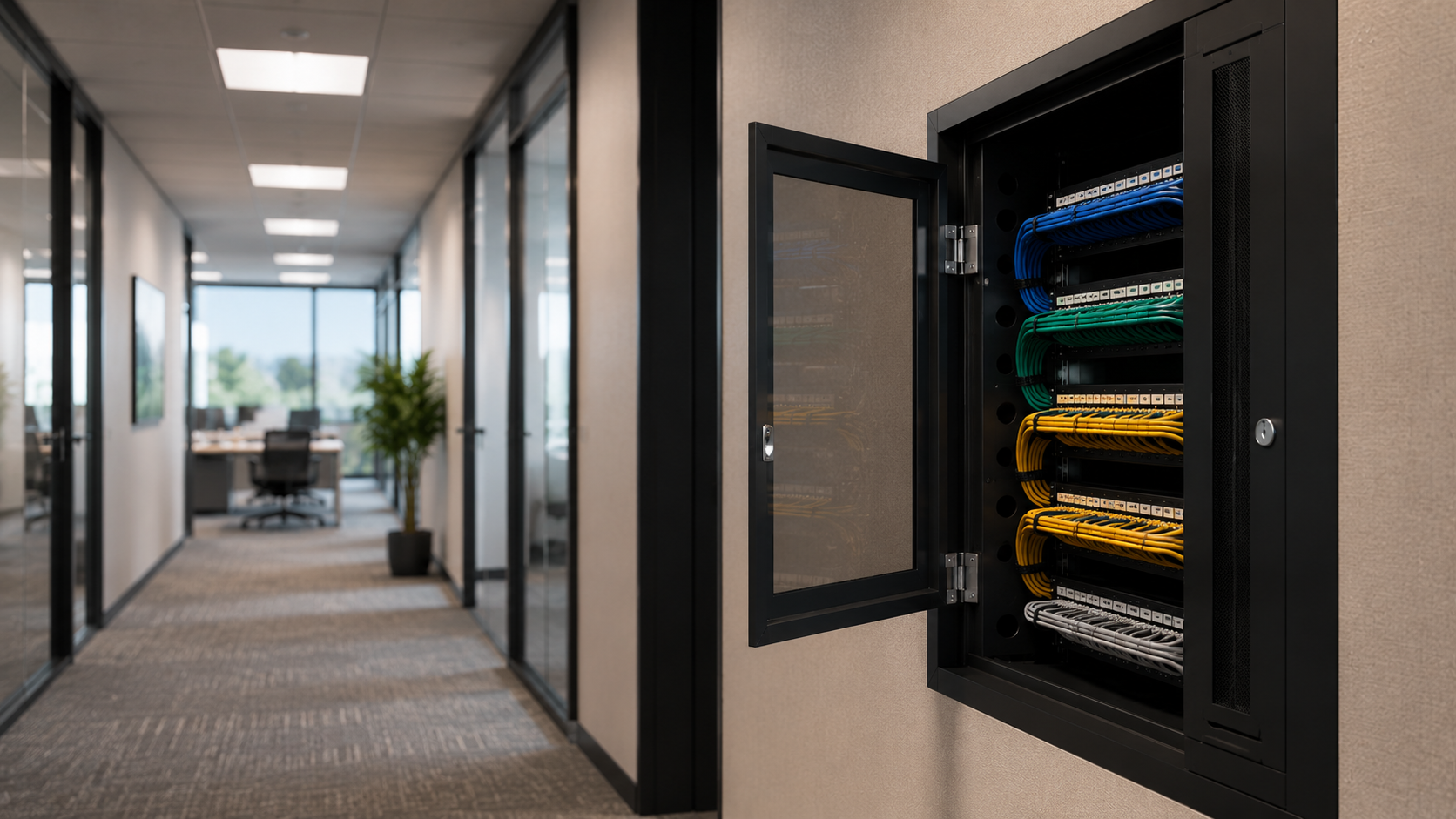
- Server rooms and network closets. Patch panel terminations documented port by port.
- Retail and point-of-sale environments. Registers, back-of-house, and display positions with routes planned around the fit-out.
- Warehouses and distribution facilities. Long runs, conduit where the environment demands it, and shielded cable where the floor justifies it.
- Healthcare and professional offices. Treatment rooms, front desk, and equipment positions placed with the room layout.
- Educational and institutional buildings. Classroom and lab positions with distribution on each floor.
- Multi-tenant and multi-floor buildings. Riser runs between floors and a distribution point on each one.
Ethernet cabling is the copper that runs from each position in a building back to the rack — the drop at a desk, the run to an access point, the line to a camera or a register. Lock and Tech USA installs it for offices, retail spaces, warehouses, and professional practices across New York City, on weekdays between 8 and 6.
Ethernet Cabling Installation
An ethernet cabling installation is three decisions repeated at every position: what cable goes in, how it gets there, and how it is terminated at both ends. The first is a specification question, the second is a building question, and the third is where installations quietly go wrong — a run that tests badly almost always fails at the connector rather than along its length.
Ethernet is one part of a larger system that also carries voice, wireless, and equipment lines on shared pathways into one rack, designed together under one label scheme. That wider discipline is covered under structured cabling, and the voice and phone side of the same infrastructure under data and VoIP cabling.
What We Install
- Horizontal ethernet runs to workstations and equipment positions
- Shielded and unshielded twisted pair, selected for the environment
- Plenum-rated cable for air-handling spaces
- Patch panel terminations, wall jacks, and keystones
- Runs through walls, ceilings, and conduit
- Access point and camera positions
- Cable management, bundling, and labeling at both ends
- Testing with results and floor plan handed over
- Repair and re-termination of existing runs
Ethernet Cabling Standards and Categories
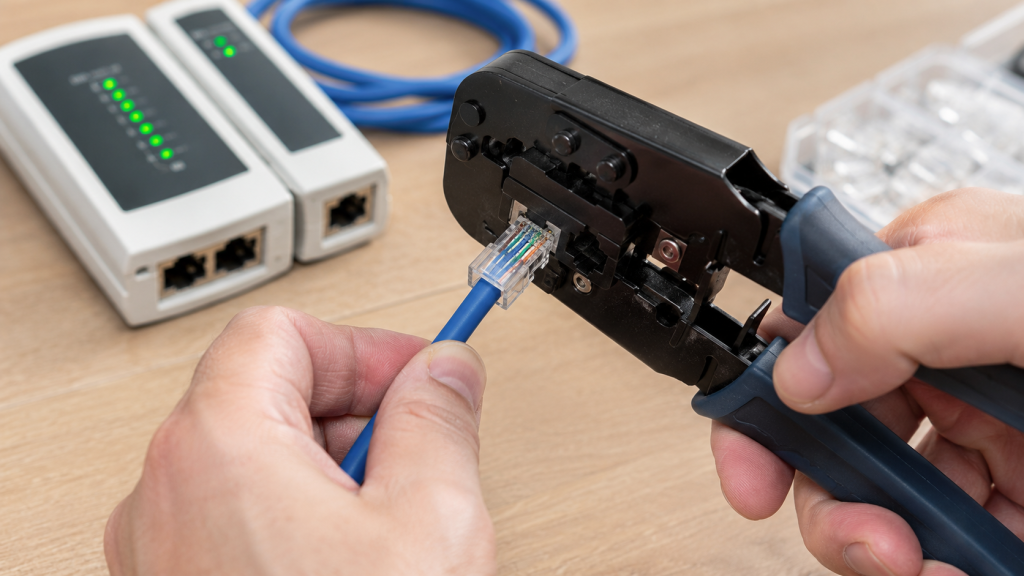
Categories differ in how tightly the pairs are twisted, how much frequency headroom they leave, and whether the pairs are separated or shielded inside the jacket. That is what the numbers describe — the cable’s own characteristics, measured in a lab, not a promise about how a particular office will perform once furniture, switches, and forty devices are in it.
Cat5e is the older workhorse: adequate for most desk positions, cheapest per foot, quickest to terminate. Cat6 adds a physical separator between pairs and more headroom, which mainly buys tolerance — the same run behaves better when it has to pass near lighting, motors, or a power run it cannot avoid crossing. Cat6a adds thicker insulation and tighter construction again, holding its characteristics over longer distances and in denser bundles, at the cost of a stiffer cable that is harder to route through tight pathways and takes longer to terminate.
Shielding is a separate axis from category. Shielded twisted pair earns its place in industrial spaces, plant rooms, and anywhere long runs travel parallel to power, and it does nothing at all unless it is properly grounded at the panel — badly grounded shielded cable performs worse than unshielded. Plenum-rated cable is a jacket question rather than a performance one: in spaces used to move air between floors, the cable’s jacket has to behave a particular way in a fire, and that changes the material, the price, and sometimes the bend radius you can work with.
Ethernet cabling standards also fix the things that have nothing to do with which box the cable came out of: the maximum length of a segment, how much jacket can be stripped back, how much untwisting is acceptable at the connector, how tightly a bundle may be cinched, and how far cable must stay from power. Those rules are why an installation done properly still works after the switches are replaced five years later, and why one done around them fails intermittently in ways nobody can trace back to the day it was pulled.
Ethernet Cabling Design
Ethernet cabling design starts from the floor plan and the position count and works backwards to the rack. Route length is the first constraint, because a segment has a limit and a run that has to detour around a stairwell can consume it faster than the plan suggests. Where distances or the electrical environment rule copper out, the answer moves to fiber or to a second distribution point.
Position count comes next: not just how many desks exist today, but where the ones added in two years will sit. Spare capacity in a pathway costs almost nothing while it is open and a great deal afterwards. Access points get positions of their own, chosen from how the walls in that building actually behave rather than from a grid — that side is covered under wireless network installation.
Where We Install
We work in offices and corporate workspaces, server rooms and network closets, retail stores and point-of-sale environments, warehouses and distribution facilities, healthcare and professional offices, educational and institutional buildings, and multi-tenant and multi-floor commercial properties. We cover New York City and Brooklyn, along with Queens, the Bronx, Staten Island, and the surrounding areas within our service radius. Businesses with several addresses can run all of them through one contractor with a consistent label scheme across sites.
Our Process and Pricing
Work starts with a site survey. Ethernet cabling installers quote from position count and route length, so we count drops, walk the pathways, and look at what is already installed before putting a number on it. That produces the layout: routes, termination points, and where the rack sits.
Installation runs pathways first, then the pull in bundles with slack left at both ends, then terminations at the jack and the panel. Every line is labeled at both ends to one scheme. In an occupied office the existing runs stay live while the new ones go in, and each position is switched over individually.
Testing closes the job. Each run is checked with a cable tester for continuity, correct pairing, length, attenuation, and crosstalk, and you receive the results as a document alongside a floor plan showing what runs where. Ethernet cabling services are priced as labor plus material for one total figure, itemized against the position count. On larger jobs payment is a partial deposit up front with the balance on completion, and a signed contract goes in place before work begins. Installation carries a 90-day warranty on the mechanical side and 12 months on electronics; repair and re-termination visits are not covered by that warranty.
Warranty, Service Area, and Payment
Lock and Tech USA backs new installations with a 90-day mechanical warranty and a 12-month electrical warranty, covering both parts and labor. Repairs are not covered by a warranty. We provide installation within 75 miles of Midtown Manhattan and support extended zones, multiple locations, and multi-site service for clients with several properties. Phone and email support is available during business hours.
We accept cash, wire transfer, ACH, credit card, and check, as well as Zelle and Venmo, and we offer invoicing and business accounts for commercial clients. Depending on the size of the job, payment is typically a partial deposit up front with the balance collected on completion. Before starting, we require a signed contract and a tax exemption form if applicable.
Frequently Asked Questions
What testing is done before handover?
Which category should we install?
When is shielded cable worth it?
Do we need plenum-rated cable?
Can you cable an office while people are working in it?
What does ethernet cabling installation cost?
What our clients say


