

- Home
- Warehouse Security Systems
- Warehouse Alarm Systems
Warehouse Alarm Systems in New York City



Tuned to the Building
Since 1989, we’ve been securing homes and businesses across NYC and New Jersey with professional security solutions you can trust. Our licensed technicians provide 24/7 emergency service, using only the latest technology and backed by comprehensive warranties on all installations.



Alarm Coverage for Warehouse Facilities
- Loading doors and dock gates. The openings that matter most, and the ones that spend the working day unsecured.
- Personnel doors and fire exits. Doors used a few times a week, and the ones that should never open from outside at all.
- Perimeter and yard gates. The boundary crossed before anything reaches the building.
- Aisles and open floor. Interior detection placed around racking rather than pointed across an open span.
- High-value and bonded storage. Cages and separate rooms armed independently of the rest of the floor.
- Dispatch and receiving areas. Zones that stay live while the rest of the building is closed.
- Offices inside the warehouse. A separate zone with its own schedule, since office hours rarely match floor hours.
A warehouse alarm system has a different job from an office one. The building is large, mostly empty of people, full of moving air and working machinery, and parts of it stay active while the rest is closed. Lock and Tech USA designs and installs alarm systems for warehouses and distribution centers across New York City, built around those conditions rather than adapted to them.
What Gets Alarmed in a Warehouse
The first question is where the protected boundary actually runs. In an office it runs around the office. In a warehouse it runs around several things at once — the yard, the building envelope, and specific areas inside it — and each of those needs to be armed and disarmed independently, because they are never all empty at the same time. That is why the design starts with zones rather than with sensors. The wider picture of what a warehouse system covers is under warehouse security systems, and how alarm systems work in general is covered under alarm systems.
Perimeter, Doors, and Loading Gates
Dock doors are the hardest part. They are large, they stand open through the working day, and they close on schedules that vary with the shift, so contacts on them have to tolerate movement and misalignment that a personnel door never sees. Sectional doors in particular settle over time, and a contact set too tightly during installation becomes a nightly fault six months later.
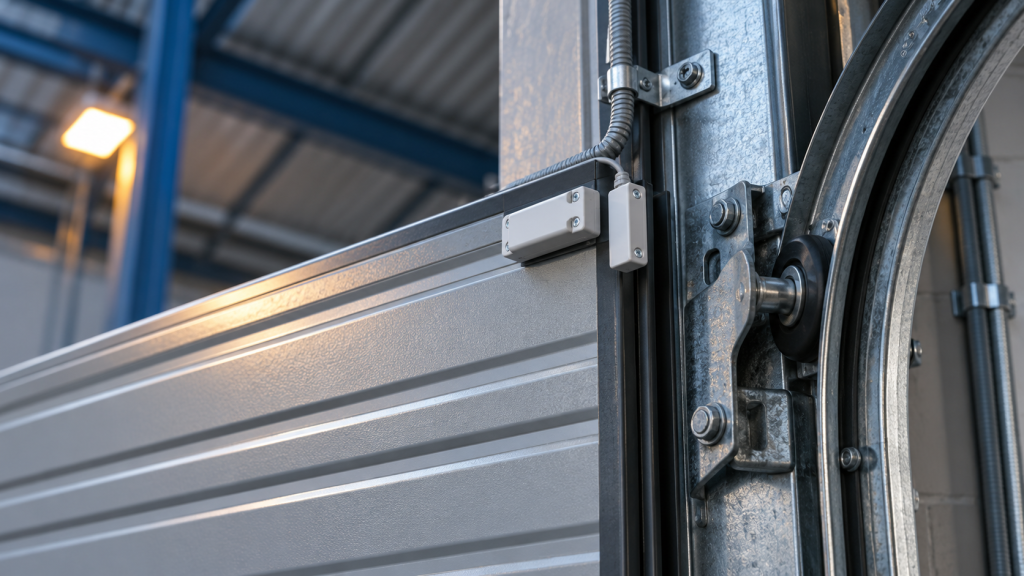
Personnel doors and fire exits are the opposite problem: they are used rarely, and an exit that should never open from outside is worth monitoring precisely because nobody would notice it opening. Yard gates form the outer boundary, and they usually pair with a way for a driver to make contact from the wrong side of them — that side is covered under intercom systems.
Motion Inside Large Spaces
Interior detection in a warehouse fails for a specific reason: sensors are designed around rooms, and a warehouse is not a room. Racking blocks the view, so a detector covering an open span at commissioning covers three aisles once stock arrives. High ceilings put the sensor far from anything worth detecting, and the same distance that reduces sensitivity also widens the area where a bird, a draft, or a hanging banner registers as movement.
What works is detection placed for routes rather than for area — aisle ends, cross-aisles, the approach to high-value storage, the path from a door to the floor. Fewer devices positioned deliberately produce a system people trust more than a grid of sensors that fires twice a week.
Panic Buttons for Staff
Fixed buttons at the dock, in receiving, and in dispatch give staff a way to raise an event without a phone in hand — useful on a floor where phones stay in lockers and radios get left on chargers. Placement matters more than quantity: a button is only useful where someone is standing when they need it.
What follows a press is set on the site rather than assumed. The system creates an event and sends notification to the contacts you nominate; who responds, and how, is agreed with you during commissioning and written into the handover documentation.
False Alarms and Why They Happen
False activations are the reason alarm systems get switched off, and in a warehouse they have causes an office never produces. Temperature and airflow move things overnight — heaters cycling, extraction running, doors sealed at one end of a large volume and not the other. Machinery left on vibrates through structure into contacts. Shrink wrap, banners, and hanging signage move in a draft that nobody notices at midday. Stock stacked near a detector changes what that detector sees without anyone touching the system.
Then there is the human half, which is the larger one. Someone arms the building while a picker is still finishing at the far end. A cleaner arrives on a schedule the system does not know about. A driver makes an out-of-hours delivery to a dock that is armed. None of that is an equipment fault, and no amount of better hardware fixes it.
The answer to both is zoning and setting, not sensitivity turned down until the system detects nothing. Zones drawn around how the site actually operates let the parts in use stay live while the rest is armed. Detectors positioned for routes rather than spans see less of what moves harmlessly. And settings are confirmed after a few weeks of real operation rather than at commissioning, because the building in December behaves differently from the building in September.
Arming, Zones, and Night Shifts
Most warehouses never reach a state where the whole building is empty, which is exactly why whole-building arming fails. Partial arming solves it: dispatch stays live for a night crew while storage and the offices are armed, or the yard is armed while receiving still works. Each zone has its own schedule, and the schedules follow the shift pattern rather than the clock.
Who can arm and disarm which zone is part of the design, not an afterthought. A shift supervisor needs the zones they work in; a cleaner needs one door and one area; an agency driver needs none. Every action is recorded — which zone, which credential, what time — so a question the following week has an answer rather than a guess. That log is also the fastest way to identify why a zone keeps failing to arm, which is usually a person and a schedule rather than a sensor.
When an event occurs, the system raises it and sends notification to the contacts on the list. The list itself is worth attention: who is called first, who is called if that person does not answer, and what each of them is expected to do. Recorded coverage of the same zones makes those decisions much easier, since the person receiving a notification can see what caused it — that side is covered under warehouse security cameras.
How the Installation Runs
It starts with a walk of the site during working hours. We look at how the shifts overlap, which doors are actually used, where racking stands and where it will stand after the next reconfiguration, and where power and network already reach. That produces the zone plan, and the zone plan produces the device list.
Installation is staged so the warehouse keeps working: cabling in sections at hours agreed against the shift pattern, and each zone brought into service as it is finished rather than everything switching on at the end. At handover we walk the system with the people who will actually arm it, including the night shift, and leave the zone plan and contact list documented. Pricing is labor plus material for one total figure, with a signed contract before work begins.
Where We Work

We work in distribution centers, storage and fulfillment warehouses, cold storage, cross-dock operations, mixed warehouse and office sites, multi-tenant industrial buildings, and yards with outdoor storage. We cover New York City and Brooklyn, along with Queens, the Bronx, Staten Island, and the surrounding areas within our service radius.
Warranty, Service Area, and Payment
Lock and Tech USA backs new installations with a 90-day mechanical warranty and a 12-month electrical warranty, covering both parts and labor. Repairs are not covered by a warranty. We provide installation within 75 miles of Midtown Manhattan and support extended zones, multiple locations, and multi-site service for clients with several properties. Phone and email support is available during business hours.
We accept cash, wire transfer, ACH, credit card, and check, as well as Zelle and Venmo, and we offer invoicing and business accounts for commercial clients. Depending on the size of the job, payment is typically a partial deposit up front with the balance collected on completion. Before starting, we require a signed contract and a tax exemption form if applicable.
Frequently Asked Questions
Our alarm keeps going off for nothing. What causes that?
Can part of the building stay live while the rest is armed?
What happens when the alarm triggers at night?
Can you work on the alarm we already have?
What our clients say