- Home
- Warehouse Security Systems
- Warehouse Security Cameras
Warehouse Security Cameras in New York City



Placed for What It Must See
Since 1989, we’ve been securing homes and businesses across NYC and New Jersey with professional security solutions you can trust. Our licensed technicians provide 24/7 emergency service, using only the latest technology and backed by comprehensive warranties on all installations.


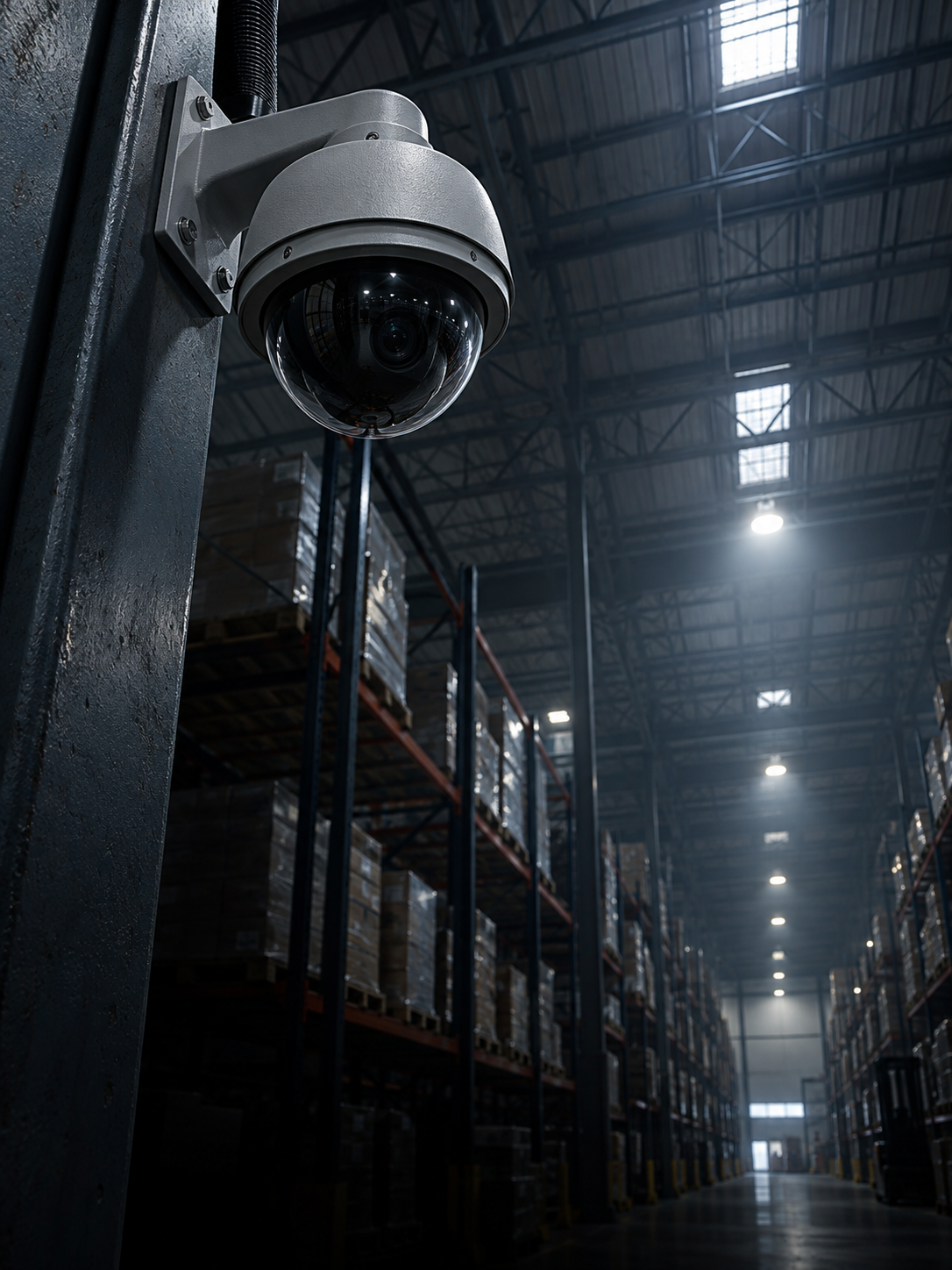
Camera Coverage for Warehouse Facilities
- Loading docks and receiving. The most valuable view in the building, and the hardest one to light correctly.
- Dispatch and outbound staging. Where goods are last accounted for before they leave the site.
- Aisles and pick faces. Coverage planned per aisle, since racking turns a wide view into a narrow one.
- High-value and bonded storage. Cages and separate rooms with their own views and their own retention.
- Perimeter and yard. Approach roads, gates, and parking, where movement happens before anything reaches the building.
- Personnel doors and fire exits. Openings that see little traffic and matter most when they do.
- Equipment and charging areas. Forklift bays and battery rooms, where damage and downtime originate.
Warehouse security cameras are usually specified by count and installed by coverage, and that is why so many warehouses have plenty of cameras and no usable footage. The useful question is which views answer a question asked three weeks after the fact. Lock and Tech USA plans and installs camera coverage for warehouses and distribution centers across New York City.
Where Cameras Go in a Warehouse
Coverage in a warehouse is counted by zone, not by camera. A number of cameras per square foot means nothing in a building where racking blocks most sightlines and where the questions asked afterwards are always about specific places: this dock, that pick face, the gate at this hour. The design starts by listing the questions the system will need to answer, then works out how few views can answer them. The wider system these views belong to is under warehouse security systems, and how camera systems work in general is covered under security camera installation.
Loading Docks and Receiving
The dock is the most valuable view in the building and the hardest one to get right. Everything of value crosses it, and it is the one place where an open door puts bright daylight directly behind whatever you are trying to see. A camera facing an open dock door records a silhouette: the shape of a person and a pallet, no face, no label, no detail.
The fix is geometry rather than equipment. Cameras are angled across the opening rather than into it, positioned so the light falls on the subject rather than behind them, and paired — one on the apron looking in, one inside looking out. Receiving needs its own view of the point where goods are counted, which is a different position from the one covering the door. Where the dock also has controlled entry, that side is covered under access control installation.
Aisles and Racking
Racking turns a wide view into a narrow one. A camera that covered a whole floor at commissioning covers three aisles once stock arrives, and covers something different again after the next reconfiguration. Coverage is therefore planned per aisle or per group of aisles, with the camera positioned down the length rather than across it.
Mounting height is the other decision, and higher is not better. From high on the structure a camera sees a wide area and identifies almost nothing in it — movement, yes; who it is, no. Lower positions on the racking or on columns give recognisable detail over a smaller area. Most warehouses need both: a few high views for overall movement, and lower ones at the places where identification actually matters.
Perimeter and Yard
Outside, the useful views are the ones that record vehicles: the gate, the approach road, the yard, and where trailers stand. A plate is only readable when a camera is positioned specifically for it — angled along the direction of travel, at a height matched to a cab, at a point where vehicles slow down. A general yard view will not produce it, which is worth knowing before an incident rather than after.
What Makes Warehouse Footage Hard to Use
Warehouses are among the harder environments to record in, and most of the reasons have nothing to do with the cameras. Light is the biggest one: a building lit by high bay fixtures, daylight through roof panels, and open dock doors has three light sources of different colour and intensity, changing through the day. A camera exposes for one of them, and the others become either black or blown out.
Night in an unheated building brings its own problems. Cold air and temperature swings put condensation on housings, infrared illumination reflects off shrink wrap and metal racking, and a view that was clear in daylight becomes a wall of glare in the dark. Dust settles on lenses faster than anyone expects in a building with constant forklift traffic, and a camera nobody has cleaned in a year is effectively looking through fog.
Vibration is the quiet one. Cameras mounted on racking move when a forklift hits the frame; cameras near dock doors shake every time one closes. The footage stays usable but nothing in it is sharp at the moment it matters. All of it is addressed at placement — mounting on structure rather than on racking, positions chosen against the light rather than facing it, and housings sited where they can actually be reached for cleaning.
Recording, Retention, and Getting Footage Out
Recording runs continuously; the question is how far back it goes. Retention depth is a function of how many cameras there are, what resolution they record at, how much movement is in frame, and how much storage was specified. Those trade against each other, which is why a number of days is decided during design rather than quoted in advance — and why it is worth deciding deliberately.
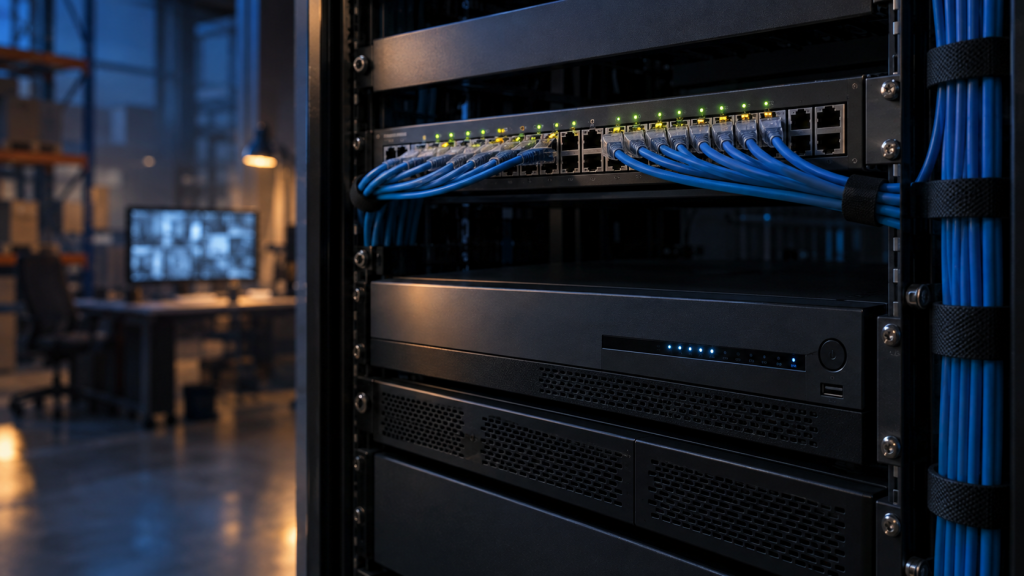
The right number comes from your own operation. A shortfall found at a weekly cycle count needs a fortnight; one found at a quarterly stocktake needs a quarter, and that changes the storage specification substantially. Working that out before the system is built costs nothing; discovering it afterwards means either rebuilding or accepting that the answer is gone.
Getting footage out matters as much as having it. At handover we set up who can view what, how a clip is exported, and where it goes — so an incident on a Friday does not become a Monday problem for the one person who knows the system. Cameras covering the same zones as alarm detection make events much easier to resolve, since a notification can be checked against what was in frame; that side is covered under warehouse alarm systems.
How the Installation Runs
It starts with a walk of the site during working hours, listing the views the system needs to deliver. We check where the light comes from at different times, where racking stands and where it will stand after the next reconfiguration, and where cable and power already reach — each camera position needs a run back to the recording location, and in a large building that run is often what decides whether a position is practical.
Installation is staged by zone so the warehouse keeps working, with cabling and work at height scheduled against your shift pattern. Each zone goes live as it is finished. At handover we walk the views with your team, confirm each one answers the question it was placed for, and leave the layout documented. Pricing is labor plus material for one total figure, with a signed contract before work begins.
Where We Work
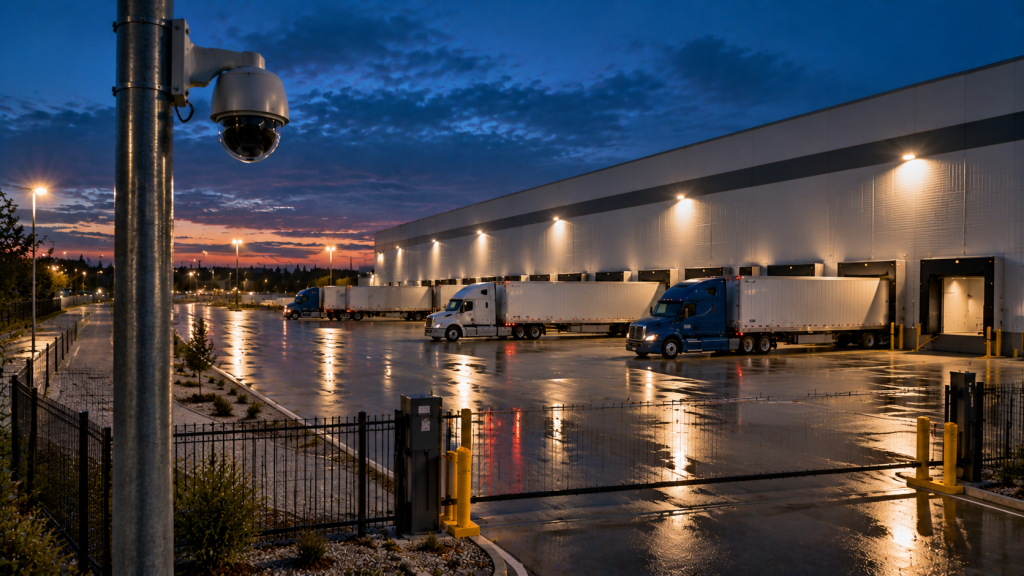
We work in distribution centers, storage and fulfillment warehouses, cold storage, cross-dock operations, mixed warehouse and office sites, multi-tenant industrial buildings, and yards with outdoor storage. Sites with a gate that needs answering out of hours usually pair camera coverage with intercom systems. We cover New York City and Brooklyn, along with Queens, the Bronx, Staten Island, and the surrounding areas within our service radius.
Warranty, Service Area, and Payment
Lock and Tech USA backs new installations with a 90-day mechanical warranty and a 12-month electrical warranty, covering both parts and labor. Repairs are not covered by a warranty. We provide installation within 75 miles of Midtown Manhattan and support extended zones, multiple locations, and multi-site service for clients with several properties. Phone and email support is available during business hours.
We accept cash, wire transfer, ACH, credit card, and check, as well as Zelle and Venmo, and we offer invoicing and business accounts for commercial clients. Depending on the size of the job, payment is typically a partial deposit up front with the balance collected on completion. Before starting, we require a signed contract and a tax exemption form if applicable.
Frequently Asked Questions
How many cameras does a warehouse need?
Will we be able to identify faces and plates?
How long is footage kept?
Do the cameras work at night?
What our clients say