
- Home
- Audio and Video Services
- Office Sound Masking
Office Sound Masking Systems in New York City



Tuned Floor by Floor
Since 1989, we’ve been securing homes and businesses across NYC and New Jersey with professional security solutions you can trust. Our licensed technicians provide 24/7 emergency service, using only the latest technology and backed by comprehensive warranties on all installations.


Sound Masking for Offices and Workplaces
- Open-plan floors. Dense desking with no barriers, where a conversation three rows away arrives fully intelligible.
- Private offices. A closed door stops far less speech than people assume, and the corridor outside carries it.
- Meeting rooms. Masking outside the door, so what is said inside does not reach the desks next to it.
- Small offices and suites. A handful of positions in one room, on a system sized for the space rather than scaled down from a floor plan.
- HR, legal, and finance areas. Teams whose ordinary working conversation should not be followed from the next desk.
- Call and support floors. Every seat on a call at once, each one competing with the rest.
- Reception and waiting areas. Conversation at the desk kept from reaching people sitting a few feet away.
Sound masking for office floors adds a low, even background sound that keeps nearby conversation from being followed word for word. Nothing gets quieter and nothing is blocked — speech simply stops carrying its detail across the room. Lock and Tech USA designs, installs, and tunes office sound masking systems for workplaces across New York City.
Sound Masking for Open-Plan Offices
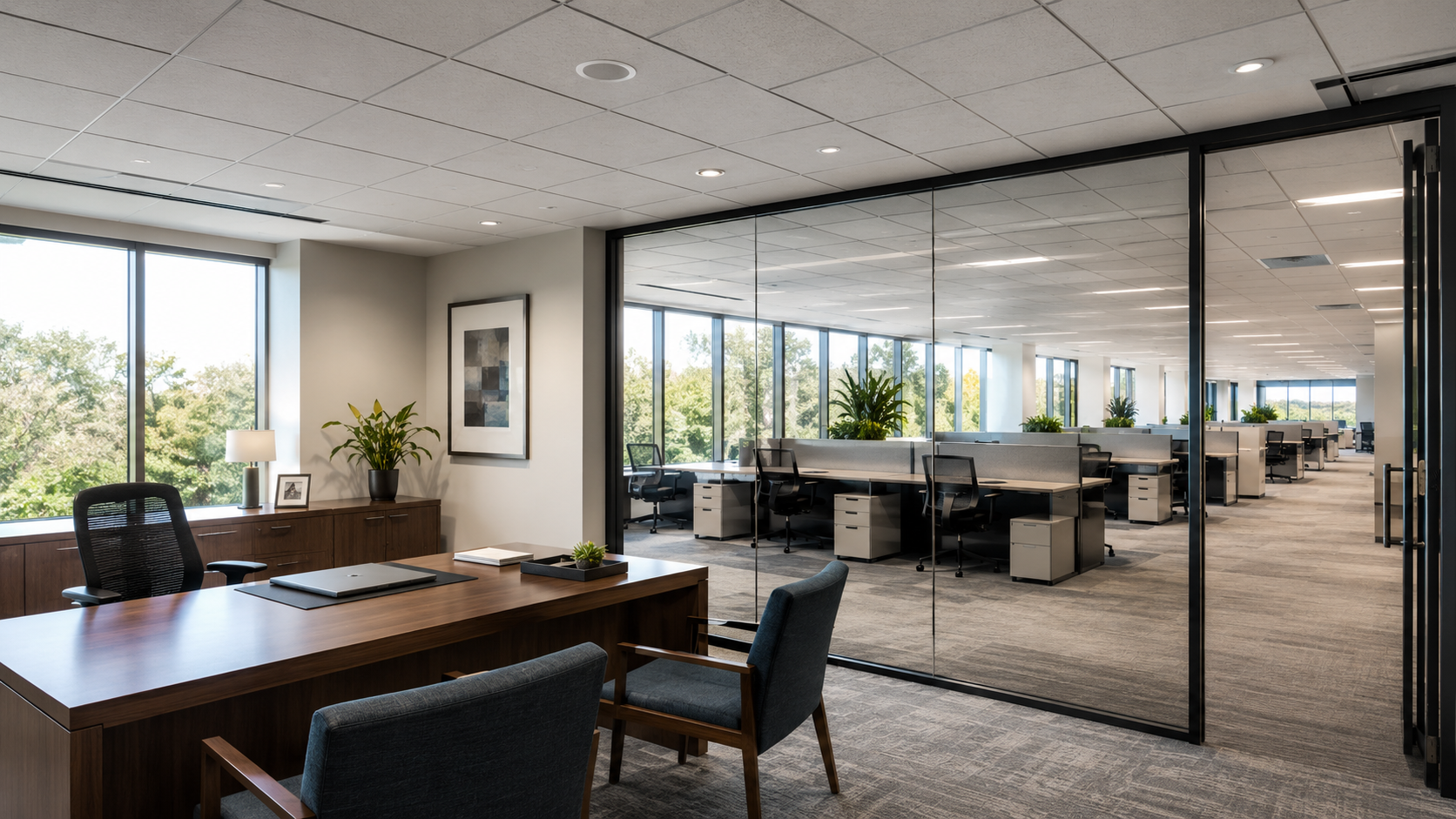
An open floor removes the walls that used to do this work. Desks sit closer, ceilings are often hard, and there is nothing between one conversation and the person trying to write an email six feet away. Masking replaces what the walls used to provide, without rebuilding anything and without asking anyone to speak more quietly.
Why Open Plans Need It
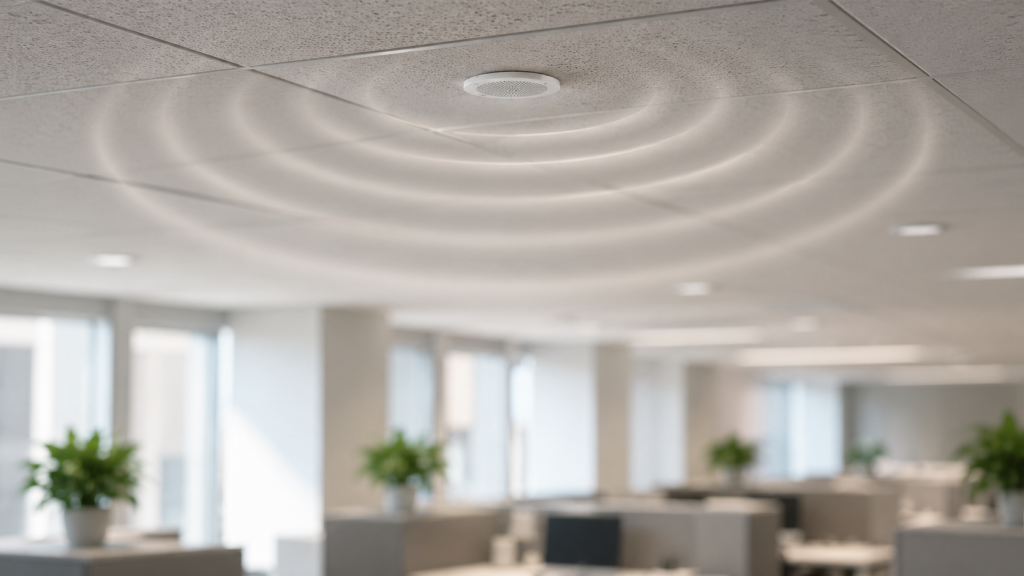
Speech interrupts because it is intelligible, not because it is loud. A conversation you can follow takes attention whether you want it to or not; the same conversation, reduced to sound without words, does not. That is the whole mechanism behind sound masking in office environments. Raising the background sound to the range speech occupies shortens the distance over which words stay intelligible — a nearby colleague is still perfectly audible, while the call two rows over becomes background. Nobody has to lower their voice, and nobody has to be moved into a box to get quiet.
Coverage and Zoning
Even coverage is what makes it work. Emitters are spaced across the ceiling from a calculation based on ceiling height and construction, so the level stays constant as someone walks the floor. A dip between emitters is heard as a gap; a hot spot is heard as a hiss. Zones then divide the floor into areas that carry their own settings, because an open bay, a row of private offices, and a reception desk rarely want the same level. On a multi-floor tenancy each floor is its own set of zones, adjusted separately and managed from one place.
Private Offices and Meeting Rooms
A closed door stops much less speech than people assume. Most interior office walls stop at the ceiling tile rather than the deck above it, which leaves the plenum as an open path from one room to the next, and doors are rarely sealed. The result is a private office where a raised voice is audible in the corridor and a meeting room where the people at the nearest desks can follow the meeting.
Masking handles this from outside rather than inside. Emitters in the corridor and in the surrounding open area raise the background where the listener is, so speech arriving from the room no longer stands out against it. The room itself usually stays untreated — masking inside a small room where people are trying to hear each other is counterproductive. Sound masking in private office areas is planned as its own zone for the same reason: those spaces need a different level from the open floor beside them, and often a different level again at night when the floor empties and the background drops.
For meeting rooms where confidentiality matters, this is combined with attention to the plenum path above the wall, which is a construction question rather than an acoustic one and worth raising with your landlord before assuming masking alone will settle it. We say so at the survey rather than after installation.
Small Offices
A small office does not need a scaled-down version of a floor plan. A suite of a few rooms, or a single open room with a handful of desks, is generally one or two zones and a short run of emitters, sized to the room rather than cut down from a larger design. A sound masking machine for small office use — a single self-contained unit — covers a very limited area and works only where one room is the whole problem. Once there is a corridor, a second room, or a reception area, separate coverage becomes the difference between a system people stop noticing and one they keep asking about.
Installation in a Working Office
Most of the work happens above the ceiling and is quiet. Emitters and cabling go in, the generator is mounted at the rack or in a closet, and zones are wired to the plan from the survey. Tiles come down and go back up section by section, so the floor stays usable, and the noisier stages are scheduled around your hours.
Timing depends on floor area and ceiling type more than on anything else: a single floor with an accessible suspended ceiling is usually a matter of days, while exposed structure or a hard ceiling takes longer because every mounting point is its own decision. Then the system is tuned — measured in each zone, adjusted for level and spectrum, with the furniture in place and people at their desks, because carpet, glass, and partitions all change what the room does with sound. We walk the floor with someone from your side so the result is agreed in the room rather than on paper, and we come back to adjust after a couple of weeks if the space needs it. Pricing is labor plus material for one total figure, with a signed contract in place before work begins.
Where We Install
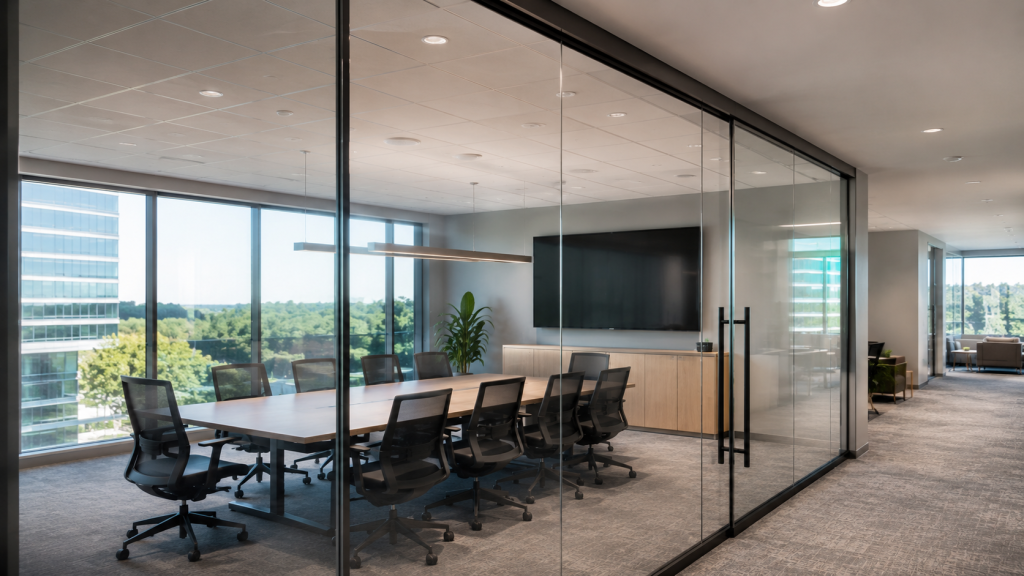
We work in open-plan floors, private offices, meeting and boardrooms, small suites, coworking spaces, call and support floors, and reception areas, in single-floor tenancies and whole-building occupancies. We cover New York City and Brooklyn, along with Queens, the Bronx, Staten Island, and the surrounding areas within our service radius. Larger sites and other property types are covered under commercial sound masking, and the technology itself under sound masking systems.
Warranty, Service Area, and Payment
Lock and Tech USA backs new installations with a 90-day mechanical warranty and a 12-month electrical warranty, covering both parts and labor. We provide installation within 75 miles of Midtown Manhattan and support extended zones, multiple locations, and multi-site service for clients with several properties. Phone and email support is available during business hours.
We accept cash, wire transfer, ACH, credit card, and check, as well as Zelle and Venmo, and we offer invoicing and business accounts for commercial clients. Depending on the size of the job, payment is typically a partial deposit up front with the balance collected on completion. Before starting, we require a signed contract and a tax exemption form if applicable.
Frequently Asked Questions
What is sound masking in offices?
What is the best sound masking system for an office?
Is a standalone machine enough for a small office?
Does it help with speech privacy in private offices?
Can it be installed while people are working?
What does office sound masking cost?
What our clients say