
- Home
- Audio and Video Services
- Sound Masking Systems
Sound Masking Systems in New York City



Tuned to the Room You Have
Since 1989, we’ve been securing homes and businesses across NYC and New Jersey with professional security solutions you can trust. Our licensed technicians provide 24/7 emergency service, using only the latest technology and backed by comprehensive warranties on all installations.


Sound Masking for Workplaces and Practices
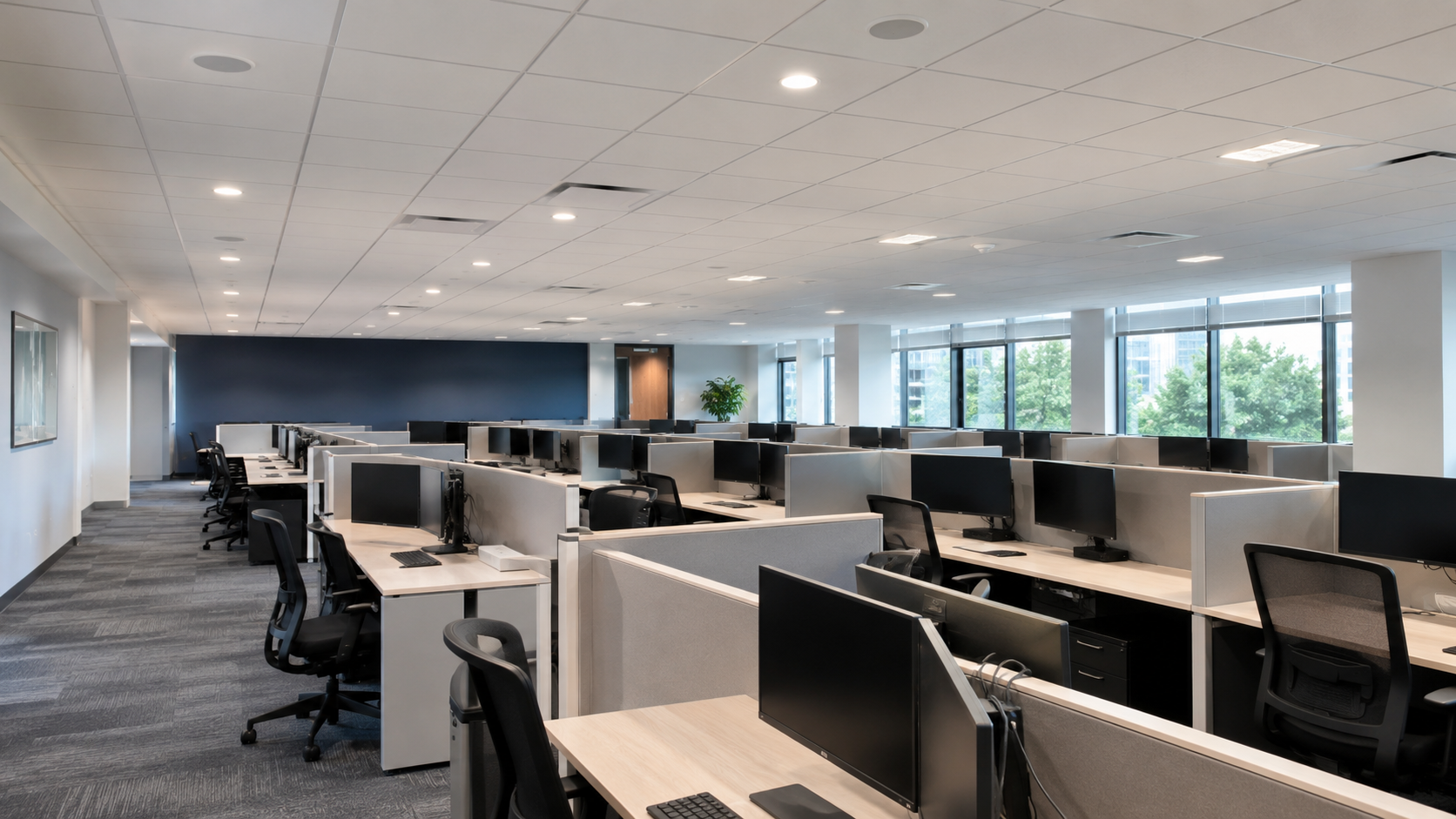
- Open-plan floors. Conversation two desks away stops registering as words, which is what makes it stop pulling attention.
- Meeting rooms. Masking outside the door, so what is said inside does not carry into the corridor.
- Medical and dental practices. Reception, waiting areas, and corridors outside treatment rooms, where conversation should not be overheard.
- Legal and financial offices. Private offices and the spaces between them, where confidentiality is a working requirement.
- Executive floors. Corridors and adjacent rooms treated as one zone rather than door by door.
- Call centers and support floors. Dense seating where every seat is on a call at once.
- Reception and waiting areas. Conversation at the desk kept from reaching the people waiting.
Sound masking is a low, even background sound played through a building’s ceiling to keep nearby conversation from being understood. It sits at the frequencies human speech occupies, so voices two desks away stop resolving into words while remaining audible as sound. Lock and Tech USA designs, installs, and tunes sound masking systems for offices, practices, and commercial spaces across New York City.
What Sound Masking Is
Speech distracts because it is intelligible, not because it is loud. A conversation you can follow pulls attention away from what you are doing; the same conversation at the same volume, reduced to unintelligible sound, does not. Sound masking works on that distinction. It raises a room’s background sound to a level where speech at a distance loses its detail, continuously and evenly, so nobody notices the sound itself after the first hour.
How the System Works
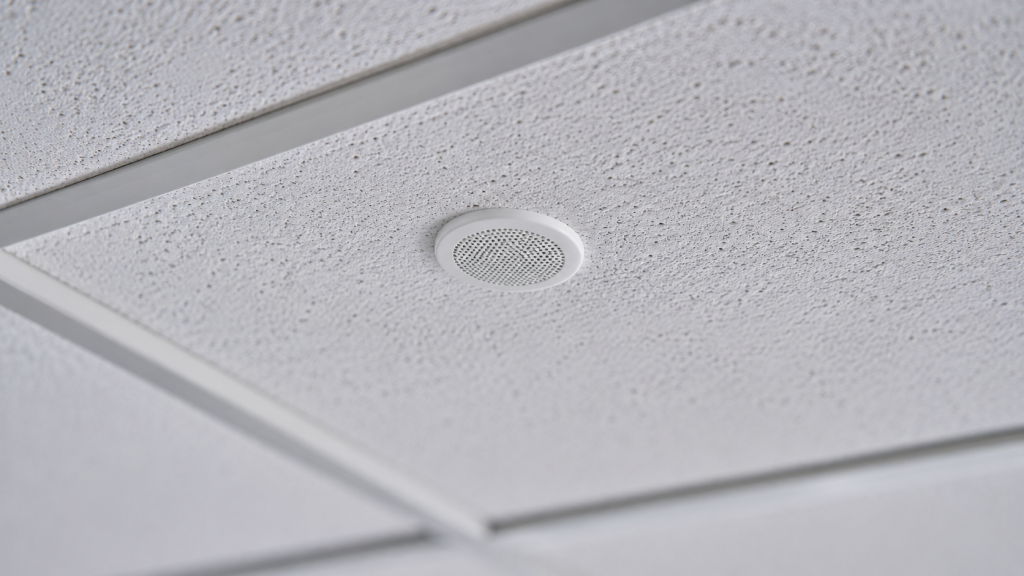
A generator produces a signal shaped to the frequency range of the human voice. That is the part a fan or a phone app cannot reproduce: the shape matters more than the volume, and a flat hiss either fails to cover speech or has to be turned up until it is worse than the problem. The signal is distributed through emitters spaced across the ceiling, usually above the tiles and facing upward, so the sound arrives reflected rather than aimed at anyone. Even coverage is the whole point — someone walking the floor should never hear the level rise or fall. Level and spectrum are set on site, in the finished room, after everything else is installed.
What It Is Not
It is not noise cancellation. Cancellation uses an opposing waveform to remove sound, works across very short distances, and has no practical application to an open floor. Masking adds sound rather than subtracting it.
It is not soundproofing. Soundproofing is construction — mass in the walls, seals at the doors, isolation between floors — and it stops sound from travelling at all. Masking accepts that sound travels and changes what happens when it arrives. The two answer the same complaint from opposite ends, and where a wall cannot be built, masking is usually the only remaining option.
What a Sound Masking System Consists Of
Four parts. The generator creates and shapes the signal and sets its level; on larger installations it also holds the zone configuration. Zones divide the building into areas that can carry different levels — an open floor, a row of private offices, and a reception area rarely want the same setting, and a single level across all three means one of them is wrong.
Emitters distribute the sound. Spacing is calculated from ceiling height and construction, because that spacing is what produces even coverage; too far apart and the level dips between them, too close and it costs more than it needs to. In a suspended ceiling they sit above the tiles. Where there is no plenum — exposed structure, hard ceilings, open industrial spaces — they are mounted in the open and aimed to bounce sound off surfaces rather than at heads.
Tuning is the fourth part and the one that decides whether the rest was worth doing. The system is measured and adjusted room by room after installation, with the furniture in place and the space finished, because carpet, partitions, glass, and ceiling type all change what the room does with sound. A masking sound system installed to a drawing and never tuned is the usual reason people say masking did not work for them.
Where Sound Masking Is Used
Open-plan floors are the common case: dense seating, no barriers, and conversation carrying across the whole space. The detailed version of that scenario is covered under sound masking for offices.
Privacy sound masking is the other half of the demand, and it comes from places where a conversation being overheard is a real problem rather than an annoyance. Medical and dental practices treat reception desks, waiting areas, and corridors outside treatment rooms. Legal and financial offices treat private offices and the spaces between them, where a closed door stops far less sound than people assume. Executive floors and HR areas are treated the same way.
Retail, banking, hospitality, and larger mixed-use buildings run the same principle at a different scale and with different ceiling conditions — that side is covered under commercial sound masking.
Installation and Tuning
A sound masking system installation starts with a ceiling survey: construction type, height, plenum depth, existing services in the void, and how the floor is divided. That decides emitter spacing and zone boundaries before anything is ordered.
Installation itself is quiet work above the ceiling and is normally done around occupancy rather than after hours. Emitters and cabling go in, the generator is mounted at the rack or in a closet, and zones are wired to match the plan. Then the system is tuned: measured in each zone, adjusted for level and spectrum, and walked through with someone from your side so the result is agreed in the room rather than on paper.
What separates sound masking companies at this stage is whether tuning is treated as a step or as a formality. We set aside time for it, return to adjust after the system has been running for a couple of weeks if the space needs it, and leave the zone settings documented. Pricing is labor plus material for one total figure, with a signed contract in place before work begins.
We install across New York City, including Brooklyn, Queens, and Staten Island, and out to the surrounding areas within our service radius. The rest of the section is listed under audio and video services.
Warranty, Service Area, and Payment
Lock and Tech USA backs new installations with a 90-day mechanical warranty and a 12-month electrical warranty, covering both parts and labor. We provide installation within 75 miles of Midtown Manhattan and support extended zones, multiple locations, and multi-site service for clients with several properties. Phone and email support is available during business hours.
We accept cash, wire transfer, ACH, credit card, and check, as well as Zelle and Venmo, and we offer invoicing and business accounts for commercial clients. Depending on the size of the job, payment is typically a partial deposit up front with the balance collected on completion. Before starting, we require a signed contract and a tax exemption form if applicable.
Frequently Asked Questions
Does sound masking actually stop people hearing conversations?
Is the sound itself distracting?
Is this the same as soundproofing?
Can different areas run at different levels?
Can it be installed while the space is in use?
What does a sound masking system cost?
What our clients say