Roll up gates are the steel security gates that cover storefronts, warehouse openings, and garage entrances, and Lock and Tech installs, repairs, replaces, and motorizes them across New York. Most New Yorkers know them as roll down gates. A licensed technician usually arrives in 20 to 40 minutes, checks the gate, its tracks, and its spring, and names the price before work starts. Gate locks are covered too, since a gate that rolls but won’t lock still leaves the store open.
Types of Roll Up Security Gates
Roll up security gates differ mainly in the curtain, the set of interlocking slats that rolls up into the hood above the opening. Solid, perforated, and grille curtains balance privacy and visibility in different ways, and the choice usually depends on what the business wants people on the street to see after hours.
Solid Slat Gates
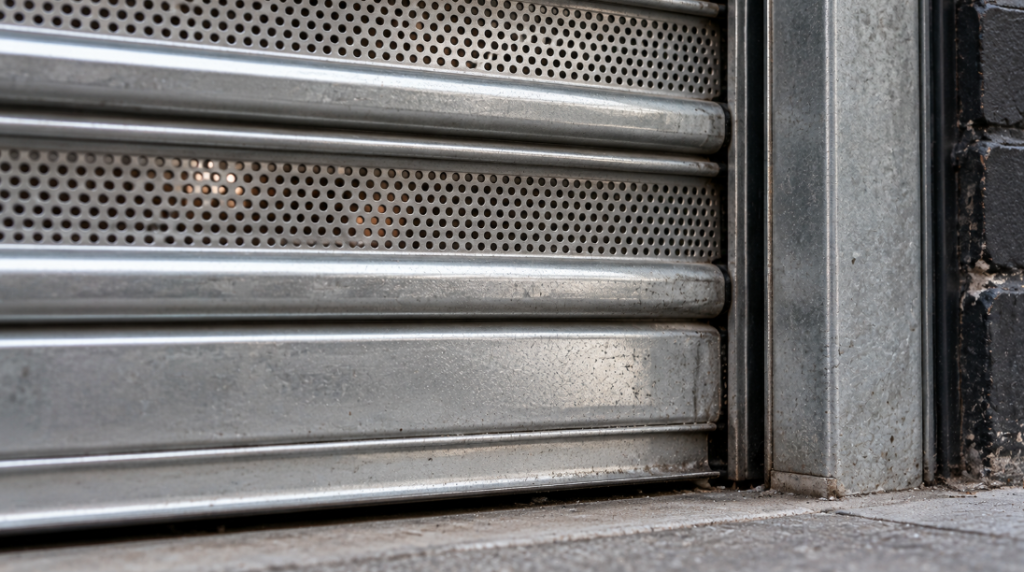
Solid slat gates use flat interlocking steel slats with no openings. When the gate is down, the window is fully covered, with no view inside and no light passing through. They suit warehouses, loading openings, and stores that keep valuable stock near the window. The tradeoff is a blank wall on the street after closing, and these gates are the heaviest of the three, so wide ones often need a motor.
Perforated Gates
Perforated gates use the same kind of slats punched with small holes. From the street, the display and the store lights behind it stay visible, while the gate still blocks entry. This is the type seen on most storefront security gates along New York’s shopping streets. Perforated slats weigh a little less than solid ones, and the holes let some air through when the store is closed.
Grille Gates
Grille gates replace slats with a pattern of rods and links, so the window stays almost fully visible. They are common in malls, building lobbies, and stores that want the display open to view at night. A grille stops entry but not rain or thrown objects, so it suits covered or interior openings best. For swing gates, window grilles, and other custom metalwork, see our iron works services.
Installation and Replacement
A new gate starts with measuring the opening: width, height, and the space above it for the hood that holds the rolled-up curtain. The installed system has four main parts: the curtain of slats, two vertical guide tracks fastened to the sides of the opening, the barrel at the top that the curtain wraps around, and the spring inside the barrel that balances the weight so the gate can be lifted by hand or by a motor.

Replacement makes sense when repairs stop paying off: many slats are bent or rusted, the tracks are distorted, or the barrel and spring are worn out. It is also the moment to change the type, for example from solid to perforated.
Rolling gates go into new storefronts as well as existing ones. In a new space, the hood and tracks are planned around the window frame and the sign band. In an existing opening, the old gate comes out and the new one is sized to the same mounting points where possible. You hear the price before work starts, and a new gate is one of the large jobs where a deposit is taken.
Stuck or Damaged Gates
Most gate calls start with one of these symptoms:
- The gate won’t go up, or goes up in jerks.
- It stopped halfway and won’t move either way.
- It sits crooked in the tracks.
- It grinds or catches as it moves.
- The spring snapped or feels weak, and the gate is suddenly heavy.
- The slats are bent after a truck hit or a forced entry.
- The bottom bar doesn’t reach the ground.
The fix depends on the cause. Bent slats are straightened or replaced one by one, so the whole curtain rarely has to go. Tracks are cleaned of dirt and debris, realigned, and lubricated. A weak spring is retensioned and a broken one is replaced. Spring work is dangerous without the right tools, so it shouldn’t be tried by hand. A bent or worn bottom bar is replaced so the gate closes flush with the sidewalk.
If the gate is stuck open at closing time, don’t force it down with weight or tools, since a twisted curtain makes the repair bigger. To keep the store secure overnight, lock the inside doors, move valuable stock away from the window, and, if needed, cover the opening with plywood until the gate is fixed.
Manual or Motorized Operation
Gates are raised in one of three ways. A manual gate with a spring barrel is lifted by hand, with the spring doing most of the work. A manual gate with a chain hoist is raised by pulling a chain that turns the barrel through a gear, which helps with heavier gates. A motorized gate is raised by an electric operator mounted beside or above the barrel and controlled by a button or a key switch.
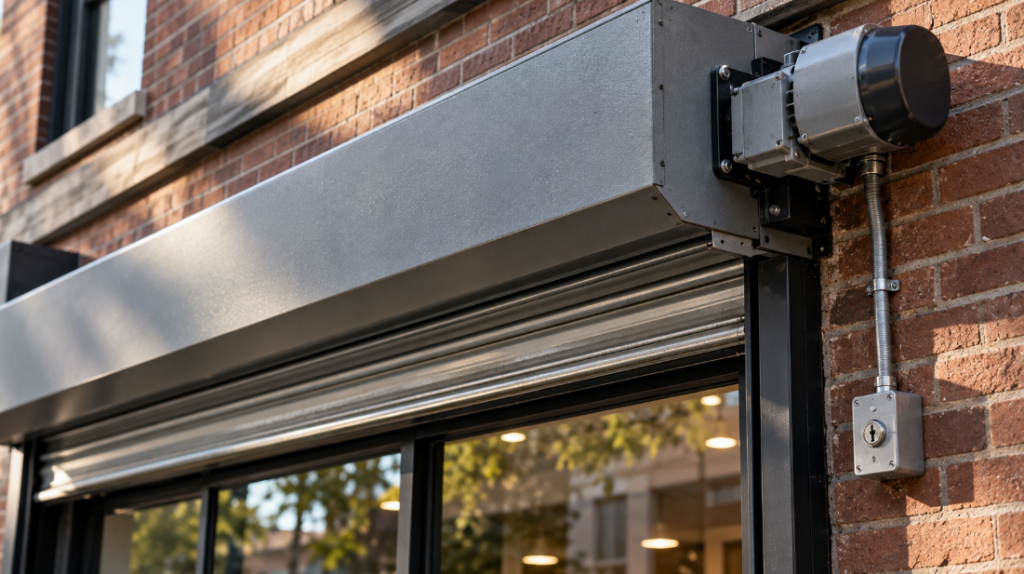
Converting a manual gate to a motor makes sense when the gate is heavy or wide, when it is opened and closed every day, or when the person opening the store struggles to lift it. The existing curtain and barrel can often stay. The spring tension, the gate’s condition, and the space for the operator are checked first.
Motorized gates fail in their own ways: the motor hums but the gate doesn’t move, the gate stops short or runs too far because the limit switches that tell the motor where to stop are out of adjustment, or the button or key switch stops responding. A new gate or a motor conversion carries a warranty of 90 days on mechanical parts and 12 months on electronics.
Gate Locks
Most roll up gates lock at the bottom. A center lock in the bottom bar throws bolts into the tracks or the ground, and many gates also have slide bolts at the sides with loops for padlocks. Over a few winters, salt, dirt, and moisture get into these locks, and the key stops turning or the bolts stop moving. A seized or broken gate lock is locksmith work rather than gate repair: the cylinder is freed or replaced, and the bolts are adjusted so they meet the tracks again. Locks on storefront doors and their hardware are covered on our commercial door locksmith page.
Where We Work
Lock and Tech works within 75 miles of Midtown Manhattan. That covers storefronts and warehouses in Manhattan and shopping streets and industrial areas across Brooklyn, along with Queens, Staten Island, and New Jersey. A technician usually arrives in 20 to 40 minutes, up to an hour depending on traffic. When you call, mention the width of the opening, whether the gate is manual or motorized, and where it is stuck.
Warranty, Service Area, and Payment
All work is done by licensed technicians. A new gate or a manual-to-motor conversion carries a warranty of 90 days on mechanical parts and 12 months on electronics. Repairs and emergency calls don’t carry a warranty, and an emergency call is charged as its own job.
The service area runs 75 miles from Midtown Manhattan. The price is named before work begins, and a deposit is taken only on large jobs, such as installing a new gate.
Payment can be made by cash, credit card, ACH, wire transfer, check, Zelle, or Venmo.
Frequently Asked Questions
Short answers to what store owners and building managers usually ask about their gates.
Can a bent gate be repaired, or does it need replacing?
Most bent roll up gates can be repaired. Bent slats are straightened or replaced one by one, and a damaged bottom bar is swapped. Replacement makes sense when much of the curtain, the tracks, or the barrel is damaged.
Can a manual gate be converted to a motor?
In most cases, yes. The curtain and barrel often stay, and an electric operator is added. The gate’s condition and the space for the operator are checked first.
What’s the difference between perforated and solid gates?
Solid slats cover the window completely. Perforated slats have small holes, so the display and the lights stay visible from the street while the gate still blocks entry.
The gate is stuck open. What should I do before the technician arrives?
Don’t force it down. Lock the inside doors, move valuable stock away from the window, and cover the opening temporarily if needed. Arrival usually takes 20 to 40 minutes.
The gate lock won’t open. Can you help?
Yes. A seized or broken gate lock is freed, repaired, or replaced, and the bolts are adjusted so they meet the tracks again.
Do you handle locks and keys for the whole business?
Yes. Door locks, rekeying, and master keys for businesses are covered under our commercial locksmith services.