
- Home
- Security System
- Intercom Systems Repair
Intercom Repair in New York



Repairs Handled on Site
Since 1989, we’ve been securing homes and businesses across NYC and New Jersey with professional security solutions you can trust. Our licensed technicians provide 24/7 emergency service, using only the latest technology and backed by comprehensive warranties on all installations.


How a Broken Intercom Shows Up
- The buzzer rings but the door never releases.
- Nobody can hear you at the door, or all you get is static.
- The screen in the apartment stays black when someone rings up.
- The call button does nothing when a visitor presses it.
- The handset in the unit is silent while the lobby panel looks fine.
- The app will not connect, so deliveries sit in the vestibule.
- One line in the tenant directory rings the wrong apartment.
- The lobby panel works for some units and drops others.
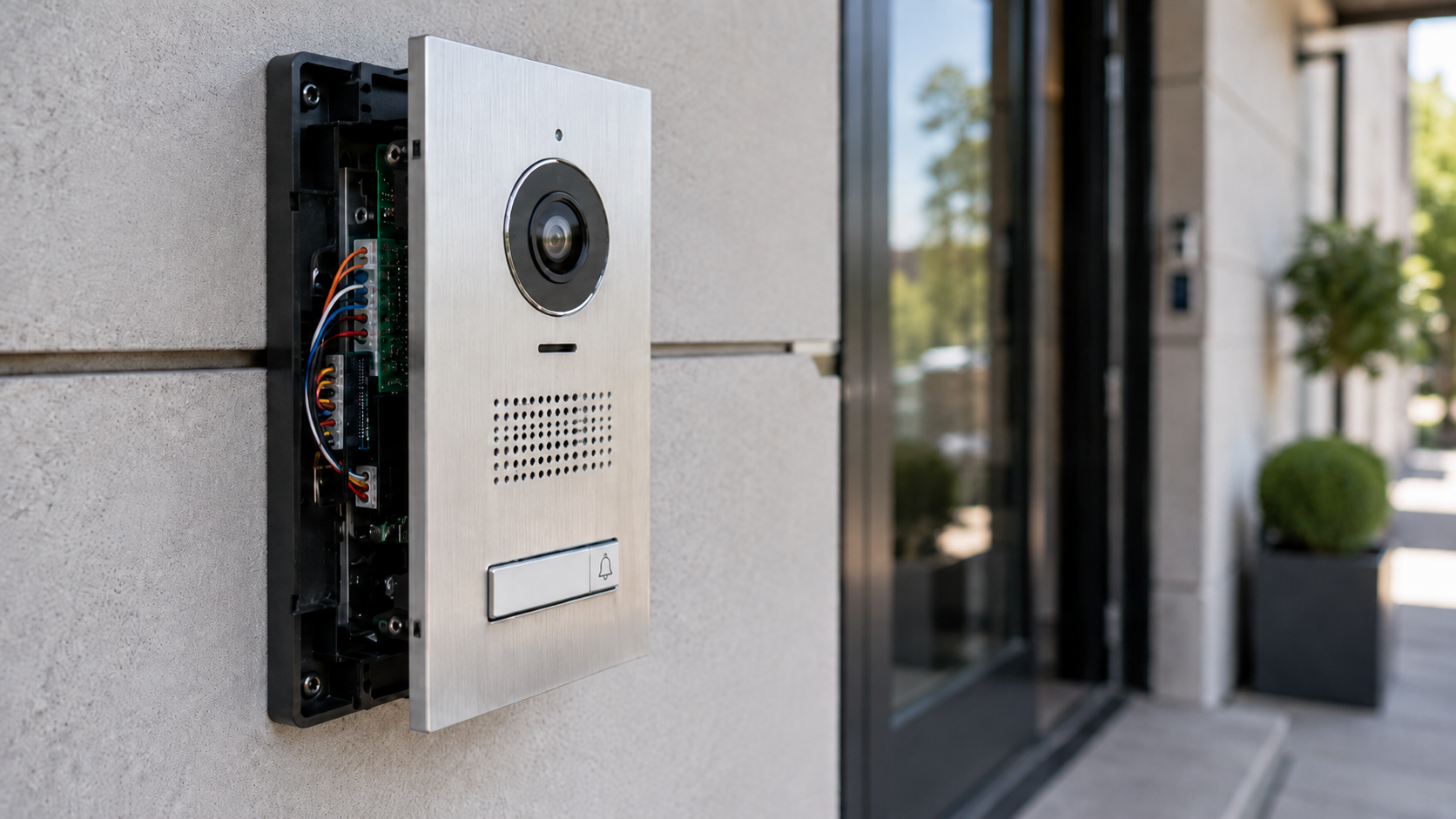
Intercom repair covers everything from a dead lobby panel to a door that will not release when the buzzer rings. We repair intercom systems in apartment buildings, co-ops, brownstones, and commercial properties across New York, on audio, video, wired, wireless, and app-connected equipment. Calls are handled weekdays, 8 a.m. to 6 p.m., and the technician is usually on site in 20 to 40 minutes, rarely more than an hour. Diagnosis happens at the door, and most repairs are finished on that first visit unless a part has to be ordered.
What Goes Wrong With an Intercom System
Intercom faults show up in a handful of ways, and the same complaint can come from the panel, the wiring, the power supply, or the lock. Describing the symptom in plain words is enough to start — sorting out the cause is our job.
- Nobody can hear you at the door, or the speaker gives back static and echo.
- Audio runs one way: the visitor hears the apartment, the apartment hears nothing back.
- The screen in the unit stays black, or the picture flickers and washes out after dark.
- The buzzer sounds but the door never releases, or it releases several seconds late.
- The call button in the lobby does nothing when a visitor presses it.
- A directory line rings the wrong apartment, or one unit stops ringing altogether.
- The app will not connect, so remote unlock and video stop working.
- The system works in the morning and drops out by the afternoon.
Audio faults usually trace back to a failed microphone or speaker, corroded contacts inside a lobby panel that sits in an open vestibule, or a wiring run that has been nicked during other work in the building. A handset that stays silent while the panel looks fine points at the riser or at the station itself, and those are different repairs with different parts.
Video intercom repair adds the camera and the monitor to that chain. Entry cameras take weather year round, and moisture behind the lens is a common reason a picture goes milky or drops out at night. A black screen inside the apartment can be the monitor, the video pair feeding it, or a configuration that was never restored after someone swapped a unit.
When the door itself is the problem, the fault sits in the release circuit rather than the intercom. Strikes wear out, magnetic locks lose holding force, push-to-exit devices stick, and a release that fires late is often a voltage drop over a long cable run. To fix an intercom system in that state we test the lock hardware and the panel together, since replacing one without the other leaves the tenant with the same dead door.
App and cloud faults are their own group. Push notifications stop, the video feed times out, or the account no longer authenticates after a firmware update. Wireless systems add interference from neighbouring networks and building materials, plus batteries that lose capacity and take the station down for part of the day.
How a Repair Call Goes
A repair starts with an inspection booked for a time that suits the building, and a technician who arrives in that window. Typical on-site response is 20 to 40 minutes, up to an hour.

On arrival the technician works the system end to end rather than starting at the part that was reported. That means power and voltage first, then the wiring between the entry panel and the stations, then the panel, the handset or monitor, and the door release. A fault that looks like one broken buzzer often turns out to be a power supply that no longer holds its rating under load.
Once the cause is identified, you get the finding and the price before anything is opened up or replaced. Intercom system repair goes ahead after you review and sign the service consent form. Work that can be completed with parts on the van is completed that visit; anything needing a component that is out of production or brand specific gets ordered, and the return visit is scheduled with the service department.
You are left with an invoice listing every service performed and every part used. Where a tax exemption applies, the form has to be in hand before work begins.
What We Test and What We Replace
Diagnosis follows a fixed order: verify supply voltage, inspect every connection and terminal, then trace the cable run for damage, shorts, and breaks. Audio is checked at each station, video at the camera and the monitor, and the release is tested at every entry point in both directions.

Parts we repair or replace on intercom calls:
- Lobby panels, call buttons, and tenant directories.
- Door release mechanisms, door strikes, and electromagnetic locks.
- Push-to-exit devices and motion sensors on the egress side.
- Buzzers, interior handsets, and apartment monitors.
- Riser and station wiring, power supplies, and system controllers.
Magnetic locks, exit devices, and readers frequently sit on the same door as the intercom and share its power. When the fault turns out to be on that side, the work belongs to door access control equipment rather than to the intercom panel, and we say so before touching anything.
Multi-Tenant Buildings and Commercial Properties
Intercom systems repair in a multi-tenant building has to be scheduled around access. Testing a riser means reaching stations inside occupied apartments, so we coordinate with building management or the super and work through the units in one pass instead of returning day after day.
Large systems are repaired in stages. A panel that serves sixty units can be brought back for the whole building while individual stations are replaced over the following visits, so nobody is left without door release in the meantime. Faults in the master station, the power distribution, or the directory database affect every tenant and are handled first.
Prewar buildings and walk-ups bring their own conditions: original conduit, spliced risers from decades of partial repairs, and panels no longer made by anyone. Those systems are usually repairable, though tracing a riser in a brownstone takes longer than in a building wired in the last ten years. Home intercom repair in a single-family house or a small walk-up is a shorter call, often one panel and one station. For portfolios, we also work on security systems for residential buildings as a whole.
Repair or Replace
Repair makes sense when the fault is a discrete component and the rest of the system tests clean — a failed power supply, one dead handset, a damaged section of cable, a worn strike. Those parts are available, and the building keeps the wiring and panels it already has.
Replacement becomes the cheaper path when parts for the model are gone, when several stations fail in the same period, or when a repaired riser is holding together older faults that will reappear. A system with recurring water damage at the entry panel falls into the same category.
If the numbers point that way, we say so during the visit and quote both. New intercom system installation is a separate scope of work with its own warranty terms, and a building often folds an upgrade into that decision — adding video to an audio-only panel, or app access for tenants and deliveries.
Brands and Older Systems
We service equipment from ABB, Aiphone, Comelit, ButterflyMX, Akuvox, DoorKing, Siedle, Alpha Communications, TekTone, Lee Dan, and Elvox, along with systems from manufacturers that no longer exist.
Discontinued models are a routine part of the work in New York, where plenty of buildings run panels installed in the 1980s and 1990s. Where the original part is unavailable, the repair is done with a compatible component or by adapting a current station to the existing riser, which keeps the rest of the building untouched.
Pricing, Payment, and Warranty
Pricing is labor plus material, quoted after diagnosis and before the repair starts. There are no hidden fees, and no surcharge for after-hours, weekend, or holiday calls.
Repair work does not carry a warranty. The 90-day mechanical and 12-month electrical warranty, covering parts and labor, applies to new installations only, and we would rather state that up front than have it come up after the invoice.
We accept cash, credit and debit cards, ACH, wire transfer, check, Zelle, and Venmo. Commercial clients can set up invoicing or a business account. Phone and email support runs during business hours.
Where We Work
We cover the five boroughs and everything within 75 miles of Midtown Manhattan, which takes in Westchester, Long Island, and northern New Jersey.
Response time across the city is 20 to 40 minutes and up to an hour, depending on traffic and the time of day. Buildings in Lower Manhattan and Brooklyn make up most of the intercom repair work, and both areas have their own service pages with local details. Outside the city line, scheduling is done by route, so an outer-county call is usually set for a fixed window rather than same-hour dispatch.
Questions We Get
How much does it cost to fix an intercom?
The price is quoted on site after diagnosis, calculated as labor plus material. A technician cannot price the job over the phone, because a dead buzzer can be a five-dollar contact or a failed controller, and those are different repairs.
Our panel is from the eighties and the company is out of business. Can it still be repaired?
Usually yes. Discontinued and legacy systems are repaired with compatible components or by adapting a current station to the existing wiring, and full replacement is only recommended when the riser itself has failed.
The buzzer rings but the door does not open. Is that the intercom or the lock?
Either one, and testing tells them apart in a few minutes. The release circuit, the strike, and the magnetic lock are checked alongside the panel, since a door that unlocks late is often a voltage problem rather than a broken buzzer.
Can you repair one apartment without shutting down the whole building?
Yes. Individual stations, handsets, and monitors are replaced while the rest of the system stays live, and tenants in other units keep door release throughout.
Is repair work covered by a warranty?
No. Repairs are not covered by a warranty. Warranty coverage of 90 days on mechanical parts and 12 months on electrical parts applies to new installations.
How soon can someone get here?
Typical on-site response is 20 to 40 minutes, up to an hour. Calls are taken weekdays from 8 a.m. to 6 p.m., and there is no surcharge for after-hours, weekend, or holiday work.
Our intercom is tied into the building alarm. Can you handle both?
Yes. Where a fault crosses into the alarm panel or its wiring, the same visit can cover security system repairs, so the building is not booking two separate service calls for one door.
What our clients say