
- Home
- Telecommunications Services
- Home Theater and Audio Video Automation
Home Theater and Audio Video Installation in New York City



Measured, Hidden, Calibrated
Since 1989, we’ve been securing homes and businesses across NYC and New Jersey with professional security solutions you can trust. Our licensed technicians provide 24/7 emergency service, using only the latest technology and backed by comprehensive warranties on all installations.


Audio and Video for Homes and Commercial Spaces
- Apartments and co-ops. Systems planned around board rules on drilling and quiet hours, with cable pulled through existing chases wherever the building allows it.
- Townhouses and brownstones. Several floors on one system, so the same sources play in a den, a kitchen, and a top-floor room.
- Dedicated theater rooms. Seating distance, screen size, and speaker placement worked out before construction closes the walls.
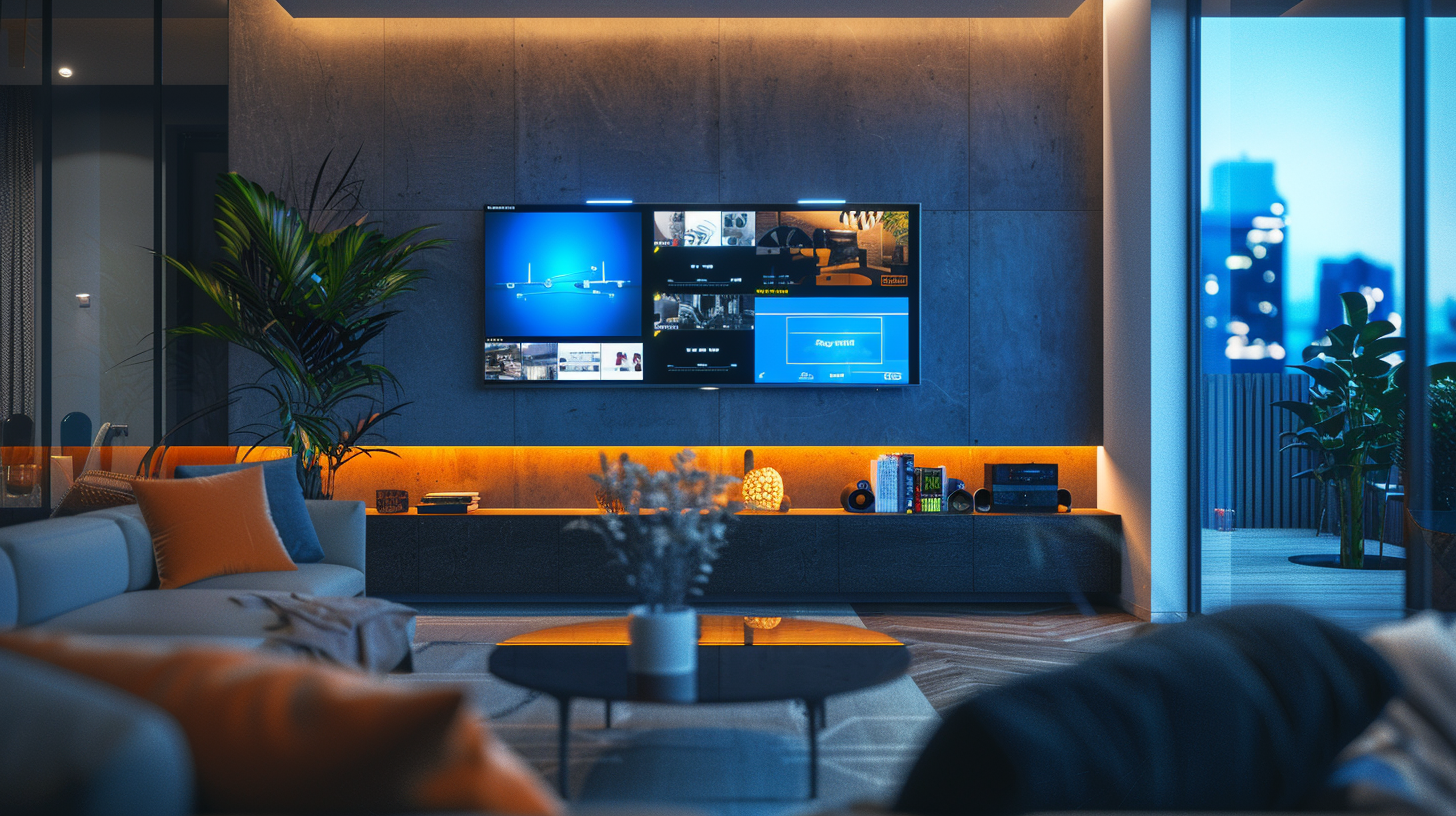
- Living rooms and open plans. Screens and speakers set into a room that also has to work as a room, not as equipment on display.
- Conference and meeting rooms. Displays, microphones, and speakers matched to the video platform an office already runs on.
- Lobbies and reception areas. Screens and background audio on a schedule, with volume set once and left alone.
- Retail and hospitality spaces. Zoned audio and displays across a floor, adjusted from one point instead of unit by unit.
Home theater installation is the work of planning a room around a screen and a set of speakers, then building it so the picture, the sound, and the controls behave as one system instead of a pile of boxes. Lock and Tech USA designs and installs home theaters and audio video systems for apartments, co-ops, houses, offices, and commercial spaces across New York City. Rooms get measured first, cable is routed out of sight, and every finished system is calibrated and handed over with training on site.
Home Theater Installation
A home theater project is not the same job as mounting a television. Screen size follows seating distance, speaker positions follow the shape of the room, and the wiring for all of it has to be planned before anything goes on a wall. Our home theater installation services cover that whole sequence — the room math, the equipment, the cable, the calibration, and the handover — so the result is a room that works on the first evening you use it.
What a Home Theater Installation Includes
A complete home theater system installation has five parts. The picture comes from a projector and screen or a large-format display, sized to the distance people actually sit at. The sound comes from a surround speaker layout, usually a mix of floor-standing, in-wall, and in-ceiling positions, driven by amplification matched to the speakers. Sources — streaming players, cable boxes, consoles, media servers — sit together in one rack rather than on a shelf under the screen. Control ties them into a single remote or panel. Room preparation covers acoustic panels, backing behind speaker positions, and power and cable runs. A custom home theater installation puts all five in one drawing before the first hole is drilled.
How the Installation Works
The first visit is measurement: room dimensions, seating positions, ceiling height, wall construction, and where power and network already reach. That produces the layout and the equipment list.
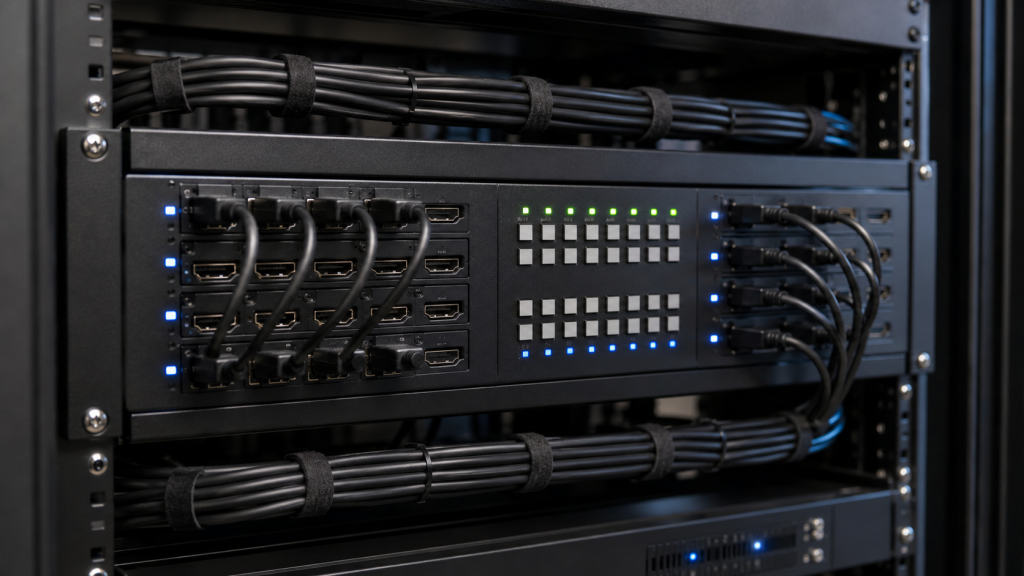
Cable goes in next, pulled inside walls and ceilings wherever the building and the construction allow it, with terminations labeled at both ends. Mounting follows: screen or display, speakers, rack, and panels. Then calibration — speaker levels and distances set by measurement, picture settings matched to how bright the room is, and every source tested through the system rather than on its own. The last step is training on site: we run the system with you, set up the mobile app on your phone, and leave the settings written down.
Dedicated Rooms and Living Spaces
A dedicated room lets the design lead. Walls can take acoustic treatment, seating rows can be raised, the projector can be ceiling-mounted at the correct throw distance, and light is controlled completely. In a living room the room leads instead. Speakers go in-wall or in-ceiling to keep sightlines clean, the display is sized for daytime brightness rather than a dark room, and equipment moves to a closet or cabinet with an extender back to the screen. Daylight is usually the limiting factor in an open living space, and window covering is handled as its own job — see motorized shades for that side of the work.
Audio and Video Automation for Homes and Businesses
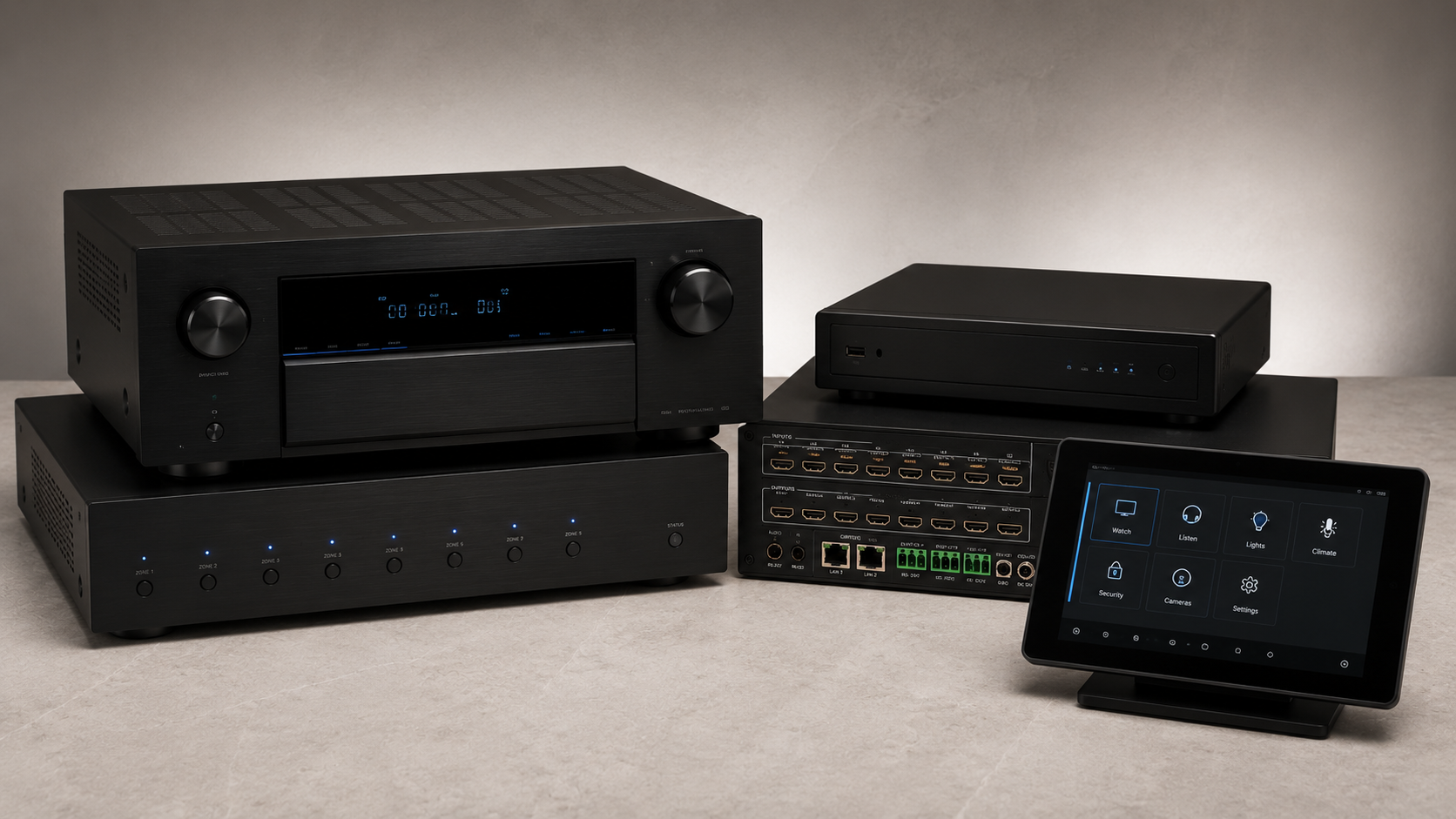
Audio video installation becomes automation when the equipment stops being operated piece by piece. Instead of one remote per device and one volume knob per room, sources, displays, and speakers run on a shared network with a single interface in front of them. This is the work people ask for when they want music in more than one room, screens in more than one place, or a meeting room that anyone can start a call in without a phone call to IT. It is a separate project from a theater, and it is frequently the larger one.
Residential Audio and Video
In a home this usually means audio in the kitchen, living areas, bedrooms, and outdoor space, with in-ceiling speakers and amplification kept in one rack. Zones play the same thing or different things. Video follows the same logic: sources in one place, displays in several. Home audio video installation in apartments and co-ops is planned around what the building permits — drilling windows, quiet hours, and which chases are available for cable.
Commercial Audio and Video Installation
Commercial audio video work covers conference and meeting rooms, lobbies, showrooms, restaurants, and retail floors. A meeting room gets a display, microphones, and speakers matched to the video platform the office already runs, so the room joins calls the way staff expect. Lobbies get screens and background audio on a schedule with volume set once. Retail and hospitality floors get zoned audio adjusted from one point instead of unit by unit.
Most commercial audio video companies get asked the same question first: does this work with what is already installed. We survey the existing equipment before quoting, keep whatever still performs, and schedule the disruptive parts of the install around your operating hours so the space stays usable while the work runs.
One-Touch Control and Integration
Scene control is what makes the rest usable. One command can bring up the display, select a source, power the amplification, and set volume for that room. Panels on the wall, handheld remotes, mobile apps, and voice assistants all reach the same system. Audio and video is normally one layer inside a larger setup, and the other layers are their own projects — lighting control and smart home automation are handled separately and tied into the same scenes.
Whole-Home Audio and Video Distribution
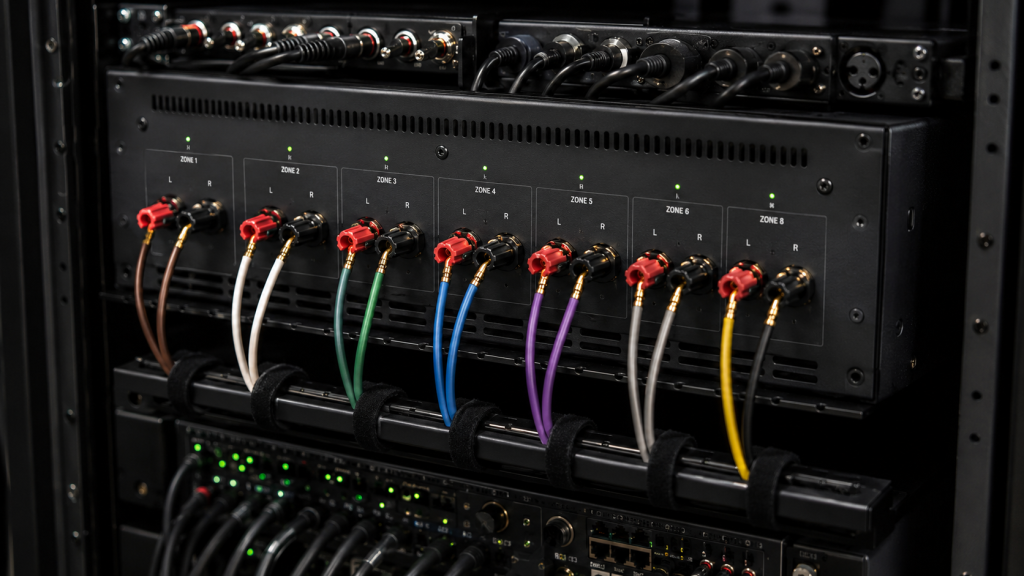
Distribution is the wiring layer under multi-room audio and video. Sources sit in a central rack and travel over structured cable to every speaker zone and every display, so a signal started in one room can be picked up in another and no source has to be duplicated. It supports 4K and 8K with HDR, and it is what makes adding a room later a cable pull rather than a rebuild.
What We Install
- Home theater systems with projection or large-format display
- Surround speaker layouts and amplification
- In-wall and in-ceiling speakers
- Acoustic treatment and room preparation
- Multi-zone audio for houses, apartments, and outdoor areas
- Video distribution from centralized sources
- Conference and meeting room audio and video
- Lobby, retail, and hospitality display and audio systems
- Motorized projection screens and mounts
- Equipment racks, power management, and structured cabling
- Touch panels, remotes, and mobile app setup
- Media servers and streaming source configuration
Where We Install
We work in apartments and co-ops, condominiums, townhouses and brownstones, single-family houses, and new construction where cable can go in before the walls close. On the commercial side we install in offices and meeting rooms, building lobbies, retail floors, showrooms, restaurants, bars, and medical and dental practices. Coverage runs across New York City, including Brooklyn, Queens, the Bronx, and Staten Island, and out to the surrounding areas within our service radius. Clients with several addresses can keep them on one system and one account.
Our Installation Process and Pricing
Work starts with a free consultation. We look at the rooms, ask how the space gets used, and put together a layout and equipment list rather than a price over the phone. Once the design is agreed, we schedule the installation and plan the sequence with you — in a working office or a lived-in apartment, the noisy and disruptive stages get placed where they cost you the least.
On site we confirm the scope, pull cable, mount equipment, and program the control system. Every system is calibrated by measurement before it is handed over, not set by ear. When the work is finished we run the system with you on site, set up the mobile app, and leave the configuration documented.
Pricing is labor plus material for one total figure, itemized against the equipment list. On larger jobs payment is a partial deposit up front with the balance on completion, and a signed contract goes in place before any work begins. Installation carries a 90-day warranty on the mechanical side and 12 months on electronics, covering parts and labor. Repair visits to equipment we did not install are not covered by that warranty.
Warranty, Service Area, and Payment
Lock and Tech USA backs new installations with a 90-day mechanical warranty and a 12-month electrical warranty, covering both parts and labor. Repairs are not covered by a warranty. We provide installation within 75 miles of Midtown Manhattan and support extended zones, multiple locations, and multi-site service for clients with several properties. Phone and email support is available during business hours.
We accept cash, wire transfer, ACH, credit card, and check, as well as Zelle and Venmo, and we offer invoicing and business accounts for commercial clients. Depending on the size of the job, payment is typically a partial deposit up front with the balance collected on completion. Before starting, we require a signed contract and a tax exemption form if applicable.
Frequently Asked Questions
How long does a home theater installation take?
Do I need a dedicated room, or can it go in my living room?
What does a home theater installation cost?
Will you have to open walls in my apartment?
Can one system cover a theater and the rest of the property?
Can you work with equipment we already own?
Is the installation covered by a warranty?
What our clients say