
- Home
- Telecommunications Services
- Home Automation Light Systems
Home Automation Light Systems in New York City



Built Around Your Rooms
Since 1989, we’ve been securing homes and businesses across NYC and New Jersey with professional security solutions you can trust. Our licensed technicians provide 24/7 emergency service, using only the latest technology and backed by comprehensive warranties on all installations.


Lighting Automation for New York Homes
- Apartments and co-ops. Existing switch locations reused wherever possible, so nothing has to be approved that the board would rather not approve.
- Condominiums. Control kept inside the unit, on the same app as the rest of the system.
- Townhouses and brownstones. Several floors on one controller, with stair and hallway lighting behaving the same on every level.
- Single-family houses. Interior, outdoor, and landscape lighting on shared schedules that follow sunrise and sunset.
- Renovations. Wiring and back boxes placed while the walls are open, including positions for keypads you may want later.
- New construction. Lighting drawn into the plan alongside the electrical layout, before anything is closed up.
- Homes with smart bulbs already installed. Existing sources kept where they work, brought under one controller instead of one app each.
A home automation light system is what replaces the row of switches by the door with something that turns a whole room on at one level with one press. Home automation lighting is the subsystem people use more than any other — dozens of times a day, every day — which is why it is usually the first thing done and the thing that decides whether the rest of the house feels worth automating. Lock and Tech USA designs and installs these systems for apartments, co-ops, townhouses, and houses across New York City.
Home Automation Light Systems
Smart bulbs are not a system. A shelf of connected lamps, each on its own app, each forgotten when someone flips the wall switch off at the plate, is a collection of devices that happens to include lighting. A system puts control at the wall as well as on the phone, holds its logic on a controller in the home, and treats a room as one thing rather than four separately addressable objects. That difference is the whole reason to do this work, and it sits inside the wider build covered under home automation installation.
What the System Includes

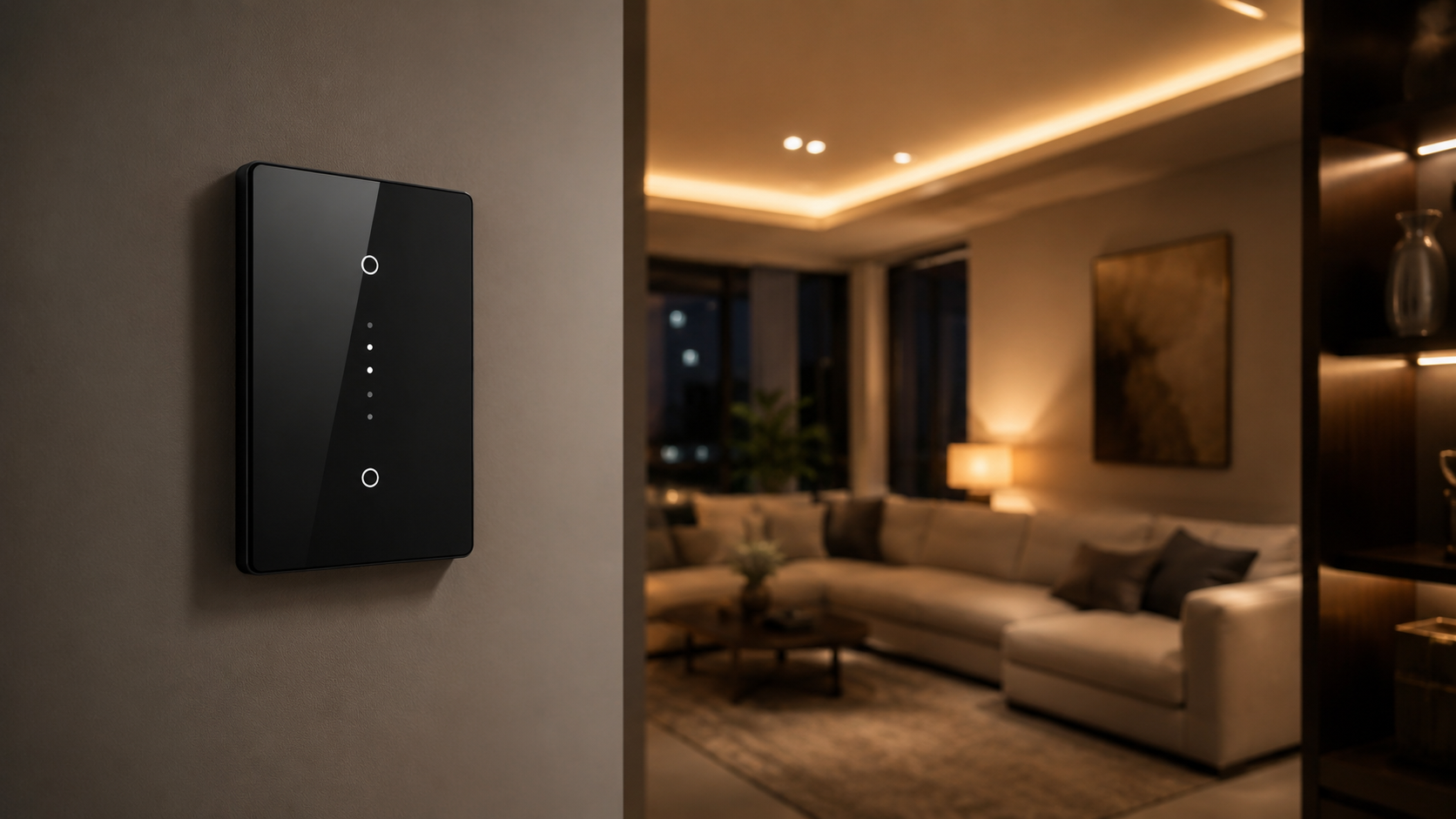
Four parts. The controller holds the scenes and schedules and keeps them running whether or not the internet is up. Dimmers and keypads go where the existing switches are: a dimmer handles one circuit, a keypad handles several, and replacing a bank of four plates with a single keypad is usually what people notice first. Light sources have to cooperate with the dimmer, which is a compatibility question rather than a brand question. Scenes are the fourth part and the reason for the other three — home automation light control means a room has three or four settings someone actually uses, not a slider nobody touches.
How the Installation Works
The survey covers every switch position in the home: what each one controls, how many plates are ganged together, and whether there is a neutral wire in the box. That last point decides a lot, because many dimmers need one and older apartments frequently do not have it at every position. We check each box and tell you where the neutral is missing before quoting. Where a wire has to be pulled, that is power work for a licensed electrician and is arranged separately — our part is the low voltage control layer.
Installation itself is a plate-by-plate replacement, room by room, with the power off at the circuit being worked on rather than at the whole apartment. Then programming: scenes built with you rather than from a template, because the levels that suit your living room are not the ones from a catalogue. We finish on site, walking the keypads with everyone who lives there and setting up the app before we leave.
Retrofits and Renovations
In a finished home the constraint is the existing wiring. We work with the switch positions that exist, reuse boxes wherever we can, and use wireless keypads where a new position is wanted and no cable can reach it. Nothing is chased into a finished wall.
In a renovation the constraint disappears for a few weeks. Boxes, cable, and neutrals go in while the walls are open, including positions for keypads you may only want in two years, because adding them later costs nothing at this stage and a great deal afterwards. If the plan includes window coverings, their wiring goes in at the same time — that side is covered under motorized shades.
Lighting Control and Scenes
Home lighting automation earns its place through scenes and schedules rather than through remote access. Turning a light on from your phone is a novelty that wears off in a week. A room that comes up correctly on one press, and a house that adjusts itself as the day moves, is the part people keep using years later.
Scenes by Room and by Time
A scene is a set of levels across several circuits, recalled by one button. A living room might hold four: full light for cleaning, a lower setting for evening, a dim one for watching something, and off. Home automation lighting control also runs on schedules, and the useful ones follow the sun rather than the clock — outdoor and entry lighting coming up at dusk stays correct in December and June without anyone adjusting it, while a fixed time drifts wrong twice a year. Dimming and schedules also mean lights spend less time at full output, which shows up on the bill without anyone needing to think about it. Scenes can extend past lighting into shades and temperature, with the climate side covered under climate control.
Motion and Occupancy
A home automation light sensor handles the places where switches are inconvenient: closets, pantries, laundry rooms, basements, hallways at night. Lights come up on entry and drop after a set period of stillness, which also ends the argument about who left the basement light on. Sensitivity and hold time are set per room, because a bathroom and a corridor want very different behaviour. The same detectors can feed other subsystems — occupancy that turns on a light can also be an input to an away scene, which is covered under home automation and security.
Switches, Dimmers, and Light Sources
Equipment is chosen on parameters, not on names. A dimmer is matched to the load it will carry and to the source type on that circuit, because a dimmer sized for incandescent draw behaves badly on a handful of LEDs. A home automation light switch replaces the plate one to one and keeps working as a switch for anyone who does not care about the system, which matters more than it sounds — a control that only works through an app fails the moment a guest walks in.
Keypads replace multi-gang plates and are the reason a wall with six switches becomes a wall with one. Button layout and engraving are decided during programming, once the scenes exist.
Home automation light bulbs are the third option, and the right one where the fixture cannot take a dimmer or where colour is wanted. The tradeoff is that a bulb must stay powered to be controllable, so a wall switch cutting its supply takes it offline. Where existing smart bulbs are already installed, they can usually stay and be brought under the same controller rather than replaced. What we check on any source is dimming performance at low levels, behaviour after a power cut, and whether the whole circuit will restore to the same state.
Where We Install
We work in apartments and co-ops, condominiums, townhouses and brownstones, single-family houses, renovations with open walls, and new construction where the layout is still on paper. Outdoor, entry, and landscape lighting is included where it runs on the same system. We cover New York City and Brooklyn, along with Queens, the Bronx, Staten Island, and the surrounding areas within our service radius.
Our Process and Pricing
Work starts with a walkthrough: room by room, switch by switch, with questions about how each space gets used rather than about what equipment you want. That produces the position count, the keypad layout, and the scene list.
Installation is staged so the home stays livable — no room is left without working light overnight. Programming follows, then handover on site with the app set up and the scenes documented. Pricing is labor plus material for one total figure, itemized against the position count. On larger jobs payment is a partial deposit up front with the balance on completion, and a signed contract goes in place before work begins. Installation carries a 90-day warranty on the mechanical side and 12 months on electronics; repair visits are not covered.
Warranty, Service Area, and Payment
Lock and Tech USA backs new installations with a 90-day mechanical warranty and a 12-month electrical warranty, covering both parts and labor. Repairs are not covered by a warranty. We provide installation within 75 miles of Midtown Manhattan and support extended zones, multiple locations, and multi-site service for clients with several properties. Phone and email support is available during business hours.
We accept cash, wire transfer, ACH, credit card, and check, as well as Zelle and Venmo, and we offer invoicing and business accounts for commercial clients. Depending on the size of the job, payment is typically a partial deposit up front with the balance collected on completion. Before starting, we require a signed contract and a tax exemption form if applicable.
Frequently Asked Questions
Do we need a neutral wire at every switch?
Can we keep the bulbs and fixtures we already have?
Does it still work if the internet goes down?
Can we start with one room and add more later?
What happens when a bulb burns out?
How long does the installation take?
What our clients say


