
- Home
- Telecommunications Services
- Home Automation Doorbell and Door Sensors
Home Automation Doorbell in New York City



Wherever You Are in the House
Since 1989, we’ve been securing homes and businesses across NYC and New Jersey with professional security solutions you can trust. Our licensed technicians provide 24/7 emergency service, using only the latest technology and backed by comprehensive warranties on all installations.


Doorbells and Sensors for New York Homes
- Apartments and co-ops. A doorbell at the unit door that reaches every room, without touching anything the building manages at the street entrance.
- Condominiums. Notifications kept inside the unit, on the same app as lighting and climate.
- Townhouses and brownstones. A street-level press that carries to the top floor, where a traditional chime never did.
- Single-family houses. Front, side, and garden doors on one set of sensors and one status view.
- Homes with a wired chime already in place. Existing wiring reused where it can carry the new hardware.
- Homes left empty for weeks. A press or an opening that reaches you wherever you are.
- Renovations. Doorbell and sensor positions planned with the wiring while the walls are open.
A home automation doorbell replaces a chime that rings in one hallway with a press that reaches the whole house — the room you are in, the phone in your pocket, the panel on the wall. Door sensors do the quieter half of the same job: they report which openings are closed, so the system knows the state of the house.
Home Automation Doorbell
The problem with a conventional doorbell is that it only works if you happen to be near it. On a top floor of a brownstone, in a back room, with a fan running or music on, a press at street level frequently arrives as nothing at all. A connected doorbell removes that dependency: the press becomes an event the system distributes, so it can sound in several rooms at once, appear on a panel, and reach your phone if you are not home.
What follows the press is where the automation matters. Entry lighting can come up when someone arrives after dark. The camera covering the door can put its view on the display in the room you are standing in rather than only in an app — that side is covered under home automation cameras. In a house where someone is asleep, an evening scene can route the press to some rooms and not others, so a delivery at nine does not wake a child at the other end of the hall.
Installation depends on what is at the door already. Where a wired chime exists, its wiring can often carry the new hardware, which is the simplest case. Where there is nothing, or where the run is unusable, a wireless unit goes in instead. Either way the press has to reach the controller reliably, and at a street door in a masonry building that is a question worth checking before choosing the hardware rather than after.
Home Automation Door Sensors
A home automation door sensor is two small parts, one on the door and one on the frame, that report whether the two are together. On its own that is a status line. Connected to the system, it becomes the thing that lets scenes behave sensibly.
An away scene can refuse to arm while a door is open, and tell you which one. A night scene can confirm that everything is closed before it runs. A door opening at an unexpected hour can bring up lighting on the path to it. And a garden or basement door that gets left ajar can announce itself instead of being discovered in the morning.
Sensors work alongside the rest of what watches the house — that side is covered under home automation and security systems. The controller holding all of it sits inside the wider build, covered under home automation installation.
Where We Install
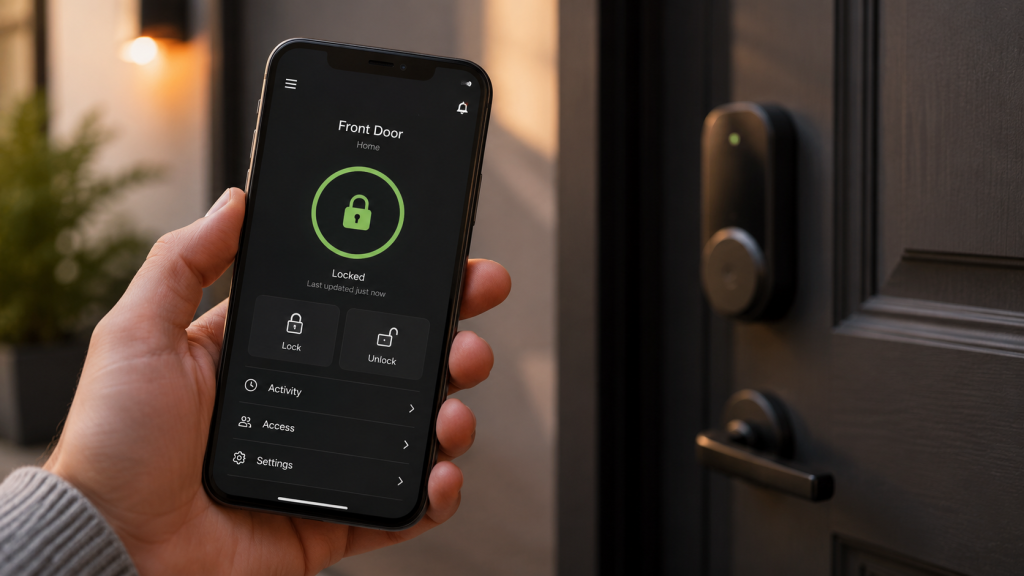
We work in apartments and co-ops, condominiums, townhouses and brownstones, and single-family houses, including homes where a wired chime is already in place and only the connection to the automation system is missing. We cover New York City and Brooklyn, along with Queens, the Bronx, Staten Island, and the surrounding areas within our service radius. After the work is finished we run the system with you on site and set up the mobile app before we leave.
Warranty, Service Area, and Payment
Lock and Tech USA backs new installations with a 90-day mechanical warranty and a 12-month electrical warranty, covering both parts and labor. Repairs are not covered by a warranty. We provide installation within 75 miles of Midtown Manhattan and support extended zones, multiple locations, and multi-site service for clients with several properties. Phone and email support is available during business hours.
We accept cash, wire transfer, ACH, credit card, and check, as well as Zelle and Venmo, and we offer invoicing and business accounts for commercial clients. Depending on the size of the job, payment is typically a partial deposit up front with the balance collected on completion. Before starting, we require a signed contract and a tax exemption form if applicable.
Frequently Asked Questions
Can we use the wiring from our existing chime?
Will the doorbell reach the top floor?
What can a door sensor trigger?
What our clients say


