- Home
- Security System
- Commercial Access Control Installation
Commercial Access Control Installation in New York



Ten Doors, Fifty People, Constant Turnover
Since 1989, we’ve been securing homes and businesses across NYC and New Jersey with professional security solutions you can trust. Our licensed technicians provide 24/7 emergency service, using only the latest technology and backed by comprehensive warranties on all installations.



Access Control for Commercial Buildings
- Office buildings. Lobby doors, floor-by-floor elevator control, and server or records rooms on a separate permission group.
- Multi-tenant properties. Each tenant gets its own credential set, while the landlord keeps the shared lobby, roof, and mechanical rooms under a single account.
- Warehouses and distribution sites. Loading dock doors, driver entrances open on a set schedule, and office areas closed off from the floor.
- Retail with several locations. Stockrooms and back-of-house doors across every store, managed from one place instead of store by store.
- Medical and dental offices. Restricted rooms for records and medication storage, with a pass log kept for each door.
- Restaurants and hospitality. Staff entrances, walk-ins, and liquor storage on credentials that stop working the day someone leaves.
- Managed portfolios. Several addresses on one system, so a property manager adds or removes a card once and it applies everywhere.
Commercial access control installation puts electronic locks, readers, and management software on the doors of a business property, so entry runs on credentials instead of keys. We handle offices, warehouses, retail locations, medical suites, and multi-tenant buildings across New York, from one controlled entrance to fifty doors on a single platform. The job covers the door survey, controllers and readers, wiring, network setup, permission rules, testing, and staff training. The service as a whole, along with the system types behind it, sits on our access control installation service.
Access Control on a Commercial Property
A commercial building runs access control across many doors at once: the lobby, the elevator, the stairwells, the server and records rooms, the loading dock, and the service entrance staff use at 6 in the morning. Each of those doors follows its own rule, and the rule has to hold while people come and go all day.
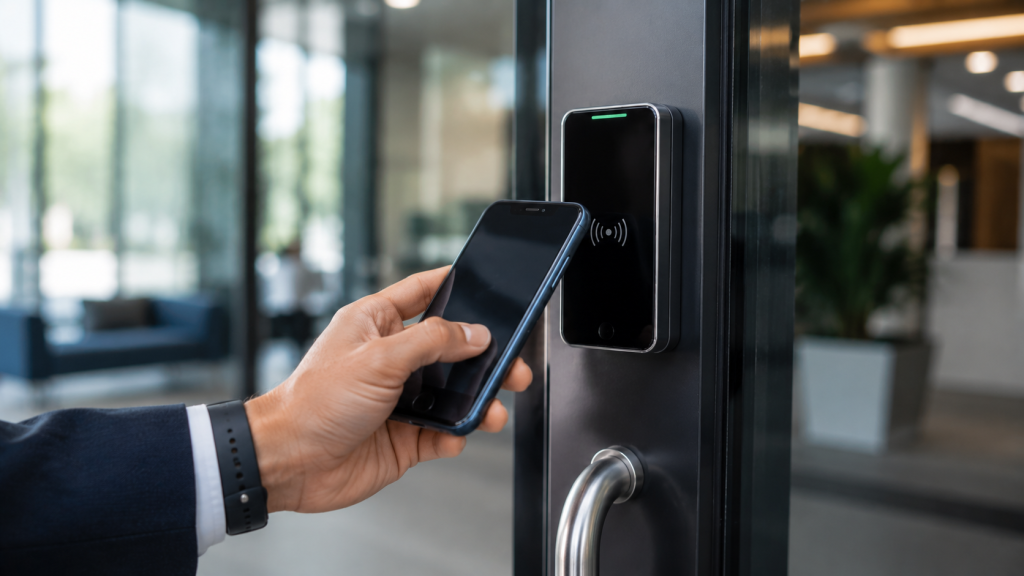
Turnover is what separates a business system from a set of locks. Fifty employees means new hires every month and departures on short notice, and a credential that stops working the same day beats a key nobody hands back. Visitors, delivery drivers, and contractors get credentials with an expiration on them, so a badge issued for a two-week cabling job dies on its own. In a multi-tenant building each tenant runs its own suite while the landlord keeps the lobby, roof, and mechanical rooms on a separate group.
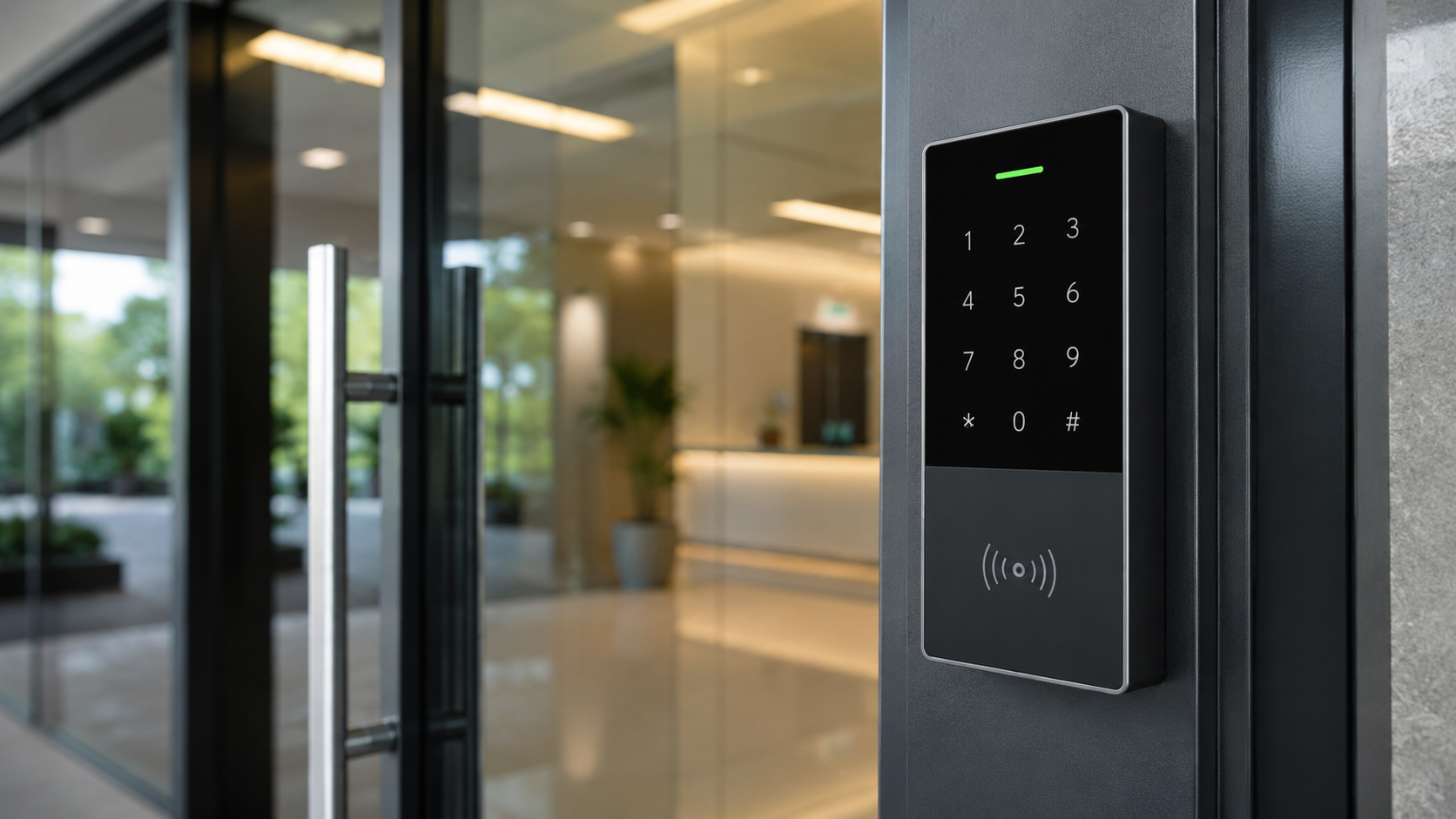
Hardware follows the door. Elevator control ties a credential to the floors a person may reach. Turnstiles and speed gates carry a lobby with heavy morning traffic. Electric strikes and magnetic locks go on glass storefronts and fire-rated stair doors. Fingerprint and face readers cover the few rooms where a shared card is a problem, which is the usual reason a building looks at commercial biometric access control in NYC. Where someone has to see a visitor before the door opens, readers work next to video intercom entry systems.
Our main platforms are Keri Systems, Rosslare, Hartmann Controls, Paxton Access, and Brivo. Brivo and Paxton run cloud management across several addresses, Keri and Hartmann handle controller-based systems on a local network, and Rosslare covers readers and standalone doors. On request we also install HID Global, ASSA ABLOY, Honeywell, Johnson Controls, Bosch, Siemens, Schneider Electric, Allegion, LenelS2, Genetec, Gallagher, and Avigilon, along with HID proximity and smart cards, keypads, and mobile credentials over Bluetooth and NFC.
What Changes as the Property Grows
One door and ten doors are different jobs. A single entrance needs a reader, a controller, and a lock. Ten doors need a permission structure: who sits in which group, which group opens which door, and what happens at 7 pm when the building locks down. Commercial access control companies usually get the call at that point, once a keyed system stops keeping up with how many people hold keys.
Time and zone rules do most of the daily work. A cleaning crew opens the office floor between 6 and 10 pm and nothing else. Warehouse staff reach the dock but not the front office. Pass reports show which credential opened which door and at what minute, which settles questions about a missing shipment without anyone guessing. Door events also hand off to cameras and alarms, so a forced door shows up in more than one place.
Several addresses change the management side more than the hardware. A property manager who adds a card once and has it apply at four buildings is running one account, not four. Before you hire a commercial access control company for a portfolio, ask whether permissions and reports come back in a single view across every address, and who holds the administrator login after handover.
How Installation Runs in an Occupied Building
A commercial access control installation starts with a door survey. We walk every entrance you want controlled, check power and network at each one, look at what the existing door hardware can take, and come back with a door-by-door plan that says which controller, reader, and lock go where.
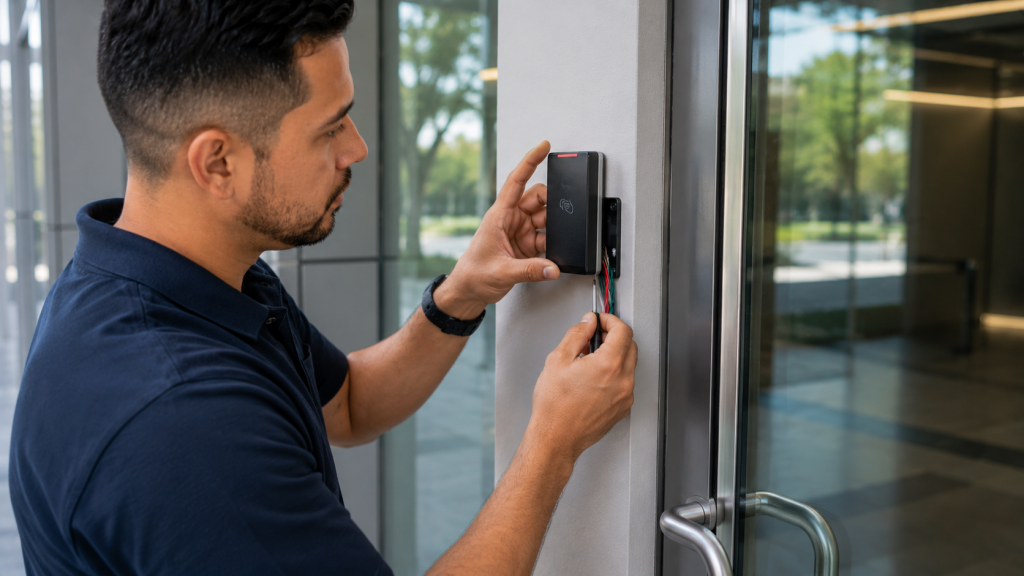
Mounting comes next. Readers go in at a usable height, controllers land in a locked closet or IT room, and cable runs through walls, ceilings, and conduit rather than across a public wall. Power supplies sit close enough to hold voltage at the far doors, and battery backup keeps the locks behaving the way you chose when the power drops.
Then the system side. A commercial access control system installation is finished when controllers are on the network, groups and schedules are programmed, and credentials are encoded and tested door by door — including the failure cases, so you know what a lost network connection or a forced door actually does. We work one door at a time and keep the rest of the building open while we do it. Handover is an on-site walkthrough with your staff, plus setup of the mobile app for whoever will be running permissions.
What It Costs
Cost on a commercial job comes down to five things: how many doors you are controlling, what lock each door needs, whether the existing wiring can be reused, which controller platform the building calls for, and how much integration with cameras, alarms, or elevators is in scope. A ten-door office with clean conduit and a five-door warehouse with none are not the same job even though the door count is close.
Pricing is labor plus material for one total price, quoted after the door survey rather than over the phone. Larger jobs run on a partial deposit up front with the balance at completion, and we need a signed contract before work starts, plus a tax exemption form if your organization has one. Commercial clients can be invoiced and can run a business account with us.
Service Area
We install access control across New York City and out to 75 miles from Midtown Manhattan, with extended zones and multi-site work for clients holding several properties. Typical response time to a site is 20 to 40 minutes.
Office and retail work runs regularly through Lower Manhattan and Brooklyn, along with the other boroughs and nearby New Jersey. We work 8 to 6 on weekdays, and phone and email support runs during those hours for permission changes, added doors, and questions after handover. Installations carry a 90-day warranty on the mechanical side and 12 months on electronics, covering parts and labor.
Commercial Access Control Installation FAQ
Who adds and removes cards when an employee leaves?
Your own staff does it, from the management software or the mobile app, and we set that up and train whoever will hold the administrator login. Removing a credential takes seconds and applies at every door in the group, so a departure on Friday afternoon is handled Friday afternoon.
Can I give contractors and visitors access for a limited time?
Yes, temporary credentials are issued with an expiration date and time, and they stop working on their own. A contractor badge can be set to open a stairwell and one mechanical room between 9 and 5 for two weeks, and nothing else on the property.
Can one system cover several locations?
Yes, multi-site management puts every address under one account, so a credential added once works at whichever buildings you assign it to. Pass reports come back in a single view instead of one login per building.
Can access be limited by time of day and by area?
Yes, every credential belongs to a group that carries both a door list and a schedule. Warehouse staff can be set to the dock and floor from 6 am to 4 pm while the office suite and server room stay closed to them around the clock.
Do we have to replace our doors and locks?
Most commercial doors stay, and the hardware changes rather than the door itself. Glass storefronts and fire-rated stair doors usually take a magnetic lock or an electric strike, and the door survey tells you which of your doors need work before anything is ordered.
What happens if a controller loses power or network?
Doors follow the fail-safe or fail-secure setting chosen for each opening, and battery backup holds the controller through short outages. Controllers keep their credential list locally, so a dropped internet connection stops remote management but not the readers at the doors.
Is a commercial installation covered by a warranty?
Yes, new installations carry a 90-day mechanical warranty and a 12-month electrical warranty, and both cover parts and labor. Support by phone and email runs 8 to 6 on weekdays for anything outside a warranty claim.
Related Services
If doors, readers, or controllers already installed have started failing, that work goes through access control repair and maintenance. When doors are one piece of a larger build with cameras, alarms, and intercoms under one design, start with a security system for business properties instead of doors alone.
What our clients say