
- Home
- Security System
- Access Control Repair
Access Control Repair in New York



We Come Out and Fix It
Since 1989, we’ve been securing homes and businesses across NYC and New Jersey with professional security solutions you can trust. Our licensed technicians provide 24/7 emergency service, using only the latest technology and backed by comprehensive warranties on all installations.



What Goes Wrong With Access Control
- The reader beeps and the light turns green, but the door stays locked.
- A badge that worked yesterday isn’t read at all today.
- The maglock keeps holding after the system shows the door released.
- The keypad is dead: no backlight, no tone when a key is pressed.
- The fingerprint or face scanner turns away people it used to let through.
- Some employees get in and others don’t, with the same permissions set.
- The door doesn’t lock at all and sits open after hours.
Access control repair covers card readers, keypads, biometric scanners, magnetic locks, electric strikes, door controllers, and the software that ties them together. We work on equipment from every manufacturer, including controllers that are no longer made. Calls are handled on weekdays from 8 a.m. to 6 p.m., and a technician is usually on site in 20 to 40 minutes, up to an hour when traffic is heavy. Our service area runs 75 miles out from Midtown Manhattan.
What Breaks in an Access Control System
Most access control system repair calls start with a door that stops behaving the way it always has. The symptom at the door rarely names the part that failed, so the first job on site is matching what you see to the component behind it.
- The reader beeps and flashes green, but the lock never releases.
- A badge that worked all last week isn’t picked up at all now.
- The magnetic lock keeps holding after the system shows the door released.
- The keypad is dark: no backlight, no tone when a key is pressed.
- The fingerprint or face scanner turns away people it used to let through.
- Some employees get in and others don’t, with the same permissions set.
- The door stops locking at all and sits open after closing.
A dead keypad usually traces back to the power supply or a broken conductor in the run. A badge that reads for one person and not for the next is a permissions or schedule problem in software, not a hardware fault. A magnetic lock that holds after the release signal points at the relay, the request-to-exit device, or the controller output. Intermittent access, where the door works in the morning and fails after lunch, comes from voltage drop, a loose connection, or a reader losing contact with the controller.
Diagnostics run in a fixed order: voltage at the supply and at the lock, continuity through the cable run, communication between reader and controller, the credential record itself, then access levels, time schedules, firmware version, and database integrity. Systems that report to a server or a cloud platform get one more step, since a sync failure can look exactly like a dead reader from the hallway. Integrations with intercom, cameras, and elevator control are checked last, because a fault there affects one path and leaves the rest of the doors working.
Components We Fix and Replace
Access control door system repair covers everything at the opening itself: card readers, keypads, biometric scanners, electric strikes, magnetic locks, door position sensors, request-to-exit buttons, closers, and the controller that drives them.
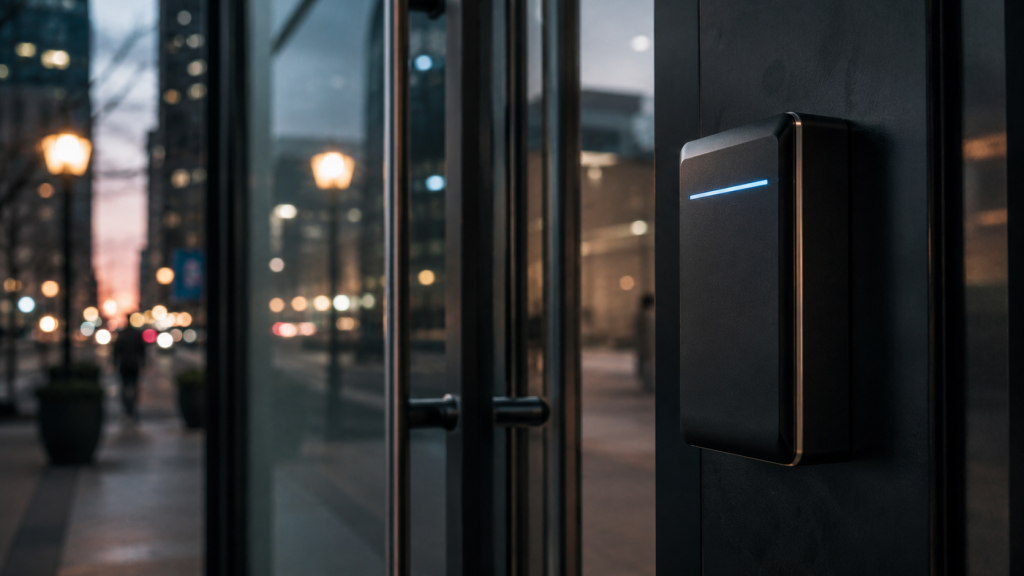
Behind the door, we service power supplies, backup batteries, relays, and the wiring between them. On the software side, the work covers firmware, credential databases, access levels, time schedules, mobile credential enrollment, and server or cloud sync. Turnstiles, speed gates, and elevator control call for the same set of checks with heavier hardware at the opening.
Fingerprint and face readers get their own treatment: sensor cleaning, recalibration, template re-enrollment, and a check on liveness detection settings, which drift over time and start rejecting people who haven’t changed anything. Full fingerprint and face reader setup is a separate service.
Keri Systems, Rosslare, Hartmann Controls, Paxton Access, and Brivo come up most often on our calls. We also work on HID Global, ASSA ABLOY, Honeywell, Johnson Controls, Bosch, Siemens, Schneider Electric, Allegion, LenelS2, Genetec, Gallagher, and Avigilon equipment, along with discontinued panels that no longer have factory support.
How a Service Call Goes
A repair starts with a call and an address, and a technician heads out the same visit window rather than a scheduled survey. Typical on-site arrival is 20 to 40 minutes, up to an hour in heavy traffic, on weekdays between 8 a.m. and 6 p.m.
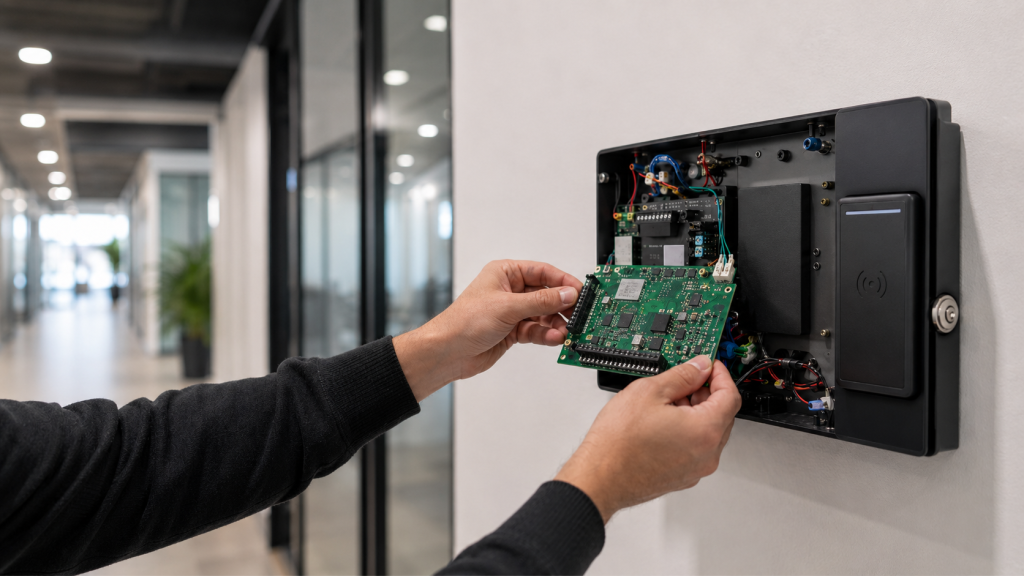
On arrival, the technician walks the door with whoever manages it and runs diagnostics in the order described above. You get the finding in plain terms: which component failed, why it failed, and what the fix takes. A signed service consent form is required before any work starts, and a tax exemption form where it applies. A partial deposit is collected upfront.
Most faults close on the first visit, since readers, strikes, power supplies, relays, and common controller boards ride in the van. Parts for discontinued controllers have to be ordered, and in that case we secure the opening in the meantime, either by leaving the door on a mechanical lock or by putting the controller into a fixed state that keeps the entrance usable. Every access control system repair ends with an invoice listing what was tested, what was replaced, and what was left in place.
Repair or Replace
Repair is the cheaper path while parts are still available and the failure sits in one component. A failed reader, a burned relay, a broken cable run, or a corrupted schedule table is a repair, no matter how old the panel is.
Replacement gets cheaper when boards keep failing across the same controller, when the panel is discontinued and no boards are left on the market, when the system can’t read the credential format the building now issues, or when the wiring has been patched so many times that the next fault is a matter of weeks. Partial upgrades are often the middle path: new readers on an existing controller, where the two are compatible. Full access control installation and system replacement is handled as its own project.
Maintenance keeps most of these failures off the calendar. Readers get cleaned, voltage gets measured under load, request-to-exit devices and door position sensors get tested, dead credentials get pruned from the database, and firmware gets brought current. Doors that see a few hundred passes a day need this more often than a single back entrance.
Pricing, Payment, and Warranty
Repairs are billed as labor plus material, with no hidden fees. A partial deposit is collected upfront and the balance is due on completion. There is no surcharge for evening, weekend, or holiday calls.
We take cash, credit and debit cards, ACH, wire transfer, check, Zelle, and Venmo. Commercial clients can set up invoicing or a business account. Phone and email support is available during business hours.
Repair work carries no warranty. The 90-day mechanical and 12-month electrical warranty, covering both parts and labor, applies to new installations only. Documents needed before work begins are the signed service consent form and, where applicable, a tax exemption form. The requirement is the same for residential, rental, and commercial clients.
Where We Work
We cover New York City and a 75-mile radius from Midtown Manhattan, with typical arrival in 20 to 40 minutes.
That includes Lower Manhattan, Midtown, the Upper East and Upper West Sides, Harlem, and Washington Heights; Brooklyn from Downtown and Williamsburg through Park Slope and Bay Ridge; Long Island City, Astoria, Flushing, and Jamaica in Queens; the Bronx; and Staten Island. Outside the five boroughs, the radius reaches Westchester, southern Connecticut, northern New Jersey, and Nassau County.
Clients with several buildings are served under one account, so the same technician sees the same equipment across sites. Office parks, retail chains, and multi-tenant buildings can also add access control for commercial properties at doors that don’t have it yet.
Access Control Repair FAQ
What kind of access control systems do you work on?
We work on every type of access control system: card readers, keypads, fingerprint and face scanners, mobile credentials, electric strikes, magnetic locks, turnstiles, speed gates, and elevator control. That covers single-door setups and networked systems across several buildings, from any manufacturer, including panels that are no longer produced.
My card reader stopped working. Can it be fixed, or do I need a new system?
A single failed reader is almost always a repair, not a system replacement. Replacement becomes the cheaper option when the controller itself is discontinued with no boards available, when boards keep failing one after another, or when the panel can’t read the credential format your building now issues.
Do you fix systems in apartment buildings as well as offices?
Yes, both. We service residential and commercial access control of any size, from one door on a walk-up to a multi-building system with elevator control, and clients with several properties are handled under one account.
Is the repair under warranty?
No. Repair work does not carry a warranty. The 90-day mechanical warranty and 12-month electrical warranty, both covering parts and labor, apply only to new installations.
How fast can someone get here?
Typical on-site arrival is 20 to 40 minutes, up to an hour when traffic is heavy. Calls are handled on weekdays between 8 a.m. and 6 p.m., anywhere within 75 miles of Midtown Manhattan, and there is no surcharge for evening, weekend, or holiday work.
How do I pay?
We accept cash, credit and debit cards, ACH, wire transfer, check, Zelle, and Venmo. Commercial clients can set up invoicing or a business account. Pricing is labor plus material, with a partial deposit upfront and the balance due on completion.
Do I need to sign anything before you start?
Yes, a service consent form is signed before work begins, and a tax exemption form is needed where it applies. The requirement is the same for residential, rental, and commercial clients, and the technician brings both forms to the call.
Related Services
Access control usually shares a building with other equipment we service. Alarm panels, sensors, and keypads that stop reporting are covered under security system troubleshooting and repair.
Entry stations, handsets, and door release wiring at the lobby fall under intercom troubleshooting, which often shares the same strike and controller as the access system.
What our clients say