
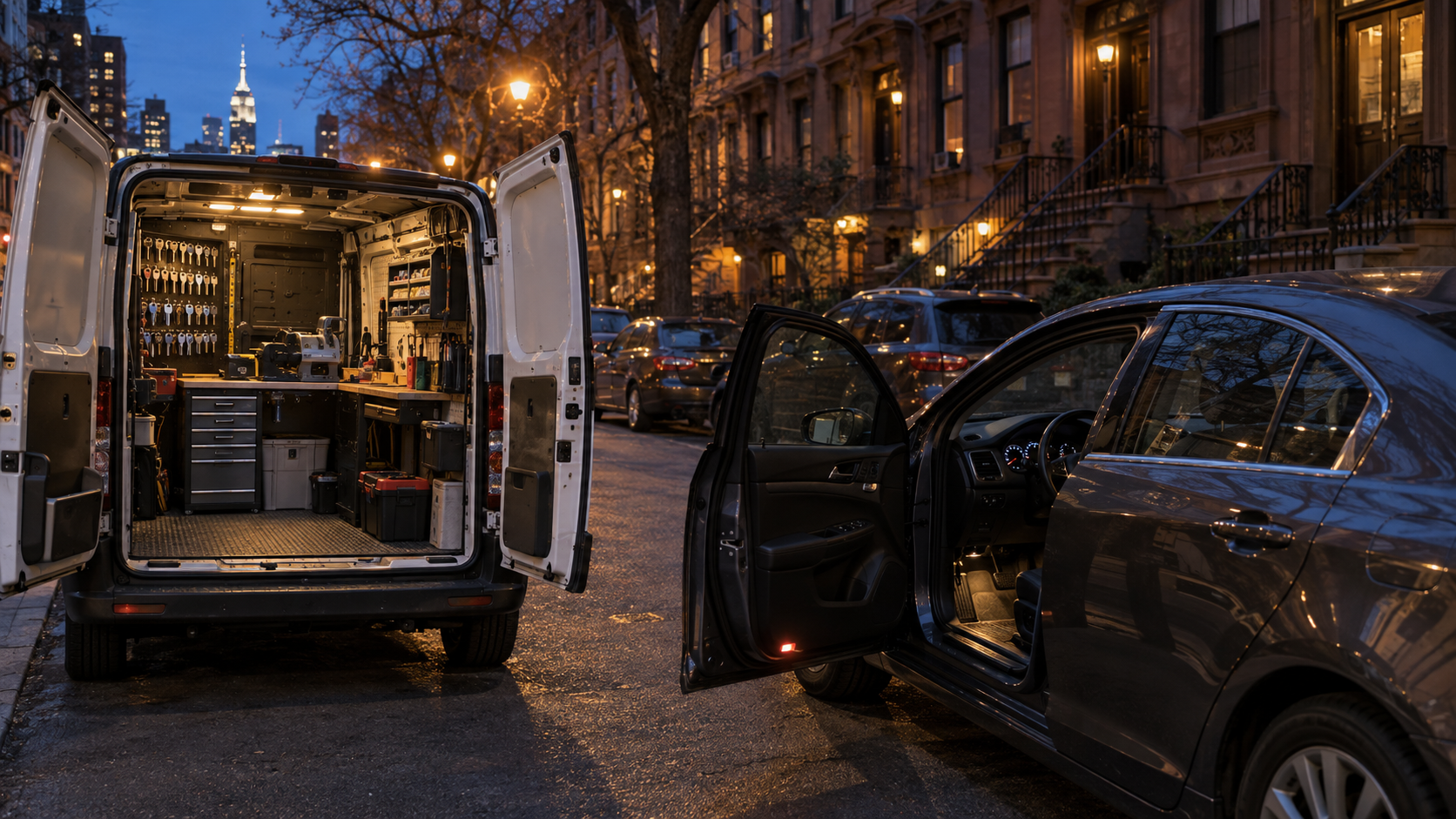
Yes — an automotive locksmith can make a car key for the large majority of vehicles on the road, including cases where no original key exists at all. Three things decide whether yours is one of them: the type of key your car uses, whether you still have a working key, and how recent the vehicle is. A small share of very new models are locked down by the manufacturer and can only be done at a dealer, and this guide explains how to tell early which situation you are in.
What Decides Whether a Locksmith Can Make Your Key
These are the same three questions any competent locksmith will ask on the phone before quoting anything, and having the answers ready shortens the call considerably.
The Type of Key You Have
A plain mechanical key with no electronics is the simplest job — it is cut and it works. A transponder key has a chip in the head that the car’s immobilizer must recognize before the engine will start, so it needs both cutting and programming. A push-to-start fob has no blade at all in normal use and pairs to the car electronically. All three are within a well-equipped locksmith’s range, but they are progressively more involved. Our guide to what a key fob is covers how to tell which one you are holding.
Whether You Still Have a Working Key
Having one working key makes everything easier. The blade can be copied directly, and on many vehicles an existing programmed key is what authorizes adding another. With no key at all, the job changes: nothing can be copied and nothing can authenticate, so the code has to be sourced another way and the security system usually has to be reset. It is still a routine job, just a longer one.
How New the Vehicle Is
This is where the honest limits sit. Cars from roughly the last twenty-five years are almost all serviceable by an independent locksmith. On the newest model years, some manufacturers require an online authorization from their own servers before any tool will write a key, and access to that is restricted. If your car is a current or near-current model, ask specifically whether the locksmith has coverage for that make and year rather than assuming.
Where the Key Code Comes From When You Have No Original
A key cannot be copied when there is nothing to copy. Instead the locksmith has to recover the cutting code that identifies the exact pattern of the blade, and there are three routes to it.
The Key Code From the Manufacturer by VIN
Every vehicle has a key code tied to its VIN, held by the manufacturer. A licensed locksmith with an account can request that code after verifying ownership, then cut a blade to it directly. This is the cleanest route when it is available, because the resulting key matches the factory specification exactly rather than being derived from a worn lock.
Decoding the Door Lock or Ignition
Where the code cannot be obtained, the pattern can be read from the vehicle itself. The locksmith reads the wafer positions inside the door lock — sometimes removing the lock cylinder to do it — and reconstructs the cutting pattern from what the lock will accept. It takes longer and requires skill, and it works on vehicles where the manufacturer route is closed.
Reading the Code Through the Diagnostic Port
On many vehicles the security module itself stores information the right tool can retrieve through the diagnostic port, including data needed to produce a working key. This route also tells the locksmith how many keys are currently registered to the car, which is worth knowing if you have recently bought it used and were handed only one.
Cutting the Key: Duplication vs Code Cutting
Duplication traces an existing key and copies its shape. It is fast, but it copies wear as well as pattern — a key cut from a fifteen-year-old original inherits every rounded edge, and the copy can end up sloppier than the one it came from.
Code cutting works from the numerical specification instead, producing a blade to original factory dimensions regardless of what condition the old key is in. When a locksmith has the code available, this is the better key even if you do have an original to copy.
The blade shape also matters for equipment. Traditional keys with notches along the edge are cut on a standard machine. Laser-cut or sidewinder keys, with a wavy channel milled along the centre of the blade, need a different machine entirely — and a locksmith who only carries the standard one cannot do them. It is worth asking about specifically if your key has that milled groove rather than edge notches.
Programming the Key to the Car
A correctly cut blade will open the door and turn in the ignition, and the engine still will not start. That is the immobilizer doing its job: until the chip inside the key is written into the car’s list of accepted keys, the vehicle treats it as an unauthorized key. Programming is a separate step from cutting, performed with a diagnostic tool through the port under the dashboard, and it is what turns a correctly shaped piece of metal into a working key. Our guide on programming a key fob covers what happens during that step and which keys can be done at home.
What You Need to Prove the Car Is Yours
Any legitimate locksmith will ask for proof of ownership before touching the vehicle. This is not bureaucracy — a locksmith who does not ask is one who would make a key to your car for someone else just as readily.
Registration, Title and Photo ID
The standard set is the vehicle registration or title showing your name, plus photo identification matching it. The locksmith records the details, and on manufacturer key-code requests they are required to. Expect the names to have to match; a registration in someone else’s name generally means that person has to be present.
What Happens If the Documents Are in the Car
Common, and not a dead end. The usual sequence is that the locksmith opens the vehicle first — a separate service from making a key — you retrieve the documents, and the key work proceeds from there. It is worth saying on the phone that the paperwork is locked inside so the visit is planned as two jobs rather than one.
Company Cars, Rentals and Recently Bought Vehicles
A company vehicle needs authorization from whoever the registration names, usually a letter or a call from the company. Rentals go through the rental company, not the driver. A car bought recently and not yet re-registered needs the bill of sale alongside your identification, and it is the case most worth flagging in advance because paperwork in transition slows things down more than anything else.
When All Keys Are Lost
Adding a key to a car that already has one is straightforward. Losing every key is a different job, and it is useful to know why before the invoice arrives.
With no working key, there is nothing for the vehicle to authenticate against, so the security system typically has to be reset and rebuilt. That reset clears every key previously registered, which is the point of it — any key still circulating becomes useless. The consequence is that a spare sitting in a drawer at home stops working too, so bring every key you own to the appointment even the ones you believe are dead. Each one you still want has to be reprogrammed in the same session.
The job also runs longer than a straight duplication, because the code has to be recovered and a blade cut before any programming can begin.
When Only the Dealer Can Do It
Three situations fall outside independent range. The first is the newest model years from manufacturers requiring online authorization through their own systems, where access is limited and sometimes tied to franchise status. The second is uncommon marques — low-volume, exotic or grey-import vehicles for which the tooling and key blanks simply are not stocked outside the brand network. The third is a vehicle whose security module has failed or been damaged, where the fix is a module replacement rather than a key.
In each case the practical consequence is the same: the car has to get to the dealer, and if it will not start, that means a tow. Worth establishing on the first phone call rather than after someone has driven out to you.
Getting It Done Where the Car Is Parked
The main practical advantage over a dealer is direction of travel. A mobile locksmith brings the cutting machine and the programming tool to the vehicle, so a car that cannot start does not need to be moved at all.
In New York that difference is larger than elsewhere. A car in an underground garage may be under a height restriction that a tow truck cannot clear, and getting a disabled vehicle out of a stacked or attended garage is its own project. On the street, alternate side rules mean a car that cannot be moved on the wrong morning collects tickets while it waits. And a vehicle already sitting on a tow lot has access hours and its own rules about who may work on it. Mentioning where the car actually is when you call changes what gets planned — our mobile automotive locksmith team covers the five boroughs and New Jersey, and the car key locksmith service covers cutting, coding and programming on site.
Frequently Asked Questions
Can a locksmith make a car key without the original?
Yes. With no original, the locksmith recovers the cutting code — from the manufacturer against the VIN, by decoding the door lock, or through the diagnostic port — then cuts and programs a new key. It takes longer than copying an existing one.
Can a locksmith make a key from a VIN number?
Yes, where the manufacturer releases the key code to licensed locksmiths. Proof of ownership is required first, and the code produces a blade cut to factory specification rather than copied from a worn key.
Can a locksmith make a key for a car with a chip?
Yes. A transponder key needs cutting and then programming, so the chip is written into the vehicle’s immobilizer with a diagnostic tool. Cutting alone opens the door but will not start the engine.
How long does it take a locksmith to make a car key?
Copying a mechanical key takes minutes. A transponder or push-to-start key cut and programmed from an existing one usually runs under an hour. An all-keys-lost job takes longer, since the code has to be recovered and the security system reset first.
What do I need to show a locksmith to get a car key made?
Vehicle registration or title in your name plus matching photo identification. For a company vehicle you also need authorization from the registered owner; for a recent purchase, the bill of sale. If the documents are locked in the car, say so when you call.
Is a locksmith or the dealer better for a replacement car key?
A locksmith comes to the vehicle, which matters when the car will not start. A dealer is necessary for the newest models requiring manufacturer authorization, for uncommon marques, and where the security module itself has failed.
Start by Identifying Your Key
Before making any call, work out two things: which type of key the car uses, and whether any working key still exists. Those two answers determine the whole job — the equipment needed, how long it takes, and whether it can be done where the car sits. If you also want a sense of the range involved before deciding between routes, our breakdown of car key replacement costs covers what each type of key involves.